



 Chat with AI
Exam 13: Monopoly

Exam 1: The Big Ideas253 Questions
Exam 2: The Power of Trade and Comparative239 Questions
Exam 3: Supply and Demand249 Questions
Exam 4: Equilibrium256 Questions
Exam 5: Elasticity and Its Applications271 Questions
Exam 6: Taxes and Subsidies225 Questions
Exam 7: The Price System275 Questions
Exam 8: Price Ceilings and Floors327 Questions
Exam 9: International Trade195 Questions
Exam 10: Externalities- When the Price Is Not Right273 Questions
Exam 11: Costs and Profit Maximization Under Competition217 Questions
Exam 12: Competition and the Invisible Hand144 Questions
Exam 13: Monopoly233 Questions
Exam 14: Price Discrimination262 Questions
Exam 15: Oligopoly and Game Theory218 Questions
Exam 16: Competing for Monopoly160 Questions
Exam 17: Monopolistic Competition and Advertising113 Questions
Exam 18: Labor Markets262 Questions
Exam 19: Public Goods and the Tragedy of the Commons244 Questions
Exam 20: Political Economy and Public Choice306 Questions
Exam 21: Economics, Ethics, and Public Policy241 Questions
Exam 22: Managing Incentives263 Questions
Exam 23: Stock Markets and Personal Finance271 Questions
Exam 24: Price Discrimination151 Questions
Exam 25: Consumer Choice145 Questions
Select questions type


Use the following to answer questions:
Figure: Monopoly 6 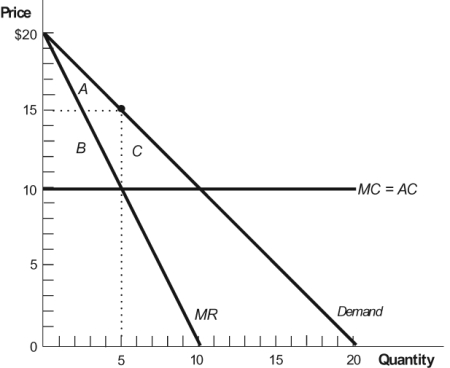 -(Figure: Monopoly 6) If the market in this figure is a monopoly, the consumer surplus is area ______, and the deadweight loss is area ______.
 (Multiple Choice)
4.8/5  (67)
(67) If the monopolist's demand is given by P = 100 - Q, marginal revenue is given by:
(Multiple Choice)
4.8/5 (86)
(86) There are three reasons why HIV drugs are priced above cost: (1) monopoly power, (2) the "people before profits" effect, and (3) the "use it or lose it" effect.
(True/False)
4.9/5 (83)
(83) Figure: Monopolist Profits  Refer to the figure. Which of the following answers correctly indicates the profit earned by this monopolist at the profit-maximizing quantity?
 (Multiple Choice)
4.8/5 (73)
(73) Which of the following is the best example of a natural monopoly?
(Multiple Choice)
4.9/5 (77)
(77) India has weak patent protection for pharmaceuticals, and Canada has price controls. The United States could adopt similar policies without any bad consequences to the future market for drugs.
(True/False)
4.7/5 (77)
(77) If pharmaceutical patents are not enforced, the number of new drugs will decrease.
(True/False)
4.7/5 (77)
(77) A monopoly maximizes profit by finding the output level where the difference between marginal revenue and marginal costs is as large as possible.
(True/False)
4.8/5 (75)
(75) Which of the following statements is TRUE?
I. Competitive markets channel the self-interest of business leaders toward social prosperity.
II. Political structures often channel self-interest toward social destruction.
III. Many monopolies are government-created.
(Multiple Choice)
4.8/5 (83)
(83) Competitive markets channel the self-interest of business leaders toward social prosperity, whereas poor institutions that limit competition channel the self-interest of business leaders toward social destruction.
(True/False)
4.8/5 (78)
(78) California's "perfect storm," following the deregulation of its electricity industry, eventually resulted in an incredible rise in electricity prices. Which of the following is NOT a reason why this occurred?
(Multiple Choice)
4.8/5 (86)
(86) When comparing a monopoly with a competitive industry, monopoly quantity:
(Multiple Choice)
5.0/5 (88)
(88) Figure: Monopoly Demand 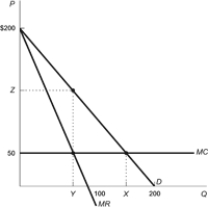 Refer to the figure. The demand curve for a profit-maximizing monopolist can be described by the equation Q = 200 - P. The marginal revenue curve for the monopolist is described by the equation MR = 200 - 2Q. The marginal cost associated with producing this good is constant at $50. Calculate the consumer surplus that consumers enjoy in this market.
 (Essay)
4.9/5 (88)
(88) Use the following to answer questions:
Figure: Monopoly Markup  -(Figure: Monopoly Markup) Refer to the figure. The deadweight loss attributable to monopoly is:
 (Multiple Choice)
4.8/5 (72)
(72) Use the following to answer questions:
Figure: Monopoly Profits  -(Figure: Monopoly Profits) Refer to the figure. What is the monopolist's optimal price and output level?
 (Multiple Choice)
4.7/5 (77)
(77) Economists call a single firm that can supply the entire market at a lower cost than two or more firms a __________ monopoly.
(Multiple Choice)
4.9/5 (78)
(78) Use the following to answer questions:
Figure: Maximum Willingness to Pay  -(Figure: Maximum Willingness to Pay) Refer to the figure. What is the profit that the monopolist is earning?
 (Multiple Choice)
4.9/5 (88)
(88) 
Filters
- Essay(0)
- Multiple Choice(0)
- Short Answer(0)
- True False(0)
- Matching(0)