



 Chat with AI
Exam 9: International Trade

Exam 1: The Big Ideas253 Questions
Exam 2: The Power of Trade and Comparative239 Questions
Exam 3: Supply and Demand249 Questions
Exam 4: Equilibrium256 Questions
Exam 5: Elasticity and Its Applications271 Questions
Exam 6: Taxes and Subsidies225 Questions
Exam 7: The Price System275 Questions
Exam 8: Price Ceilings and Floors327 Questions
Exam 9: International Trade195 Questions
Exam 10: Externalities- When the Price Is Not Right273 Questions
Exam 11: Costs and Profit Maximization Under Competition217 Questions
Exam 12: Competition and the Invisible Hand144 Questions
Exam 13: Monopoly233 Questions
Exam 14: Price Discrimination262 Questions
Exam 15: Oligopoly and Game Theory218 Questions
Exam 16: Competing for Monopoly160 Questions
Exam 17: Monopolistic Competition and Advertising113 Questions
Exam 18: Labor Markets262 Questions
Exam 19: Public Goods and the Tragedy of the Commons244 Questions
Exam 20: Political Economy and Public Choice306 Questions
Exam 21: Economics, Ethics, and Public Policy241 Questions
Exam 22: Managing Incentives263 Questions
Exam 23: Stock Markets and Personal Finance271 Questions
Exam 24: Price Discrimination151 Questions
Exam 25: Consumer Choice145 Questions
Select questions type


What are the gains and losses of a trade restriction versus free trade? Explain carefully.

Free
(Essay)
5.0/5  (72)
(72) Correct Answer: Verified
There are two types of losses from a trade restriction, such as a tariff or quota. First, it involves a waste of resources that could be freed up to produce other goods and services under free trade. Second, a trade restriction creates a deadweight loss, which is the value of lost gains from trade. In the case of a tariff, the market price increases so that there is a loss in consumer surplus. On the other hand, a higher price raises producer surplus, which is the gain from domestic producers. In other words, domestic producers gain while domestic consumers lose with a trade restriction.
Use the following to answer questions:
Figure: A Tariff on Imports 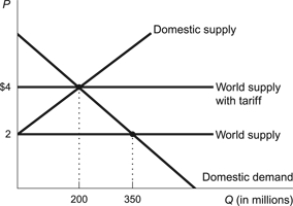 -(Figure: A Tariff on Imports) Refer to the figure. Suppose the government intervenes with a $2 tariff; the total value of deadweight loss as a result of the tariff is:
Free
(Multiple Choice)
4.8/5 (71)
(71) Correct Answer:Verified
VerifiedA
Governments can use tariffs to help domestic firms act like a cartel when selling to international buyers:
Free
(Multiple Choice)
4.7/5 (75)
(75) Correct Answer:Verified
VerifiedC
Use the following to answer questions:
Figure: Trade 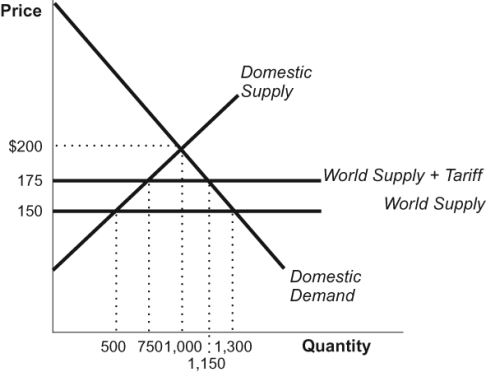 -(Figure: Trade) Refer to the figure. If this figure represents the market for oil and the country imposes no tariffs on international trade, domestic consumption will be:
 (Multiple Choice)
5.0/5 (77)
(77) Which of the following is TRUE about the economic policy of "protectionism"?
(Multiple Choice)
4.9/5 (87)
(87) Use the following to answer questions:
Figure: Shirts 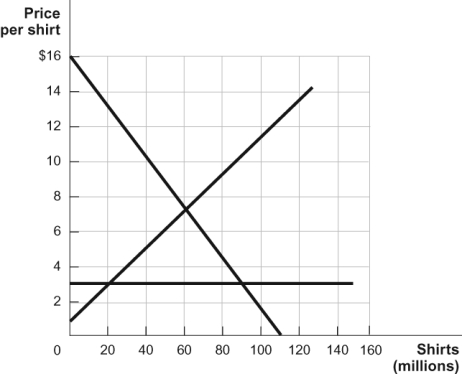 -(Figure: Shirts) Refer to the figure. If a tariff raised the world price to $4 a shirt, how much consumer surplus would be lost?
 (Multiple Choice)
5.0/5 (93)
(93) Use the following to answer questions:
Figure: Shirts
-(Figure: Shirts) Refer to the figure. If a $5 tariff was levied on shirts, how much tax revenue would the government collect?
-(Figure: Shirts) Refer to the figure. If a $5 tariff was levied on shirts, how much tax revenue would the government collect? (Multiple Choice)
4.8/5 (67)
(67) A tariff on a good when the world price is lower than the domestic price leads to:
(Multiple Choice)
4.8/5 (73)
(73) An increase in import trade tends to ______ domestic prices.
(Multiple Choice)
4.7/5 (65)
(65) Domestic consumers lose more than domestic producers gain because of import restrictions.
(True/False)
4.7/5 (75)
(75) A tariff results in a higher:
I. consumer surplus.
II. producer surplus.
III. government revenue.
(Multiple Choice)
4.9/5 (73)
(73) Figure: Market Activity with and without Trade 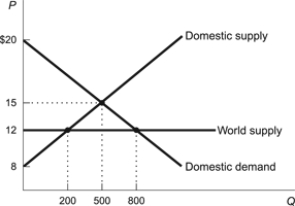 Refer to the figure. Using the diagram for market activity with and without trade to consider the effects of a trade restriction that eliminated foreign trade in an economy, answer the following questions.
a. What is the dollar amount of deadweight loss created as a result of the trade restriction?
b. What is the dollar value of wasted resources as a result of the trade restriction?
c. What is the dollar gain in domestic producer surplus as a result of the trade restriction?
Refer to the figure. Using the diagram for market activity with and without trade to consider the effects of a trade restriction that eliminated foreign trade in an economy, answer the following questions.
a. What is the dollar amount of deadweight loss created as a result of the trade restriction?
b. What is the dollar value of wasted resources as a result of the trade restriction?
c. What is the dollar gain in domestic producer surplus as a result of the trade restriction? (Short Answer)
4.9/5 (87)
(87) Use the following to answer questions:
Figure: Costs of Tariffs  -(Figure: Costs of Tariffs) Refer to the figure. In the figure representing the market for leather, what price would consumers pay for leather in the absence of a tariff or other import restrictions?
 (Multiple Choice)
4.8/5 (81)
(81) Protectionism protects domestic industries from the competitive forces exerted by foreign firms.
(True/False)
4.8/5 (79)
(79) Reducing tariffs causes consumer surplus to increase but producer surplus to decrease.
(True/False)
4.8/5 (77)
(77) In 1845, French economist Frédéric Bastiat famously compared tariffs to blocking out the sun since both low-priced imports and free sunlight discourage domestic industry. What part of the trade diagram best describes the encouragement of domestic industry if Bastiat's "blockade" was taken seriously?
(Multiple Choice)
4.8/5 (72)
(72) 
Filters
- Essay(0)
- Multiple Choice(0)
- Short Answer(0)
- True False(0)
- Matching(0)