



 Chat with AI
Exam 9: International Trade

Exam 1: The Big Ideas253 Questions
Exam 2: The Power of Trade and Comparative239 Questions
Exam 3: Supply and Demand249 Questions
Exam 4: Equilibrium256 Questions
Exam 5: Elasticity and Its Applications271 Questions
Exam 6: Taxes and Subsidies225 Questions
Exam 7: The Price System275 Questions
Exam 8: Price Ceilings and Floors327 Questions
Exam 9: International Trade195 Questions
Exam 10: Externalities- When the Price Is Not Right273 Questions
Exam 11: Costs and Profit Maximization Under Competition217 Questions
Exam 12: Competition and the Invisible Hand144 Questions
Exam 13: Monopoly233 Questions
Exam 14: Price Discrimination262 Questions
Exam 15: Oligopoly and Game Theory218 Questions
Exam 16: Competing for Monopoly160 Questions
Exam 17: Monopolistic Competition and Advertising113 Questions
Exam 18: Labor Markets262 Questions
Exam 19: Public Goods and the Tragedy of the Commons244 Questions
Exam 20: Political Economy and Public Choice306 Questions
Exam 21: Economics, Ethics, and Public Policy241 Questions
Exam 22: Managing Incentives263 Questions
Exam 23: Stock Markets and Personal Finance271 Questions
Exam 24: Price Discrimination151 Questions
Exam 25: Consumer Choice145 Questions
Select questions type


Use the following to answer questions:
Figure: Foreign Trade  -(Figure: Foreign Trade) Refer to the figure. What quantity would be traded in the absence of any international trade?
 (Multiple Choice)
4.7/5  (71)
(71) Use the following to answer questions:
Figure: International Trade 3 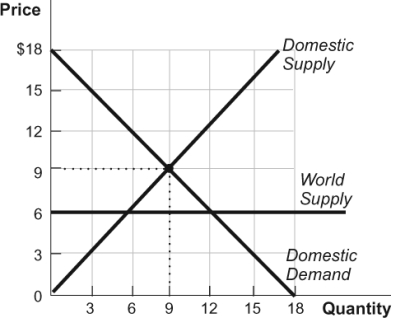 -(Figure: International Trade 3) Refer to the figure. If the government in this diagram eliminates all imports with a tariff, the value of the wasted resources will be:
 (Multiple Choice)
4.9/5 (74)
(74) The U.S. price of sugar is higher than the world price of sugar due primarily to a:
(Multiple Choice)
4.7/5 (77)
(77) Dividing the total tariff revenue in the trade diagram introduced in this chapter by the size of the tariff yields:
(Multiple Choice)
4.9/5 (70)
(70) Which of the following is NOT true regarding job destruction due to trade?
(Multiple Choice)
4.9/5 (79)
(79) In the case of sugar, moving from a situation of no trade to free trade causes both domestic consumption and production to increase.
(True/False)
4.8/5 (80)
(80) Trade moves jobs from import-competing industries to export industries.
(True/False)
4.8/5 (93)
(93) Which of the following arguments is valid in the economics of international trade?
(Multiple Choice)
4.7/5 (72)
(72) Use the following to answer questions:
Figure: International Trade 2  -(Figure: International Trade 2) Refer to the figure. What is the size of the tariff in this figure?
 (Multiple Choice)
4.8/5 (78)
(78) What is the difference between a tariff and a trade quota?
(Multiple Choice)
4.8/5 (68)
(68) The key industries argument for trade restrictions relies on the notion that:
(Multiple Choice)
4.9/5 (81)
(81) History has shown that one of the most effective tools against child labor is:
(Multiple Choice)
4.9/5 (83)
(83) If the world price of cotton is less than the price that would occur domestically without trade, then a country will:
(Multiple Choice)
5.0/5 (86)
(86) Consider the following statements:
I. Relative to a no-trade situation, if the United States exported wheat, the U.S. domestic wheat price would rise and domestic production of wheat would expand.
II. Relative to a no-trade situation, international trade causes the prices of all goods to rise.
(Multiple Choice)
4.9/5 (79)
(79) There is strong evidence to support the idea that protectionism increases domestic job growth.
(True/False)
4.9/5 (79)
(79) 
Filters
- Essay(0)
- Multiple Choice(0)
- Short Answer(0)
- True False(0)
- Matching(0)