



 Chat with AI
Exam 9: International Trade

Exam 1: The Big Ideas253 Questions
Exam 2: The Power of Trade and Comparative239 Questions
Exam 3: Supply and Demand249 Questions
Exam 4: Equilibrium256 Questions
Exam 5: Elasticity and Its Applications271 Questions
Exam 6: Taxes and Subsidies225 Questions
Exam 7: The Price System275 Questions
Exam 8: Price Ceilings and Floors327 Questions
Exam 9: International Trade195 Questions
Exam 10: Externalities- When the Price Is Not Right273 Questions
Exam 11: Costs and Profit Maximization Under Competition217 Questions
Exam 12: Competition and the Invisible Hand144 Questions
Exam 13: Monopoly233 Questions
Exam 14: Price Discrimination262 Questions
Exam 15: Oligopoly and Game Theory218 Questions
Exam 16: Competing for Monopoly160 Questions
Exam 17: Monopolistic Competition and Advertising113 Questions
Exam 18: Labor Markets262 Questions
Exam 19: Public Goods and the Tragedy of the Commons244 Questions
Exam 20: Political Economy and Public Choice306 Questions
Exam 21: Economics, Ethics, and Public Policy241 Questions
Exam 22: Managing Incentives263 Questions
Exam 23: Stock Markets and Personal Finance271 Questions
Exam 24: Price Discrimination151 Questions
Exam 25: Consumer Choice145 Questions
Select questions type


Use the following to answer questions:
Figure: International Trade 2  -(Figure: International Trade 2) Refer to the figure. At the tariff equilibrium in this figure, the quantity of imports is ______, which is ______ than at the free trade equilibrium.
 (Multiple Choice)
4.8/5  (91)
(91) The U.S. government restricting the quantity of sugar imports into the country is an example of a(n):
(Multiple Choice)
4.9/5 (82)
(82) According to the supply and demand framework in the text, an increase in import trade tends to ______ domestic production of a good.
(Multiple Choice)
4.8/5 (93)
(93) Trade increases competition for domestic producers and results in lower prices of domestic goods.
(True/False)
4.8/5 (87)
(87) Both domestic production and consumption increase because of tariffs.
(True/False)
4.9/5 (75)
(75) Use the following to answer questions:
Figure: International Trade 3 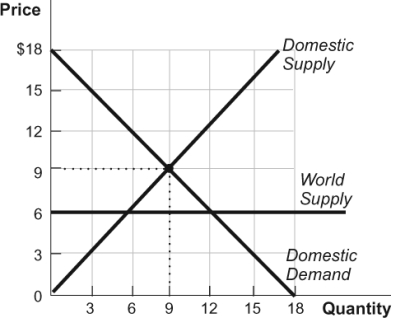 -(Figure: International Trade 3) Refer to the figure. If the government in this diagram eliminates all imports with a tariff, the value of the lost gains from trade is:
 (Multiple Choice)
4.9/5 (79)
(79) ______ have a similar effect upon domestic consumption levels.
(Multiple Choice)
4.7/5 (78)
(78) Economic policies of protectionism include:
I. reduced trade barriers.
II. tariffs.
III. quotas.
(Multiple Choice)
4.8/5 (66)
(66) Which of the following statements is TRUE about the removal of trade barriers?
(Multiple Choice)
4.9/5 (89)
(89) The economics of international trade is substantially different from that of ordinary trade.
(True/False)
4.8/5 (81)
(81) The biggest retail contributor to the 1990s productivity boom was:
(Multiple Choice)
4.8/5 (73)
(73) In a demand and supply diagram, the effects of a tariff and a quota on the supply and demand curves are identical.
(True/False)
4.8/5 (68)
(68) Briefly describe a few activities that a typical student might do on any given day that reflect the effects of globalization.
(Essay)
5.0/5 (68)
(68) With the aid of demand and supply curves, compare the amounts of imports and the prices of goods under (i) free trade, (ii) trade with a tariff, and (iii) a closed economy without trade.
(Essay)
4.8/5 (78)
(78) Use the following to answer questions:
Figure: Foreign Trade with a Tariff 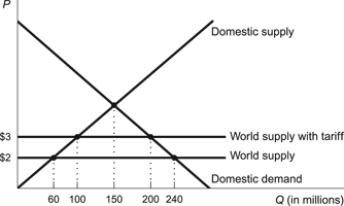 -(Figure: Foreign Trade with a Tariff) Refer to the figure. A $1 tariff generates increased domestic production by:
 (Multiple Choice)
4.8/5 (81)
(81) Imposing tariffs results in both wasted resources and lost gains from trade.
(True/False)
4.9/5 (69)
(69) Suppose that a tariff increases domestic production of a good from 25 million units to 75 million units and raises the domestic price by $1.50. Assuming a linear domestic supply curve and a perfectly elastic world supply curve, what is the value of the resources wasted by increased domestic production?
(Multiple Choice)
4.9/5 (73)
(73) 
Filters
- Essay(0)
- Multiple Choice(0)
- Short Answer(0)
- True False(0)
- Matching(0)