



 Chat with AI
Exam 9: International Trade

Exam 1: The Big Ideas253 Questions
Exam 2: The Power of Trade and Comparative239 Questions
Exam 3: Supply and Demand249 Questions
Exam 4: Equilibrium256 Questions
Exam 5: Elasticity and Its Applications271 Questions
Exam 6: Taxes and Subsidies225 Questions
Exam 7: The Price System275 Questions
Exam 8: Price Ceilings and Floors327 Questions
Exam 9: International Trade195 Questions
Exam 10: Externalities- When the Price Is Not Right273 Questions
Exam 11: Costs and Profit Maximization Under Competition217 Questions
Exam 12: Competition and the Invisible Hand144 Questions
Exam 13: Monopoly233 Questions
Exam 14: Price Discrimination262 Questions
Exam 15: Oligopoly and Game Theory218 Questions
Exam 16: Competing for Monopoly160 Questions
Exam 17: Monopolistic Competition and Advertising113 Questions
Exam 18: Labor Markets262 Questions
Exam 19: Public Goods and the Tragedy of the Commons244 Questions
Exam 20: Political Economy and Public Choice306 Questions
Exam 21: Economics, Ethics, and Public Policy241 Questions
Exam 22: Managing Incentives263 Questions
Exam 23: Stock Markets and Personal Finance271 Questions
Exam 24: Price Discrimination151 Questions
Exam 25: Consumer Choice145 Questions
Select questions type


Removing tariffs and quotas will ensure that goods are sold by the low-cost producers and increase the sum of consumer and producer surplus.
(True/False)
4.9/5  (62)
(62) Although domestic consumers gain more from free trade than domestic producers lose, the matter may not be that simple. Why might domestic producers also gain from free trade policies over those that impose tariffs on all goods?
(Multiple Choice)
4.8/5 (83)
(83) Sugar production is highly protected in the United States. Sugar importers must pay such high tariffs that it is hardly profitable for them to sell any sugar in the United States. Who are the winners and losers from such protectionism? Is the resulting market economically efficient? Why? If not, why would the government continue import restrictions that promote economic inefficiency?
(Essay)
4.9/5 (79)
(79) Use the following to answer questions:
Figure: Costs of Tariffs  -(Figure: Costs of Tariffs) Refer to the figure. In the figure representing the market for leather, domestic suppliers are the high-cost producers of leather. However, import restrictions push the domestic price up to $100. Which area represents the deadweight loss that results?
 (Multiple Choice)
4.8/5 (85)
(85) Use the following to answer questions:
Figure: Foreign Trade 2  -(Figure: Foreign Trade 2) Refer to the figure. What is the dollar value of the producer surplus gained as a result of prohibiting trade in this market?
 (Multiple Choice)
4.8/5 (76)
(76) Use the following to answer questions:
Figure: World Imports 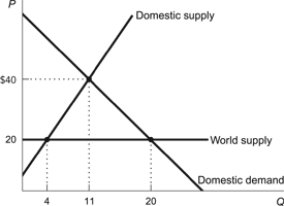 -(Figure: World Imports) Refer to the figure. An imposition of extreme trade restrictions that eliminated all trade in that market, would generate wasted resources of:
 (Multiple Choice)
4.9/5 (100)
(100) The prevalence of child labor tends to increase as countries get richer.
(True/False)
4.7/5 (81)
(81) Use the following to answer questions:
Figure: Foreign Trade Market  -(Figure: Foreign Trade Market) Refer to the figure. What is the dollar value of the lost consumer surplus as a result of prohibiting trade in this market?
 (Multiple Choice)
4.9/5 (68)
(68) Use the following to answer questions:
Figure: Foreign Trade 2
-(Figure: Foreign Trade 2) Refer to the figure. What is the dollar value of wasted resources as a result of prohibiting trade in this market?
-(Figure: Foreign Trade 2) Refer to the figure. What is the dollar value of wasted resources as a result of prohibiting trade in this market? (Multiple Choice)
4.8/5 (77)
(77) Use the following to answer questions:
Figure: International Trade 2  -(Figure: International Trade 2) Refer to the figure. How much revenue does the tariff in this figure generate for the government?
 (Multiple Choice)
4.7/5 (70)
(70) A tariff benefits domestic producers but hurts domestic consumers.
(True/False)
4.9/5 (83)
(83) If Tyler and Alex are trading partners, do their gains from trade depend on whether Tyler and Alex live in the same country?
(Multiple Choice)
4.8/5 (74)
(74) With free trade, the domestic price of a good must be equal to the world price of a good.
(True/False)
4.8/5 (80)
(80) Economic growth requires job destruction, since the destroyed jobs free up resources for more productive activities.
(True/False)
4.9/5 (94)
(94) According to the text, in a typical month in the United States:
(Multiple Choice)
4.9/5 (78)
(78) Which of the following results from a tariff on imported goods?
I. domestic production increases
II. domestic consumption increases
III. government revenues increase
(Multiple Choice)
4.9/5 (92)
(92) Use the following to answer questions:
Figure: Costs of Tariffs
-(Figure: Costs of Tariffs) Refer to the figure. From left to right, the first triangle, rectangle, and second triangle in the diagram for analyzing a tariff represent:
-(Figure: Costs of Tariffs) Refer to the figure. From left to right, the first triangle, rectangle, and second triangle in the diagram for analyzing a tariff represent: (Multiple Choice)
4.7/5 (84)
(84) 
Filters
- Essay(0)
- Multiple Choice(0)
- Short Answer(0)
- True False(0)
- Matching(0)