



 Chat with AI
Exam 9: International Trade

Exam 1: The Big Ideas253 Questions
Exam 2: The Power of Trade and Comparative239 Questions
Exam 3: Supply and Demand249 Questions
Exam 4: Equilibrium256 Questions
Exam 5: Elasticity and Its Applications271 Questions
Exam 6: Taxes and Subsidies225 Questions
Exam 7: The Price System275 Questions
Exam 8: Price Ceilings and Floors327 Questions
Exam 9: International Trade195 Questions
Exam 10: Externalities- When the Price Is Not Right273 Questions
Exam 11: Costs and Profit Maximization Under Competition217 Questions
Exam 12: Competition and the Invisible Hand144 Questions
Exam 13: Monopoly233 Questions
Exam 14: Price Discrimination262 Questions
Exam 15: Oligopoly and Game Theory218 Questions
Exam 16: Competing for Monopoly160 Questions
Exam 17: Monopolistic Competition and Advertising113 Questions
Exam 18: Labor Markets262 Questions
Exam 19: Public Goods and the Tragedy of the Commons244 Questions
Exam 20: Political Economy and Public Choice306 Questions
Exam 21: Economics, Ethics, and Public Policy241 Questions
Exam 22: Managing Incentives263 Questions
Exam 23: Stock Markets and Personal Finance271 Questions
Exam 24: Price Discrimination151 Questions
Exam 25: Consumer Choice145 Questions
Select questions type


Without trade restrictions the price of tennis shoes is $30, and with trade restrictions the price of tennis shoes is $45. The difference in the two prices reflects:
(Multiple Choice)
4.9/5  (99)
(99) If the United States bans the importation of Japanese automobiles:
(Multiple Choice)
4.9/5 (73)
(73) The total number of child laborers is usually smaller for middle-income countries than for very poor countries.
(True/False)
4.9/5 (78)
(78) Rising tariffs increase domestic production, but reduce domestic consumption.
(True/False)
4.9/5 (80)
(80) Consider the following two statements and select the best answer.
I. The national security argument might be a valid argument for trade protection.
II. Industries with spillover effects should be protected from foreign competition.
(Multiple Choice)
4.7/5 (76)
(76) Use the following to answer questions:
Figure: World Imports 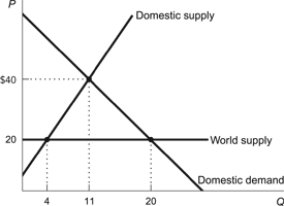 -(Figure: World Imports) Refer to the figure. The solution for a country without trade restrictions is where the equilibrium price and quantity are ________, respectively.
 (Multiple Choice)
4.8/5 (75)
(75) After a pair of wars in the late seventeenth and early eighteenth centuries, French-British relations decayed to the point that England began putting high tariffs on French wines. A large part of the support for this law came from British brewers and distillers who feared the return of French competition after the wars. These tariffs help explain why, to this day, the English prefer beer over wine. Of the arguments against free trade, which seems most likely to apply here, given the information provided?
(Multiple Choice)
4.9/5 (88)
(88) A tariff ______ the amount of output produced by domestic firms and ______ the amount of goods bought by domestic consumers.
(Multiple Choice)
5.0/5 (70)
(70) Which economic concept best explains why poorer countries have higher concentrations of child labor?
(Multiple Choice)
4.9/5 (70)
(70) Use the following to answer questions:
Figure: Foreign Trade Market  -Which, if any, of the following conditions for efficient market functioning do tariffs and quotas violate?
I. demanders with the highest willingness to pay purchase the supply of goods
II. producers with the lowest costs produce and sell the supply of goods
III. the sum of consumer and producer surplus is maximized
-Which, if any, of the following conditions for efficient market functioning do tariffs and quotas violate?
I. demanders with the highest willingness to pay purchase the supply of goods
II. producers with the lowest costs produce and sell the supply of goods
III. the sum of consumer and producer surplus is maximized (Multiple Choice)
4.9/5 (73)
(73) During the recent financial crisis many workers lost their jobs. Amy, for example, lost her job as a pharmaceutical salesperson. After five months of unemployment she spent $6,000 on a class that taught her the skills she would need to sell medical devices. Today Amy makes 25%more than she did in pharmaceutical sales and enjoys her new job much more than her old job. Which of the following concepts best illustrates this scenario?
(Multiple Choice)
4.8/5 (90)
(90) Protectionism policies restrain trade through price controls that burden foreign producers but not domestic producers.
(True/False)
4.8/5 (73)
(73) Use the following to answer questions:
Figure: International Trade 1 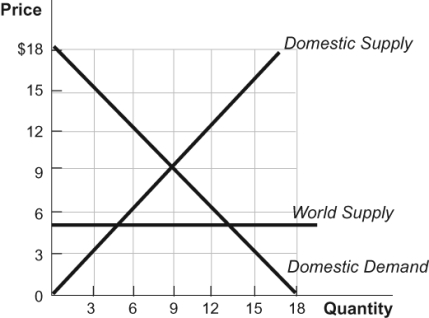 -(Figure: International Trade 1) Refer to the figure. With the international trade in this figure, domestic consumption is ______ units, and ______ of those units are imported.
 (Multiple Choice)
4.9/5 (76)
(76) Figure: Consumption with and without Trade 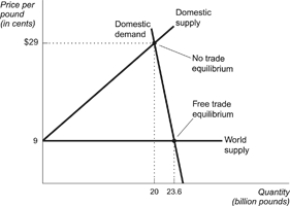 Refer to the figure. Suppose this diagram represents the market for sugar in the United States.
a. What is the equilibrium price of sugar before trade?
b. What is the equilibrium quantity of sugar before trade?
c. What is the price of sugar after trade is allowed?
d. What is the quantity of sugar imported after trade is allowed?
e. What is the amount of consumer surplus before trade?
f. By how much does consumer surplus increase after trade?
g. What is the amount of producer surplus before trade?
h. What is the amount of producer surplus after trade?
Refer to the figure. Suppose this diagram represents the market for sugar in the United States.
a. What is the equilibrium price of sugar before trade?
b. What is the equilibrium quantity of sugar before trade?
c. What is the price of sugar after trade is allowed?
d. What is the quantity of sugar imported after trade is allowed?
e. What is the amount of consumer surplus before trade?
f. By how much does consumer surplus increase after trade?
g. What is the amount of producer surplus before trade?
h. What is the amount of producer surplus after trade? (Essay)
4.8/5 (82)
(82) Because of pressure from the United States, the garment industry in Bangladesh dismissed 30,000 to 50,000 child laborers. This action:
(Multiple Choice)
4.9/5 (102)
(102) 
Filters
- Essay(0)
- Multiple Choice(0)
- Short Answer(0)
- True False(0)
- Matching(0)