



 Chat with AI
Exam 9: International Trade

Exam 1: The Big Ideas253 Questions
Exam 2: The Power of Trade and Comparative239 Questions
Exam 3: Supply and Demand249 Questions
Exam 4: Equilibrium256 Questions
Exam 5: Elasticity and Its Applications271 Questions
Exam 6: Taxes and Subsidies225 Questions
Exam 7: The Price System275 Questions
Exam 8: Price Ceilings and Floors327 Questions
Exam 9: International Trade195 Questions
Exam 10: Externalities- When the Price Is Not Right273 Questions
Exam 11: Costs and Profit Maximization Under Competition217 Questions
Exam 12: Competition and the Invisible Hand144 Questions
Exam 13: Monopoly233 Questions
Exam 14: Price Discrimination262 Questions
Exam 15: Oligopoly and Game Theory218 Questions
Exam 16: Competing for Monopoly160 Questions
Exam 17: Monopolistic Competition and Advertising113 Questions
Exam 18: Labor Markets262 Questions
Exam 19: Public Goods and the Tragedy of the Commons244 Questions
Exam 20: Political Economy and Public Choice306 Questions
Exam 21: Economics, Ethics, and Public Policy241 Questions
Exam 22: Managing Incentives263 Questions
Exam 23: Stock Markets and Personal Finance271 Questions
Exam 24: Price Discrimination151 Questions
Exam 25: Consumer Choice145 Questions
Select questions type


A quota is a stated quality standard that an imported good must reach before it can be allowed into the borders of the importing country.
(True/False)
4.9/5  (81)
(81) Studies show that more openness to trade __________ income and _______ child labor.
(Multiple Choice)
4.8/5 (79)
(79) Use the following to answer questions:
Figure: Foreign Trade with a Tariff 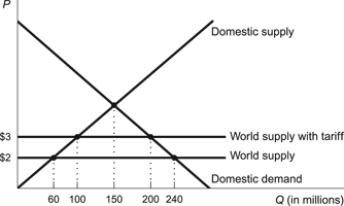 -(Figure: Foreign Trade with a Tariff) Refer to the figure. A $1 tariff results in:
 (Multiple Choice)
4.8/5 (75)
(75) If, at a world price of $200, domestic consumers buy 900 units and domestic producers sell 600 units, imports equal 1,500.
(True/False)
4.9/5 (87)
(87) If the United States imports teacups from other countries, then U.S. producers of teacups are better off, and U.S. consumers of teacups are worse off, as a result of trade.
(True/False)
4.7/5 (73)
(73) If the world price of a good is greater than the domestic price in a country that can engage in international trade, then that country becomes an importer of that good.
(True/False)
4.9/5 (92)
(92) Which of the following statements describes reasons why free trade is beneficial for the United States?
(Multiple Choice)
4.7/5 (79)
(79) Some goods generate spillover benefits from production, but it is:
(Multiple Choice)
4.8/5 (82)
(82) Use the following to answer questions:
Figure: Trade 2 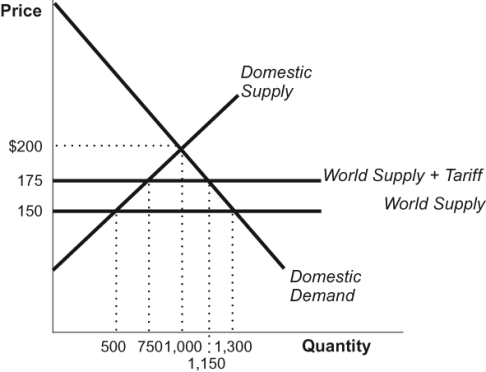 -(Figure: Trade 2) Refer to the figure. In this figure representing the market for oil, what are the total revenues generated by the tariff?
 (Multiple Choice)
4.8/5 (80)
(80) Use the following to answer questions:
Figure: Foreign Trade  -(Figure: Foreign Trade) Refer to the figure. What quantity would be traded in a free-trade environment?
 (Multiple Choice)
4.8/5 (76)
(76) Which statement(s) is TRUE?
I. When U.S. consumers buy lower-priced imports, they have more money to buy other goods, leading to increased jobs in other industries.
II. On net, free trade reduces total employment.
III. When foreign producers receive U.S. dollars for their exports, some of these dollars are used to buy U.S. goods and assets, increasing employment in U.S. exporting industries.
(Multiple Choice)
5.0/5 (75)
(75) Use the following to answer questions:
Figure: International Trade 1 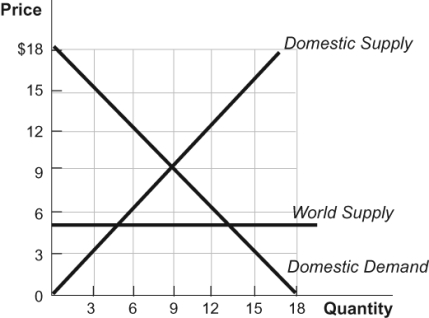 -(Figure: International Trade 1) Refer to the figure. According to the figure, which of the following statements is TRUE?
 (Multiple Choice)
4.8/5 (70)
(70) Use the following to answer questions:
Figure: International Trade 4 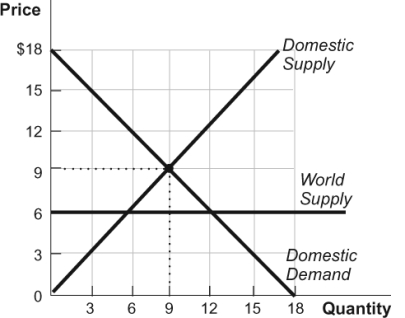 -(Figure: International Trade 4) Refer to the figure. If, in this figure, the government allowed free trade, consumer surplus would:
 (Multiple Choice)
4.9/5 (75)
(75) Use the following to answer questions:
Figure: Foreign Trade Market  -(Figure: Foreign Trade Market) Refer to the figure. What is the dollar value of wasted resources as a result of prohibiting trade in this market?
 (Multiple Choice)
4.9/5 (79)
(79) If a tariff decreases domestic consumption of a good from 230 million units to 150 million units and raises the domestic price by $1.50, given a linear domestic demand curve and a perfectly elastic world supply curve, what is the value of the unexploited gains from trade caused by decreased domestic consumption?
(Multiple Choice)
4.9/5 (70)
(70) 
Filters
- Essay(0)
- Multiple Choice(0)
- Short Answer(0)
- True False(0)
- Matching(0)