



 Chat with AI
Exam 22: Managing Incentives

Exam 1: The Big Ideas253 Questions
Exam 2: The Power of Trade and Comparative239 Questions
Exam 3: Supply and Demand249 Questions
Exam 4: Equilibrium256 Questions
Exam 5: Elasticity and Its Applications271 Questions
Exam 6: Taxes and Subsidies225 Questions
Exam 7: The Price System275 Questions
Exam 8: Price Ceilings and Floors327 Questions
Exam 9: International Trade195 Questions
Exam 10: Externalities- When the Price Is Not Right273 Questions
Exam 11: Costs and Profit Maximization Under Competition217 Questions
Exam 12: Competition and the Invisible Hand144 Questions
Exam 13: Monopoly233 Questions
Exam 14: Price Discrimination262 Questions
Exam 15: Oligopoly and Game Theory218 Questions
Exam 16: Competing for Monopoly160 Questions
Exam 17: Monopolistic Competition and Advertising113 Questions
Exam 18: Labor Markets262 Questions
Exam 19: Public Goods and the Tragedy of the Commons244 Questions
Exam 20: Political Economy and Public Choice306 Questions
Exam 21: Economics, Ethics, and Public Policy241 Questions
Exam 22: Managing Incentives263 Questions
Exam 23: Stock Markets and Personal Finance271 Questions
Exam 24: Price Discrimination151 Questions
Exam 25: Consumer Choice145 Questions
Select questions type


Piece rates increase the incentive to work when output is easy to measure.

Free
(True/False)
4.9/5  (70)
(70) Correct Answer: Verified
True
Firms with at least one large shareholder ______ pay executives based on relative stock performance.
Free
(Multiple Choice)
4.9/5 (80)
(80) Correct Answer:Verified
VerifiedB
A tournament system rewards workers based on absolute, not relative, performance.
Free
(True/False)
4.7/5 (79)
(79) Correct Answer:Verified
VerifiedFalse
For-profit prisons should be less costly to operate than public prisons, but these cost savings may come at the expense of lower quality.
(True/False)
4.8/5 (82)
(82) Which of the following are problems with a piece rate system?
I. The piece rate system might attract the least productive workers.
II. Workers might be concerned more about quantity than quality.
III. Inevitably, piece rate systems cause wages to rise more than productivity.
(Multiple Choice)
4.9/5 (89)
(89) Use the following to answer questions:
Figure: Piece Rates 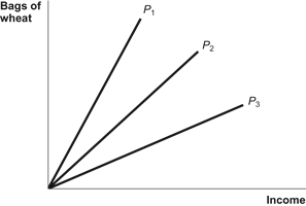 -(Figure: Piece Rates) Refer to the figure. A piece rate is offered for every 10 bags of wheat that workers fill. Which of the three piece rates plotted in the figure above has the highest dollar value to the firm?
 (Multiple Choice)
4.9/5 (85)
(85) Even though firms and workers can both benefit from piece rates, piece rates are sometimes not implemented because of:
(Multiple Choice)
4.8/5 (87)
(87) According to the text, how many American workers currently own stock in the companies for which they work ?
(Multiple Choice)
5.0/5 (92)
(92) Paying executives based on relative stock performance in industry rewards results due to external factors ______ paying executives based on absolute performance in industry.
(Multiple Choice)
4.9/5 (79)
(79) If your professor is difficult to understand, this is an example of:
(Multiple Choice)
5.0/5 (67)
(67) Hart, Shleifer, and Vishny (HSV) argue that private prisons have strong incentives to cut costs at the expense of quality, therefore public prisons are better than private prisons. Is there a problem with HSV's argument? If so, explain.
(Essay)
4.9/5 (81)
(81) If a firm's owner is better able than the sales staff to bear the risk of a recession, weak incentives:
(Multiple Choice)
4.8/5 (67)
(67) When sales vary for reasons having little to do with hard work, strong incentives may be more appropriate rewards for productivity.
(True/False)
4.8/5 (87)
(87) Explain tournament theory and include an example of the theory in practice.
(Essay)
4.7/5 (75)
(75) If rewards are mostly based on luck, the incentive to exert effort will be low.
(True/False)
4.8/5 (94)
(94) 
Filters
- Essay(0)
- Multiple Choice(0)
- Short Answer(0)
- True False(0)
- Matching(0)