



 Chat with AI
Exam 22: Managing Incentives

Exam 1: The Big Ideas253 Questions
Exam 2: The Power of Trade and Comparative239 Questions
Exam 3: Supply and Demand249 Questions
Exam 4: Equilibrium256 Questions
Exam 5: Elasticity and Its Applications271 Questions
Exam 6: Taxes and Subsidies225 Questions
Exam 7: The Price System275 Questions
Exam 8: Price Ceilings and Floors327 Questions
Exam 9: International Trade195 Questions
Exam 10: Externalities- When the Price Is Not Right273 Questions
Exam 11: Costs and Profit Maximization Under Competition217 Questions
Exam 12: Competition and the Invisible Hand144 Questions
Exam 13: Monopoly233 Questions
Exam 14: Price Discrimination262 Questions
Exam 15: Oligopoly and Game Theory218 Questions
Exam 16: Competing for Monopoly160 Questions
Exam 17: Monopolistic Competition and Advertising113 Questions
Exam 18: Labor Markets262 Questions
Exam 19: Public Goods and the Tragedy of the Commons244 Questions
Exam 20: Political Economy and Public Choice306 Questions
Exam 21: Economics, Ethics, and Public Policy241 Questions
Exam 22: Managing Incentives263 Questions
Exam 23: Stock Markets and Personal Finance271 Questions
Exam 24: Price Discrimination151 Questions
Exam 25: Consumer Choice145 Questions
Select questions type


What are the four lessons economists have learned that are important to keep in mind when designing an incentive scheme?
(Essay)
4.9/5  (82)
(82) In order to encourage students who are concerned about their GPAs to take harder classes, professors of these classes should:
(Multiple Choice)
4.7/5 (92)
(92) What evidence was put forth for teachers cheating on standardized tests?
(Multiple Choice)
4.9/5 (69)
(69) Voters, politicians, and parents all must think about and choose incentives.
(True/False)
4.8/5 (87)
(87) A worker might prefer a(n) ______ if the quantity produced is largely affected by things outside the worker's control.
(Multiple Choice)
4.9/5 (70)
(70) In situations where worker productivity largely depends on factors outside the worker's control (e.g., the state of the economy):
(Multiple Choice)
4.7/5 (85)
(85) In Austria, everyone is automatically considered to be an organ donor unless they have signed a non-donor card. This is considered:
(Multiple Choice)
4.9/5 (76)
(76) In which of the following scenarios would the average person exert the greatest effort?
(Multiple Choice)
4.8/5 (74)
(74) Corporate culture is needed to help firms incentivize what is easy to measure.
(True/False)
4.8/5 (80)
(80) Table: Salaries
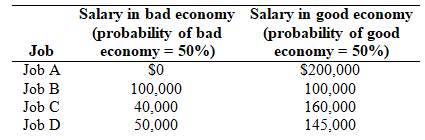 For the data in this table, most workers would prefer:
 (Multiple Choice)
4.8/5 (81)
(81) Pirate captains had to make sure their crew would storm the enemy vessel en masse to ensure victory. Individual crew members, however, would want to hold back and let their fellow crew mates fight. To solve help solve this problem, captains would offer bonus pay to the first member of the crew aboard the ship. What kind of incentive structure is this?
(Multiple Choice)
4.9/5 (79)
(79) Centralized economic planning in the Soviet Union was the epitome of the top-down approach: factories received quotas from Moscow that they had to fill. Enforcing such orders was difficult since there were so many factories to monitor. For example, a nail factory might fulfill an order of 250,000 nails by making very small nails, or substandard nails. Suppose Moscow wants nails to build houses. It is actually paying for:
(Multiple Choice)
4.9/5 (93)
(93) Giving employees shares of the company's stock is a form of:
(Multiple Choice)
4.8/5 (78)
(78) 
Filters
- Essay(0)
- Multiple Choice(0)
- Short Answer(0)
- True False(0)
- Matching(0)