



 Chat with AI
Exam 9: International Trade

Exam 1: The Big Ideas253 Questions
Exam 2: The Power of Trade and Comparative239 Questions
Exam 3: Supply and Demand249 Questions
Exam 4: Equilibrium256 Questions
Exam 5: Elasticity and Its Applications271 Questions
Exam 6: Taxes and Subsidies225 Questions
Exam 7: The Price System275 Questions
Exam 8: Price Ceilings and Floors327 Questions
Exam 9: International Trade195 Questions
Exam 10: Externalities- When the Price Is Not Right273 Questions
Exam 11: Costs and Profit Maximization Under Competition217 Questions
Exam 12: Competition and the Invisible Hand144 Questions
Exam 13: Monopoly233 Questions
Exam 14: Price Discrimination262 Questions
Exam 15: Oligopoly and Game Theory218 Questions
Exam 16: Competing for Monopoly160 Questions
Exam 17: Monopolistic Competition and Advertising113 Questions
Exam 18: Labor Markets262 Questions
Exam 19: Public Goods and the Tragedy of the Commons244 Questions
Exam 20: Political Economy and Public Choice306 Questions
Exam 21: Economics, Ethics, and Public Policy241 Questions
Exam 22: Managing Incentives263 Questions
Exam 23: Stock Markets and Personal Finance271 Questions
Exam 24: Price Discrimination151 Questions
Exam 25: Consumer Choice145 Questions
Select questions type


When the world price is below the domestic price, the elimination of a tariff decreases domestic production and provides a benefit because:
(Multiple Choice)
4.9/5  (74)
(74) The United States is not competitive with Brazil in sugar production partly because:
(Multiple Choice)
4.7/5 (83)
(83) The benefits of trade include:
I. greater productivity due to specialization.
II. higher output due to specialization according to comparative advantage.
III. increased welfare when preferences differ.
(Multiple Choice)
4.9/5 (78)
(78) Suppose a government is facing accusations of allowing domestic jobs to be lost to foreign labor in other countries. How can the government address these concerns?
I. Governments can ensure that unemployment insurance and strong education programs exist to help workers retrain for new jobs.
II. Governments can stress the importance of job creation in those industries that benefit from international trade, and encourage job creation in those industries.
III. Governments can set up extensive trade restrictions to limit the impact of foreign firms on domestic production.
(Multiple Choice)
4.7/5 (79)
(79) Use the following to answer questions:
Figure: Bananas 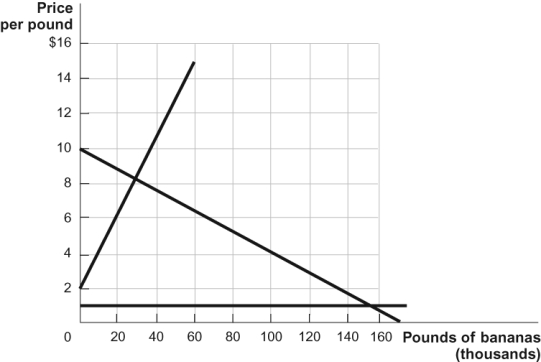 -(Figure: Bananas) If there is a $3 tariff on bananas, what is the total tariff revenue?
 (Multiple Choice)
4.8/5 (86)
(86) Use the following to answer questions:
Figure: Costs of Tariffs  -(Figure: Costs of Tariffs) Refer to the figure. In the figure representing the market for leather, domestic suppliers are the high-cost producers of leather. However, import restrictions push domestic prices up to $100. Which area represents the value of wasted resources?
 (Multiple Choice)
4.9/5 (71)
(71) According to the text, the sugar tariff wastes ______ worth of resources.
(Multiple Choice)
4.8/5 (76)
(76) The United States is the only government that engages in protectionist policies.
(True/False)
4.9/5 (87)
(87) Use the following to answer questions:
Figure: Shirts 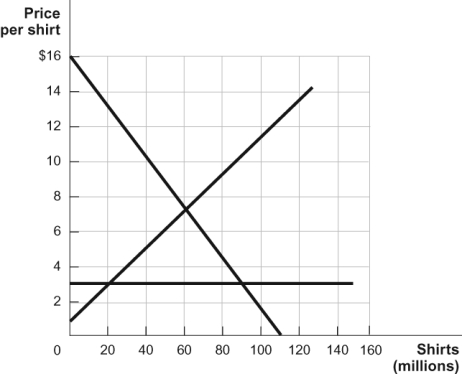 -(Figure: Shirts) Refer to the figure. If a tariff raised the world price to $4 a shirt, how much deadweight loss would it create?
 (Multiple Choice)
4.9/5 (81)
(81) Taxes and quotas on imports can ______ jobs in industries that import and ________ jobs in industries that export.
(Multiple Choice)
4.8/5 (77)
(77) Use the following to answer questions:
Figure: Foreign Trade  -(Figure: Foreign Trade) Refer to the figure. What quantity would be imported?
 (Multiple Choice)
4.8/5 (90)
(90) When a country adopts free trade and becomes a net exporter of a good, that good:
(Multiple Choice)
4.9/5 (86)
(86) Because of pressure from Western countries, garment producers in Bangladesh quit employing 30,000 to 50,000 child workers. What happened to these children?
(Multiple Choice)
4.8/5 (80)
(80) The paradox of trade restrictions on countries with child labor is that:
(Multiple Choice)
4.9/5 (88)
(88) Free trade has reduced the number of jobs in U.S. manufacturing as well as the overall number of jobs in the U.S. economy.
(True/False)
4.8/5 (82)
(82) 
Filters
- Essay(0)
- Multiple Choice(0)
- Short Answer(0)
- True False(0)
- Matching(0)