



 Chat with AI
Exam 13: Monopoly

Exam 1: The Big Ideas253 Questions
Exam 2: The Power of Trade and Comparative239 Questions
Exam 3: Supply and Demand249 Questions
Exam 4: Equilibrium256 Questions
Exam 5: Elasticity and Its Applications271 Questions
Exam 6: Taxes and Subsidies225 Questions
Exam 7: The Price System275 Questions
Exam 8: Price Ceilings and Floors327 Questions
Exam 9: International Trade195 Questions
Exam 10: Externalities- When the Price Is Not Right273 Questions
Exam 11: Costs and Profit Maximization Under Competition217 Questions
Exam 12: Competition and the Invisible Hand144 Questions
Exam 13: Monopoly233 Questions
Exam 14: Price Discrimination262 Questions
Exam 15: Oligopoly and Game Theory218 Questions
Exam 16: Competing for Monopoly160 Questions
Exam 17: Monopolistic Competition and Advertising113 Questions
Exam 18: Labor Markets262 Questions
Exam 19: Public Goods and the Tragedy of the Commons244 Questions
Exam 20: Political Economy and Public Choice306 Questions
Exam 21: Economics, Ethics, and Public Policy241 Questions
Exam 22: Managing Incentives263 Questions
Exam 23: Stock Markets and Personal Finance271 Questions
Exam 24: Price Discrimination151 Questions
Exam 25: Consumer Choice145 Questions
Select questions type


The stated reason for resorting to regulation of public utilities rather than promoting competition through antitrust is that the industry in question is believed to be a:
(Multiple Choice)
4.9/5  (79)
(79) Figure: Demand Curve  In this figure, the marginal revenue of the third unit is given by area:
 (Multiple Choice)
4.8/5 (74)
(74) Use the following to answer questions:
Figure: Monopoly Profits  -(Figure: Monopoly Profits) Refer to the figure. The monopolist earns a profit of:
 (Multiple Choice)
4.7/5 (71)
(71) To better feed his army, Napoleon established a technology prize that led to the development of canning in 1809. Napoleon required the inventor-Nicolas Francois Appert-to publish the method. Napoleon's reign as Emperor ended after his defeat at Waterloo, a defeat which might not have been so decisive had canned food not made its way to the enemies' mouths. By demanding Appert publish his method, what did Napoleon force Appert to give up?
(Multiple Choice)
4.8/5 (87)
(87) Apple's iPod provides an example that market power may arise from:
(Multiple Choice)
4.8/5 (81)
(81) To assuage the deadweight loss from a natural monopoly, governments could employ a price control.
(True/False)
5.0/5 (66)
(66) Which of the following statements are TRUE?
I. Monopolists can raise prices as high as they want and still earn economic profits.
II. Even with no competitors, firms face a downward-sloping demand curve.
III. Just like competitive firms, monopolists maximize profits where marginal revenue equals marginal cost.
(Multiple Choice)
4.9/5 (94)
(94) Use the following to answer questions:
Figure: Monopoly 6 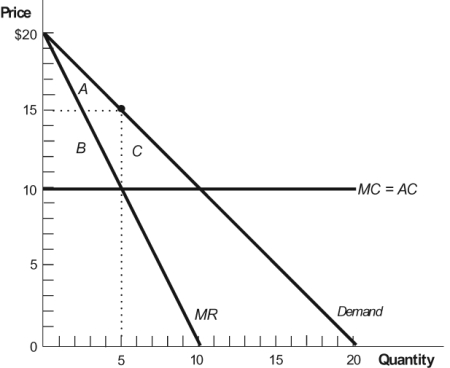 -(Figure: Monopoly 6) If the market in this figure is a competitive market, consumer surplus is given by area(s):
 (Multiple Choice)
4.7/5 (75)
(75) Patent buyouts could reduce deadweight loss from monopolies, while still protecting the incentive to innovate.
(True/False)
4.9/5 (82)
(82) In comparison to competitive firms, monopolies do not maximize the sum of producer and consumer surplus and thus create deadweight loss.
(True/False)
4.9/5 (79)
(79) A monopoly is a firm with market power, and market power may arise from economies of scale, patent protection, and innovation.
(True/False)
4.9/5 (83)
(83) Use the following to answer questions:
Figure: Monopolist 3  -(Figure: Monopolist 3) In this figure, the profit-maximizing monopolist sells:
 (Multiple Choice)
4.7/5 (77)
(77) Today anything beyond the most basic tier cable service is predominantly free of regulation, and cable companies are free to charge a market rate for their services. As a result:
(Multiple Choice)
4.8/5 (93)
(93) Patents may be beneficial in that they encourage firms to innovate and develop new products.
(True/False)
4.8/5 (93)
(93) Use the following to answer questions:
Figure: Paint Market 2 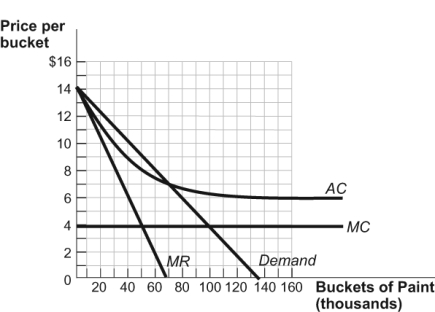 -(Figure: Paint Market 2) What is the deadweight loss (if any) from the monopoly in this diagram relative to its optimum quantity?
 (Multiple Choice)
4.8/5 (85)
(85) If you had the opportunity to operate a firm with market power either in the market for fast-food or for pharmaceuticals, which market should you choose in order to earn the highest profits and why?
(Essay)
4.8/5 (84)
(84) 
Filters
- Essay(0)
- Multiple Choice(0)
- Short Answer(0)
- True False(0)
- Matching(0)