



 Chat with AI
Exam 13: Monopoly

Exam 1: The Big Ideas253 Questions
Exam 2: The Power of Trade and Comparative239 Questions
Exam 3: Supply and Demand249 Questions
Exam 4: Equilibrium256 Questions
Exam 5: Elasticity and Its Applications271 Questions
Exam 6: Taxes and Subsidies225 Questions
Exam 7: The Price System275 Questions
Exam 8: Price Ceilings and Floors327 Questions
Exam 9: International Trade195 Questions
Exam 10: Externalities- When the Price Is Not Right273 Questions
Exam 11: Costs and Profit Maximization Under Competition217 Questions
Exam 12: Competition and the Invisible Hand144 Questions
Exam 13: Monopoly233 Questions
Exam 14: Price Discrimination262 Questions
Exam 15: Oligopoly and Game Theory218 Questions
Exam 16: Competing for Monopoly160 Questions
Exam 17: Monopolistic Competition and Advertising113 Questions
Exam 18: Labor Markets262 Questions
Exam 19: Public Goods and the Tragedy of the Commons244 Questions
Exam 20: Political Economy and Public Choice306 Questions
Exam 21: Economics, Ethics, and Public Policy241 Questions
Exam 22: Managing Incentives263 Questions
Exam 23: Stock Markets and Personal Finance271 Questions
Exam 24: Price Discrimination151 Questions
Exam 25: Consumer Choice145 Questions
Select questions type


In which of the following scenarios will automobile prices be the lowest?
(Multiple Choice)
4.8/5  (77)
(77) The power to raise price above marginal cost without fear that other firms will enter the market is:
(Multiple Choice)
4.8/5 (89)
(89) When goods produced in monopolistic markets become inputs to produce other goods,
(Multiple Choice)
4.9/5 (71)
(71) Explain how a firm can use its monopoly power to earn above-normal profits.
(Essay)
4.9/5 (75)
(75) Assuming the same cost structure, a competitive market produces ________ output at ________ prices than a monopoly market.
(Multiple Choice)
4.9/5 (74)
(74) Under monopoly, the portion of the outgoing consumer surplus that is not transferred to the monopoly firm or still considered consumer surplus is:
(Multiple Choice)
5.0/5 (73)
(73) When a monopolist decreases the price of its good, consumers:
(Multiple Choice)
5.0/5 (77)
(77) Rex Pharma produces anti-acid medication that is sold in a monopoly market. ' Rex Pharma sells 10,000,000 pills for $12.50 per pill. If the pills were sold for the marginal cost of production of $0.50, Rex Pharma would be able to sell 25,000,000 pills. What is the deadweight loss of this monopoly market?
(Multiple Choice)
4.9/5 (87)
(87) Which of the following correctly defines a monopoly that arises from economies of scale?
(Multiple Choice)
4.8/5 (83)
(83) Which of the following represents the nature of a monopolist's deadweight loss?
(Multiple Choice)
4.8/5 (82)
(82) The trade-off for natural monopolies weighs the benefits of economies of scale against the costs of deadweight loss.
(True/False)
4.8/5 (74)
(74) Monopolists that produce products with very elastic demand tend to have the highest price markups.
(True/False)
4.9/5 (74)
(74) The "you can't take it with you" and "other people's money" effects give rise to an inelastic demand for pharmaceutical drugs.
(True/False)
4.7/5 (71)
(71) Use the following to answer questions:
Figure: Maximize Monopoly Profits 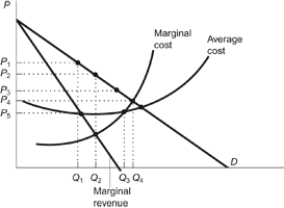 -(Figure: Maximize Monopoly Profits) Refer to the figure. The monopolist will maximize its profit by producing at output equal to:
 (Multiple Choice)
4.9/5 (81)
(81) 
Filters
- Essay(0)
- Multiple Choice(0)
- Short Answer(0)
- True False(0)
- Matching(0)