



 Chat with AI
Exam 13: Monopoly

Exam 1: The Big Ideas253 Questions
Exam 2: The Power of Trade and Comparative239 Questions
Exam 3: Supply and Demand249 Questions
Exam 4: Equilibrium256 Questions
Exam 5: Elasticity and Its Applications271 Questions
Exam 6: Taxes and Subsidies225 Questions
Exam 7: The Price System275 Questions
Exam 8: Price Ceilings and Floors327 Questions
Exam 9: International Trade195 Questions
Exam 10: Externalities- When the Price Is Not Right273 Questions
Exam 11: Costs and Profit Maximization Under Competition217 Questions
Exam 12: Competition and the Invisible Hand144 Questions
Exam 13: Monopoly233 Questions
Exam 14: Price Discrimination262 Questions
Exam 15: Oligopoly and Game Theory218 Questions
Exam 16: Competing for Monopoly160 Questions
Exam 17: Monopolistic Competition and Advertising113 Questions
Exam 18: Labor Markets262 Questions
Exam 19: Public Goods and the Tragedy of the Commons244 Questions
Exam 20: Political Economy and Public Choice306 Questions
Exam 21: Economics, Ethics, and Public Policy241 Questions
Exam 22: Managing Incentives263 Questions
Exam 23: Stock Markets and Personal Finance271 Questions
Exam 24: Price Discrimination151 Questions
Exam 25: Consumer Choice145 Questions
Select questions type


If these were monopolistic markets, which one would clearly have a greater markup than a monopolized banana industry?
(Multiple Choice)
4.9/5  (84)
(84) Since the popular video game Grand Theft Auto IV cost more than $100 million to develop,:
(Multiple Choice)
4.8/5 (85)
(85) A firm with monopoly power is able to set a markup price that is:
(Multiple Choice)
4.7/5 (71)
(71) Suppose that the government decided to reduce pharmaceutical patent protection by requiring companies to sell their drugs at marginal cost. What are the likely consequences of such a policy?
(Multiple Choice)
4.7/5 (91)
(91) Many people argue that the U.S. government should control pharmaceutical prices. What would most likely happen as a result of this policy?
(Multiple Choice)
4.8/5 (89)
(89) Which of the following is NOT perceived as a problem with monopolies?
(Multiple Choice)
4.8/5 (78)
(78) A monopolist's demand curve is described by the equation Q = 50 - 0.5P. The marginal revenue curve is described by the equation MR = 50 - Q. Marginal cost per unit is constant at $5, and there are no fixed costs to be considered here. What is the monopolist's profit-maximizing quantity and profit level? Show all your calculations.
(Essay)
4.9/5 (83)
(83) Figure: Monopolist 4 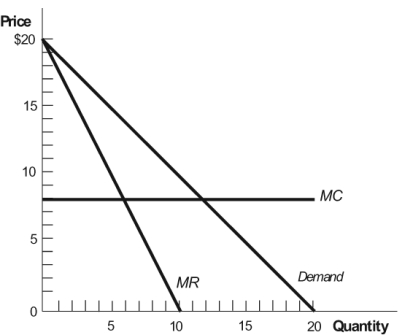 What is the profit-maximizing price and output level for the monopolist in this figure?
 (Multiple Choice)
5.0/5 (82)
(82) If the quantity demanded for a hand-carved pineapple is two at a price of $16, and the quantity demanded will increase to three if the seller lowers the price to $14, what is the seller's marginal revenue from selling 3 units of pineapple?
(Multiple Choice)
4.8/5 (75)
(75) Which of the following statements is TRUE?
I. The deadweight loss from a monopoly refers to the loss in consumer surplus that is captured by the monopolist as profit.
II. According to theory, if the government sets a natural monopolist's price equal to marginal cost, the socially optimum quantity of output will result.
III. Deregulation of cable television caused higher prices and fewer programming choices for customers.
(Multiple Choice)
4.9/5 (83)
(83) When a monopolist's demand curve is inelastic, raising the price:
(Multiple Choice)
4.9/5 (74)
(74) The more inelastic the demand curve for a product is, the:
(Multiple Choice)
5.0/5 (72)
(72) Monopolies may arise from economies of scale, government regulation, patent protection, and control over key inputs that are difficult to duplicate.
(True/False)
5.0/5 (77)
(77) A government can maximize efficiency in monopoly markets by setting prices equal to the monopolist's average cost of production albeit at the cost of reduced long term innovation.
(True/False)
4.8/5 (88)
(88) 'When a single firm can supply the entire market at a lower cost than two or more firms, the firm can be said to have which of the following characteristics?
(Multiple Choice)
4.7/5 (91)
(91) Which of the following statements is TRUE?
I. Government ownership is a potential solution to the natural monopoly problem but it stifles innovation.
II. Regulated monopolies have little incentive to reduce costs, as they simply pass the higher costs on to consumers.
III. Government ownership of utilities worked well for several decades.
(Multiple Choice)
5.0/5 (71)
(71) 
Filters
- Essay(0)
- Multiple Choice(0)
- Short Answer(0)
- True False(0)
- Matching(0)