



 Chat with AI
Exam 14: Price Discrimination

Exam 1: The Big Ideas253 Questions
Exam 2: The Power of Trade and Comparative239 Questions
Exam 3: Supply and Demand249 Questions
Exam 4: Equilibrium256 Questions
Exam 5: Elasticity and Its Applications271 Questions
Exam 6: Taxes and Subsidies225 Questions
Exam 7: The Price System275 Questions
Exam 8: Price Ceilings and Floors327 Questions
Exam 9: International Trade195 Questions
Exam 10: Externalities- When the Price Is Not Right273 Questions
Exam 11: Costs and Profit Maximization Under Competition217 Questions
Exam 12: Competition and the Invisible Hand144 Questions
Exam 13: Monopoly233 Questions
Exam 14: Price Discrimination262 Questions
Exam 15: Oligopoly and Game Theory218 Questions
Exam 16: Competing for Monopoly160 Questions
Exam 17: Monopolistic Competition and Advertising113 Questions
Exam 18: Labor Markets262 Questions
Exam 19: Public Goods and the Tragedy of the Commons244 Questions
Exam 20: Political Economy and Public Choice306 Questions
Exam 21: Economics, Ethics, and Public Policy241 Questions
Exam 22: Managing Incentives263 Questions
Exam 23: Stock Markets and Personal Finance271 Questions
Exam 24: Price Discrimination151 Questions
Exam 25: Consumer Choice145 Questions
Select questions type


Price discrimination is selling the same good to different customers at different prices.
(True/False)
4.8/5  (72)
(72) Figure: Monopolist's Profits under Price Discrimination 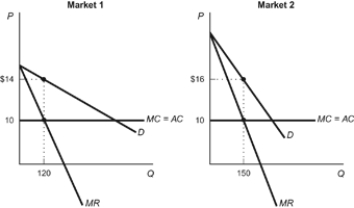 Refer to the figure. Using the principles of price discrimination, explain and calculate how much profit the monopolist serving these markets could make.
 (Essay)
4.9/5 (75)
(75) One example of price discrimination occurs in the publishing industry when a publisher initially releases an expensive hardcover edition of a popular novel, and later releases a cheaper paperback edition. Use this example to demonstrate both the benefits as well as the potential pitfalls of a price discrimination pricing strategy.
(Essay)
4.8/5 (79)
(79) Which of the following is NOT an easy way to split markets in order to practice price discrimination?
(Multiple Choice)
4.9/5 (80)
(80) Which of the following statements is FALSE?
I. If the demand curves are different, it is more profitable to set a single price than different prices in markets.
II. To maximize profit the firm should set a lower price in markets with more elastic demand.
III. The presence of arbitrage makes it easy for a firm to price discriminate.
(Multiple Choice)
5.0/5 (86)
(86) The difference between tying and bundling in pricing strategies is that:
(Multiple Choice)
4.8/5 (75)
(75) Which of the following is a necessary condition for perfect price discrimination?
(Multiple Choice)
4.7/5 (77)
(77) To maximize profits, the monopolist should set a higher price in a market with ______ demand.
(Multiple Choice)
4.8/5 (81)
(81) A perfectly price-discriminating monopolist produces until:
(Multiple Choice)
5.0/5 (83)
(83) Which of the following is TRUE about price discrimination in monopolistic markets?
I. Price discrimination may be good if it leads to higher output.
II. Price discrimination may help to offset high fixed costs, but it leads to less research and innovation.
III. Single pricing tends to increase prices for at least a subset of the market.
(Multiple Choice)
4.8/5 (71)
(71) Why is it harder to price discriminate with shampoo than with haircuts?
(Multiple Choice)
4.7/5 (71)
(71) Tying is a form of price discrimination in which one good called the ________ is tied to a second good called the ________.
(Multiple Choice)
4.8/5 (66)
(66) Haircuts for men are often cheaper than haircuts for women, even when they are offered by the same stylist. Why might this be price discrimination?
(Multiple Choice)
4.8/5 (87)
(87) Use the following to answer questions:
Figure: PPD 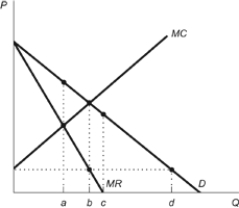 -(Figure: PPD) Refer to the figure. Which of the following statements best explains why a firm that perfectly price discriminates would sell additional units beyond c units of output?
 (Multiple Choice)
4.8/5 (87)
(87) 
Filters
- Essay(0)
- Multiple Choice(0)
- Short Answer(0)
- True False(0)
- Matching(0)