



 Chat with AI
Exam 14: Price Discrimination

Exam 1: The Big Ideas253 Questions
Exam 2: The Power of Trade and Comparative239 Questions
Exam 3: Supply and Demand249 Questions
Exam 4: Equilibrium256 Questions
Exam 5: Elasticity and Its Applications271 Questions
Exam 6: Taxes and Subsidies225 Questions
Exam 7: The Price System275 Questions
Exam 8: Price Ceilings and Floors327 Questions
Exam 9: International Trade195 Questions
Exam 10: Externalities- When the Price Is Not Right273 Questions
Exam 11: Costs and Profit Maximization Under Competition217 Questions
Exam 12: Competition and the Invisible Hand144 Questions
Exam 13: Monopoly233 Questions
Exam 14: Price Discrimination262 Questions
Exam 15: Oligopoly and Game Theory218 Questions
Exam 16: Competing for Monopoly160 Questions
Exam 17: Monopolistic Competition and Advertising113 Questions
Exam 18: Labor Markets262 Questions
Exam 19: Public Goods and the Tragedy of the Commons244 Questions
Exam 20: Political Economy and Public Choice306 Questions
Exam 21: Economics, Ethics, and Public Policy241 Questions
Exam 22: Managing Incentives263 Questions
Exam 23: Stock Markets and Personal Finance271 Questions
Exam 24: Price Discrimination151 Questions
Exam 25: Consumer Choice145 Questions
Select questions type


Movie theaters typically price discriminate by charging ______ a lower price than ______.
(Multiple Choice)
4.8/5  (82)
(82) HP ties its printer ink to its printers by embedding a patented printer head in its ink cartridge rather than build it into the printer. This raises the cost of producing the ink cartridge. If the government passed a law requiring HP ink be used with HP printers, would this law increase or decrease deadweight loss?
(Multiple Choice)
4.9/5 (74)
(74) Pfizer sells Atgam in New Zealand for $14 per pill and in Brazil for $8 per pill. This implies that the demand curve in New Zealand must be ________ than in Brazil.
(Multiple Choice)
4.8/5 (79)
(79) Pharmaceuticals with high fixed costs can benefit with the practice of price discrimination because:
(Multiple Choice)
4.8/5 (90)
(90) Use the following to answer questions:
Figure: PPD 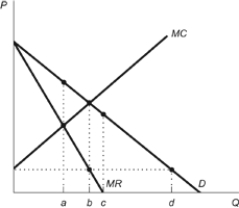 -(Figure: PPD) Refer to the figure. Which of the following statements best explains why a firm that perfectly price discriminates would sell additional units beyond a units of output?
 (Multiple Choice)
4.9/5 (86)
(86) Why are patients who suffer from rare terminal diseases more likely to die if the cost of new drug development is about the same for rare and more common terminal diseases?
(Multiple Choice)
4.8/5 (80)
(80) Monopolists that are able to perfectly price discriminate generate the most deadweight losses.
(True/False)
4.9/5 (82)
(82) Price discrimination discourages innovation and new product development in industries with high fixed costs.
(True/False)
4.8/5 (77)
(77) Price discrimination is considered bad when ________, but good when ________.
(Multiple Choice)
4.9/5 (88)
(88) Bundling is expected to provide greater profits when the two bundled goods are:
I. substitutes.
II. goods that have high fixed costs and low marginal costs.
III. very close complements.
(Multiple Choice)
4.9/5 (81)
(81) Some bars host a "ladies' night," on which women get drinks free or at a discount. Aside from differing elasticities of demand, why might bars want to charge a lower price to women than to men?
(Multiple Choice)
4.9/5 (70)
(70) Arbitrage makes it more difficult for firms to practice price discrimination.
(True/False)
4.9/5 (82)
(82) Why are seniors charged less for coffee at McDonald's than younger people?
(Multiple Choice)
4.9/5 (70)
(70) To price discriminate, firms must identify a customer's or a group of customers' willingness to pay.
(True/False)
4.9/5 (77)
(77) Figure: Price-Discriminating Monopolist 3 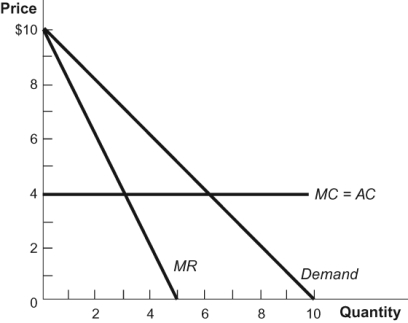 Refer to the figure. Profit for the single-price monopoly in this diagram is ______, and under perfect price discrimination, profit is ______.
 (Multiple Choice)
4.9/5 (77)
(77) Bundling increases ________ and hence increases the incentives to ________.
(Multiple Choice)
4.9/5 (89)
(89) Tying is a legal strategy, but bundling is illegal in the United States.
(True/False)
4.8/5 (85)
(85) 
Filters
- Essay(0)
- Multiple Choice(0)
- Short Answer(0)
- True False(0)
- Matching(0)