



 Chat with AI
Exam 2: Trade-Offs, Comparative Advantage, and the Market System

Exam 1: Economics: Foundations and Models444 Questions
Exam 2: Trade-Offs, Comparative Advantage, and the Market System498 Questions
Exam 3: Where Prices Come From: the Interaction of Demand and Supply475 Questions
Exam 4: Economic Efficiency, Government Price Setting, and Taxes419 Questions
Exam 5: Externalities, Environmental Policy, and Public Goods266 Questions
Exam 6: Elasticity: the Responsiveness of Demand and Supply295 Questions
Exam 7: The Economics of Health Care334 Questions
Exam 8: Firms, the Stock Market, and Corporate Governance278 Questions
Exam 9: Comparative Advantage and the Gains From International Trade379 Questions
Exam 10: Consumer Choice and Behavioral Economics302 Questions
Exam 11: Technology, Production, and Costs330 Questions
Exam 12: Firms in Perfectly Competitive Markets298 Questions
Exam 13: Monopolistic Competition: the Competitive Model in a More Realistic Setting276 Questions
Exam 14: Oligopoly: Firms in Less Competitive Markets262 Questions
Exam 15: Monopoly and Antitrust Policy271 Questions
Exam 16: Pricing Strategy263 Questions
Exam 17: The Markets for Labor and Other Factors of Production286 Questions
Exam 18: Public Choice, Taxes, and the Distribution of Income258 Questions
Exam 19: GDP: Measuring Total Production and Income266 Questions
Exam 20: Unemployment and Inflation292 Questions
Exam 21: Economic Growth, the Financial System, and Business Cycles257 Questions
Exam 22: Long-Run Economic Growth: Sources and Policies268 Questions
Exam 23: Aggregate Expenditure and Output in the Short Run306 Questions
Exam 24: Aggregate Demand and Aggregate Supply Analysis284 Questions
Exam 25: Money, Banks, and the Federal Reserve System280 Questions
Exam 26: Monetary Policy277 Questions
Exam 27: Fiscal Policy303 Questions
Exam 28: Inflation, Unemployment, and Federal Reserve Policy257 Questions
Exam 29: Macroeconomics in an Open Economy278 Questions
Exam 30: The International Financial System262 Questions
Select questions type


Figure 2-4  Figure 2-4 shows various points on three different production possibilities frontiers for a nation.
-Refer to Figure 2-4. A movement from ________ could occur because of an influx of immigrant labor.
Figure 2-4 shows various points on three different production possibilities frontiers for a nation.
-Refer to Figure 2-4. A movement from ________ could occur because of an influx of immigrant labor. (Multiple Choice)
4.9/5  (85)
(85) Which of the following is an example of spending on goods and services in the circular flow model?
(Multiple Choice)
4.7/5 (90)
(90) The payment received by suppliers of entrepreneurial skills is called profit.
(True/False)
4.9/5 (76)
(76) Table 2-16
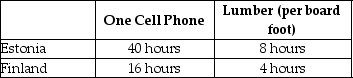 Table 2-16 shows the number of labor hours required to produce a cell phone and a board foot of lumber in Estonia and Finland.
-As job opportunities for women and the wages those jobs pay have increased, the opportunity cost of doing housework has ________, so many families have chosen to hire specialists in households chores, such as cleaning services and lawn care services, because the cost of these specialists is ________ than the cost of the wife (or husband) performing those chores.
Table 2-16 shows the number of labor hours required to produce a cell phone and a board foot of lumber in Estonia and Finland.
-As job opportunities for women and the wages those jobs pay have increased, the opportunity cost of doing housework has ________, so many families have chosen to hire specialists in households chores, such as cleaning services and lawn care services, because the cost of these specialists is ________ than the cost of the wife (or husband) performing those chores. (Multiple Choice)
4.8/5 (68)
(68) Figure 2-4 Figure 2-4 shows various points on three different production possibilities frontiers for a nation.
-Refer to Figure 2-4. A movement from ________ is the result of negative technological change in plastic production.
Figure 2-4 shows various points on three different production possibilities frontiers for a nation.
-Refer to Figure 2-4. A movement from ________ is the result of negative technological change in plastic production. (Multiple Choice)
4.8/5 (83)
(83) Figure 2-14  Figure 2-14 shows the production possibilities frontiers for Costa Rica and Guatemala. Each country produces two goods, pineapples and coconuts.
-Refer to Figure 2-14. Which country has a comparative advantage in the production of pineapples?
Figure 2-14 shows the production possibilities frontiers for Costa Rica and Guatemala. Each country produces two goods, pineapples and coconuts.
-Refer to Figure 2-14. Which country has a comparative advantage in the production of pineapples? (Multiple Choice)
4.7/5 (72)
(72) A bed of oysters is not an example of a factor of production, but the shucked oysters used to make oyster stew is a factor of production.
(True/False)
4.9/5 (72)
(72) Figure 2-14 Figure 2-14 shows the production possibilities frontiers for Costa Rica and Guatemala. Each country produces two goods, pineapples and coconuts.
-Refer to Figure 2-14. What is the opportunity cost of producing 1 ton of pineapples in Costa Rica?
Figure 2-14 shows the production possibilities frontiers for Costa Rica and Guatemala. Each country produces two goods, pineapples and coconuts.
-Refer to Figure 2-14. What is the opportunity cost of producing 1 ton of pineapples in Costa Rica? (Multiple Choice)
4.8/5 (80)
(80) Figure 2-4 Figure 2-4 shows various points on three different production possibilities frontiers for a nation.
-Refer to Figure 2-4. Consider the following events: a. an increase in the unemployment rate
B. a decrease in a nation's money supply
C. a war that kills a significant portion of a nation's population
Which of the events listed above could cause a movement from Z to X?
Figure 2-4 shows various points on three different production possibilities frontiers for a nation.
-Refer to Figure 2-4. Consider the following events: a. an increase in the unemployment rate
B. a decrease in a nation's money supply
C. a war that kills a significant portion of a nation's population
Which of the events listed above could cause a movement from Z to X? (Multiple Choice)
4.8/5 (80)
(80) Table 2-26
 -Refer to Table 2-21. This table shows the number of labor hours required to produce a digital cameras and a bushel of wheat in China and South Korea.
a. Which country has an absolute advantage in the production of digital cameras?
b. Which country has an absolute advantage in the production of wheat?
c. What is China's opportunity cost of producing one digital camera?
d. What is South Korea's opportunity cost of producing one digital camera?
e. What is China's opportunity cost of producing one pound of wheat?
f. What is South Korea's opportunity cost of producing one pound of what?
g. If each country specializes in the production of the product in which it has a comparative advantage, who should produce digital cameras?
h. If each country specializes in the production of the product in which it has a comparative advantage, who should produce wheat?
-Refer to Table 2-21. This table shows the number of labor hours required to produce a digital cameras and a bushel of wheat in China and South Korea.
a. Which country has an absolute advantage in the production of digital cameras?
b. Which country has an absolute advantage in the production of wheat?
c. What is China's opportunity cost of producing one digital camera?
d. What is South Korea's opportunity cost of producing one digital camera?
e. What is China's opportunity cost of producing one pound of wheat?
f. What is South Korea's opportunity cost of producing one pound of what?
g. If each country specializes in the production of the product in which it has a comparative advantage, who should produce digital cameras?
h. If each country specializes in the production of the product in which it has a comparative advantage, who should produce wheat? (Essay)
4.9/5 (87)
(87) Table 2-18
 Table 2-18 shows the output per week of two people, Minnie and Mickey. They can either devote their time to making hats or making umbrellas.
-Refer to Table 2-18. What is Minnie's opportunity cost of making a hat?
Table 2-18 shows the output per week of two people, Minnie and Mickey. They can either devote their time to making hats or making umbrellas.
-Refer to Table 2-18. What is Minnie's opportunity cost of making a hat? (Multiple Choice)
4.8/5 (75)
(75) Article Summary
Since 2008, the United States has been involved in trade negotiations over the Trans-Pacific Partnership (TPP), a free trade agreement with 11 other countries on both sides of the Pacific Ocean. One area of the negotiations involves patents and intellectual property rights in the pharmaceutical industry. A number of developing countries have ignored international agreements concerning patents and intellectual property rights as a way to benefit their domestic pharmaceutical industries, to the detriment of those companies which have spent considerable time and money developing new medicines. For every 5,000 to 10,000 experimental drugs contemplated, only one will typically gain FDA approval, and this occurs only after up to 15 years of research at an average cost of more than $1 billion. Also, 30 percent of the U.S. workforce is either directly or indirectly employed in the pharmaceutical industry, so protection of these intellectual property rights is very important for the U.S. economy.
Source: Doug Schoen, "Intellectual Property Rights Matter," Forbes, September 24, 2013.
-Refer to the Article Summary. If these developing countries continue to ignore the international agreements which protect intellectual property rights, all of the following would most likely occur except
(Multiple Choice)
4.9/5 (79)
(79) Figure 2-9  -Refer to Figure 2-9. Carlos Vanya grows tomatoes and strawberries on his land. His land is equally suited for growing either fruit. Which of the graphs in Figure 2-3 represents his production possibilities frontier?
 (Multiple Choice)
4.8/5 (74)
(74) Figure 2-1  -Refer to Figure 2-1. ________ is (are) unattainable with current resources.
 (Multiple Choice)
4.8/5 (89)
(89) Figure 2-4 Figure 2-4 shows various points on three different production possibilities frontiers for a nation.
-The Great Depression of the 1930s with a large number of workers and factories unemployed would be represented in a production possibilities frontier graph by
Figure 2-4 shows various points on three different production possibilities frontiers for a nation.
-The Great Depression of the 1930s with a large number of workers and factories unemployed would be represented in a production possibilities frontier graph by (Multiple Choice)
4.8/5 (79)
(79) A stand of redwood trees is not an example of a factor of production, but the harvested and processed redwood is a factor of production.
(True/False)
4.8/5 (82)
(82) Table 2-20
 Table 2-20 shows the number of labor hours required to produce a wristwatch and a pound of rice in Japan and Thailand.
-Refer to Table 2-20. What is Japan's opportunity cost of producing one pound of rice?
Table 2-20 shows the number of labor hours required to produce a wristwatch and a pound of rice in Japan and Thailand.
-Refer to Table 2-20. What is Japan's opportunity cost of producing one pound of rice? (Multiple Choice)
4.8/5 (91)
(91) 
Filters
- Essay(0)
- Multiple Choice(0)
- Short Answer(0)
- True False(0)
- Matching(0)