



 Chat with AI
Exam 2: Trade-Offs, Comparative Advantage, and the Market System

Exam 1: Economics: Foundations and Models444 Questions
Exam 2: Trade-Offs, Comparative Advantage, and the Market System498 Questions
Exam 3: Where Prices Come From: the Interaction of Demand and Supply475 Questions
Exam 4: Economic Efficiency, Government Price Setting, and Taxes419 Questions
Exam 5: Externalities, Environmental Policy, and Public Goods266 Questions
Exam 6: Elasticity: the Responsiveness of Demand and Supply295 Questions
Exam 7: The Economics of Health Care334 Questions
Exam 8: Firms, the Stock Market, and Corporate Governance278 Questions
Exam 9: Comparative Advantage and the Gains From International Trade379 Questions
Exam 10: Consumer Choice and Behavioral Economics302 Questions
Exam 11: Technology, Production, and Costs330 Questions
Exam 12: Firms in Perfectly Competitive Markets298 Questions
Exam 13: Monopolistic Competition: the Competitive Model in a More Realistic Setting276 Questions
Exam 14: Oligopoly: Firms in Less Competitive Markets262 Questions
Exam 15: Monopoly and Antitrust Policy271 Questions
Exam 16: Pricing Strategy263 Questions
Exam 17: The Markets for Labor and Other Factors of Production286 Questions
Exam 18: Public Choice, Taxes, and the Distribution of Income258 Questions
Exam 19: GDP: Measuring Total Production and Income266 Questions
Exam 20: Unemployment and Inflation292 Questions
Exam 21: Economic Growth, the Financial System, and Business Cycles257 Questions
Exam 22: Long-Run Economic Growth: Sources and Policies268 Questions
Exam 23: Aggregate Expenditure and Output in the Short Run306 Questions
Exam 24: Aggregate Demand and Aggregate Supply Analysis284 Questions
Exam 25: Money, Banks, and the Federal Reserve System280 Questions
Exam 26: Monetary Policy277 Questions
Exam 27: Fiscal Policy303 Questions
Exam 28: Inflation, Unemployment, and Federal Reserve Policy257 Questions
Exam 29: Macroeconomics in an Open Economy278 Questions
Exam 30: The International Financial System262 Questions
Select questions type


Identify whether each of the following transactions will take place in the factor market or in the product market.:
a. Graciela buys a Tesla Motors Model X.
b. Lashan works 60 hours a week at a law firm.
c. Tito sells his family's farmland to a housing developer.
d. Tesla Motors increases employment at its Fremont, California plant.
(Essay)
5.0/5  (83)
(83) In a free market there are virtually no restrictions, or at best few restrictions, on how a good or service can be produced or sold.
(True/False)
4.9/5 (75)
(75) The opportunity cost of going to an outdoor music festival is
(Multiple Choice)
4.9/5 (78)
(78) Table 2-17
 Table 2-17 shows the output per week of two people, James and Lucy. They can either devote their time to making wagons or making tricycles.
-Refer to Table 2-17. Which of the following statements is true?
Table 2-17 shows the output per week of two people, James and Lucy. They can either devote their time to making wagons or making tricycles.
-Refer to Table 2-17. Which of the following statements is true? (Multiple Choice)
4.8/5 (85)
(85) In 18th century Europe, governments gave guilds legal authority to limit production of goods. Did this authority obstruct or improve the market mechanism and how?
(Multiple Choice)
4.9/5 (69)
(69) An Inquiry into the Nature and Causes of the Wealth of Nations, published in 1776, was written by
(Multiple Choice)
4.9/5 (66)
(66) Table 2-4
Production Choices for Dina's Diner
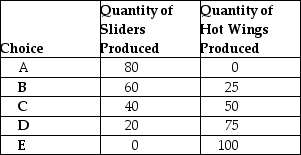 -According to the production possibility model, if more resources are allocated to the production of physical and human capital, then all of the following are likely to happen except
 (Multiple Choice)
4.8/5 (89)
(89) In a production possibilities frontier model, a point ________ the frontier is productively inefficient.
(Multiple Choice)
4.8/5 (62)
(62) Tesla Motors manufacturers its cars at a plant in Fremont, California. At this plant, Tesla is able to take advantage of the high level of technical training possessed by its American workers, but it also sacrifices the ability to pay lower wages had it chosen to open its plant in a low-wage country such as Mexico, India, or China. In deciding to open the Fremont plant, Tesla
(Multiple Choice)
4.9/5 (75)
(75) If opportunity costs are ________, the production possibilities frontier would be graphed as a negatively sloped straight line.
(Multiple Choice)
4.8/5 (82)
(82) In the circular flow model, households demand resources such as labor services in the factor market.
(True/False)
4.8/5 (81)
(81) Table 2-11
 Table 2-11 shows the number of labor hours required to produce a digital camera and a pound of wheat in China and South Korea.
-Refer to Table 2-11. What is South Korea's opportunity cost of producing one digital camera?
Table 2-11 shows the number of labor hours required to produce a digital camera and a pound of wheat in China and South Korea.
-Refer to Table 2-11. What is South Korea's opportunity cost of producing one digital camera? (Multiple Choice)
4.8/5 (78)
(78) Figure 2-19  -Refer to Figure 2-19. Which two arrows in the diagram depict the following transaction: Lizzie Haxem hires "The Paint Pros," a professional painting company, to paint her home.
 (Multiple Choice)
4.9/5 (87)
(87) Figure 2-4  Figure 2-4 shows various points on three different production possibilities frontiers for a nation.
-Refer to Figure 2-4. Consider the following events: a. an increase in the unemployment rate
B. a decrease in a nation's money supply
C. a war that kills a significant portion of a nation's population
Which of the events listed above could cause a movement from Y to W ?
Figure 2-4 shows various points on three different production possibilities frontiers for a nation.
-Refer to Figure 2-4. Consider the following events: a. an increase in the unemployment rate
B. a decrease in a nation's money supply
C. a war that kills a significant portion of a nation's population
Which of the events listed above could cause a movement from Y to W ? (Multiple Choice)
4.8/5 (80)
(80) Figure 2-13  Figure 2-13 shows the production possibilities frontiers for Tahiti and Bora Bora. Each country produces two goods, milk and honey.
-Refer to Figure 2-13. Which country has a comparative advantage in the production of honey?
Figure 2-13 shows the production possibilities frontiers for Tahiti and Bora Bora. Each country produces two goods, milk and honey.
-Refer to Figure 2-13. Which country has a comparative advantage in the production of honey? (Multiple Choice)
4.8/5 (92)
(92) Figure 2-7  Mercedes Benz recently decided to introduce its B-class automobile in the U.S. market, an electric car that is has designed and developed in a partnership with Tesla Motors. Assume Mercedes Benz chooses to produce both electric-engine vehicles and gasoline-engine vehicles. Figure 2-7 shows changes to its production possibilities frontier in response to new developments and different strategic production decisions.
-Refer to Figure 2-7. Assume a technological advancement greatly reduces the cost to produce electric-engine vehicles. This is best represented by the
Mercedes Benz recently decided to introduce its B-class automobile in the U.S. market, an electric car that is has designed and developed in a partnership with Tesla Motors. Assume Mercedes Benz chooses to produce both electric-engine vehicles and gasoline-engine vehicles. Figure 2-7 shows changes to its production possibilities frontier in response to new developments and different strategic production decisions.
-Refer to Figure 2-7. Assume a technological advancement greatly reduces the cost to produce electric-engine vehicles. This is best represented by the (Multiple Choice)
4.7/5 (69)
(69) Any output combination inside a production possibility frontier is associated with unused or underutilized resources.
(True/False)
4.8/5 (86)
(86) Table 2-12
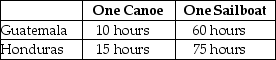 Table 2-12 shows the number of labor hours required to produce a canoe and a sailboat in Guatemala and Honduras.
-Refer to Table 2-12. What is Guatemala's opportunity cost of producing one sailboat?
Table 2-12 shows the number of labor hours required to produce a canoe and a sailboat in Guatemala and Honduras.
-Refer to Table 2-12. What is Guatemala's opportunity cost of producing one sailboat? (Multiple Choice)
4.9/5 (70)
(70) 
Filters
- Essay(0)
- Multiple Choice(0)
- Short Answer(0)
- True False(0)
- Matching(0)