



 Chat with AI
Exam 2: Trade-Offs, Comparative Advantage, and the Market System

Exam 1: Economics: Foundations and Models444 Questions
Exam 2: Trade-Offs, Comparative Advantage, and the Market System498 Questions
Exam 3: Where Prices Come From: the Interaction of Demand and Supply475 Questions
Exam 4: Economic Efficiency, Government Price Setting, and Taxes419 Questions
Exam 5: Externalities, Environmental Policy, and Public Goods266 Questions
Exam 6: Elasticity: the Responsiveness of Demand and Supply295 Questions
Exam 7: The Economics of Health Care334 Questions
Exam 8: Firms, the Stock Market, and Corporate Governance278 Questions
Exam 9: Comparative Advantage and the Gains From International Trade379 Questions
Exam 10: Consumer Choice and Behavioral Economics302 Questions
Exam 11: Technology, Production, and Costs330 Questions
Exam 12: Firms in Perfectly Competitive Markets298 Questions
Exam 13: Monopolistic Competition: the Competitive Model in a More Realistic Setting276 Questions
Exam 14: Oligopoly: Firms in Less Competitive Markets262 Questions
Exam 15: Monopoly and Antitrust Policy271 Questions
Exam 16: Pricing Strategy263 Questions
Exam 17: The Markets for Labor and Other Factors of Production286 Questions
Exam 18: Public Choice, Taxes, and the Distribution of Income258 Questions
Exam 19: GDP: Measuring Total Production and Income266 Questions
Exam 20: Unemployment and Inflation292 Questions
Exam 21: Economic Growth, the Financial System, and Business Cycles257 Questions
Exam 22: Long-Run Economic Growth: Sources and Policies268 Questions
Exam 23: Aggregate Expenditure and Output in the Short Run306 Questions
Exam 24: Aggregate Demand and Aggregate Supply Analysis284 Questions
Exam 25: Money, Banks, and the Federal Reserve System280 Questions
Exam 26: Monetary Policy277 Questions
Exam 27: Fiscal Policy303 Questions
Exam 28: Inflation, Unemployment, and Federal Reserve Policy257 Questions
Exam 29: Macroeconomics in an Open Economy278 Questions
Exam 30: The International Financial System262 Questions
Select questions type


Table 2-13
 Table 2-13 shows the output per day of two pet groomers, Tammi and Horace. They can either devote their time to grooming dogs or bathing cats.
-Refer to Table 2-13. Which of the following statements is true?
Table 2-13 shows the output per day of two pet groomers, Tammi and Horace. They can either devote their time to grooming dogs or bathing cats.
-Refer to Table 2-13. Which of the following statements is true? (Multiple Choice)
4.9/5  (70)
(70) Figure 2-14  Figure 2-14 shows the production possibilities frontiers for Costa Rica and Guatemala. Each country produces two goods, pineapples and coconuts.
-Refer to Figure 2-14. If the two countries have the same amount of resources and the same technological knowledge, which country has an absolute advantage in the production of both pineapples and coconuts?
Figure 2-14 shows the production possibilities frontiers for Costa Rica and Guatemala. Each country produces two goods, pineapples and coconuts.
-Refer to Figure 2-14. If the two countries have the same amount of resources and the same technological knowledge, which country has an absolute advantage in the production of both pineapples and coconuts? (Multiple Choice)
4.9/5 (90)
(90) Figure 2-10  -Refer to Figure 2-10. If the economy is currently producing at point E, what is the opportunity cost of moving to point B?
 (Multiple Choice)
4.8/5 (73)
(73) Figure 2-4  Figure 2-4 shows various points on three different production possibilities frontiers for a nation.
-According to the production possibility model, if more resources are allocated to the production of physical and human capital, then which of the following is likely to happen?
Figure 2-4 shows various points on three different production possibilities frontiers for a nation.
-According to the production possibility model, if more resources are allocated to the production of physical and human capital, then which of the following is likely to happen? (Multiple Choice)
4.9/5 (75)
(75) Table 2-4
Production Choices for Dina's Diner
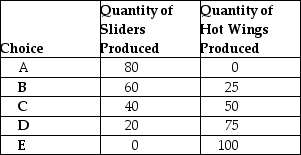 -________ a nation's production possibilities frontier represents economic growth.
 (Multiple Choice)
5.0/5 (68)
(68) An organization of producers that limits the amount of a good produced is known as a
(Multiple Choice)
4.9/5 (76)
(76) Consider the following items: a. the novel The DaVinci Code by Dan Brown
B. the "The Spirited Shipper," an innovative wine shipping box
C. a Swiss chef's award-winning recipe
D. an original fabric design, for example, the fabric used for "Coach" bags and luggage
Which of the items listed is an example of intellectual property?
(Multiple Choice)
4.7/5 (75)
(75) Figure 2-13  Figure 2-13 shows the production possibilities frontiers for Tahiti and Bora Bora. Each country produces two goods, milk and honey.
-Refer to Figure 2-13. What is the opportunity cost of producing one gallon of milk in Bora Bora?
Figure 2-13 shows the production possibilities frontiers for Tahiti and Bora Bora. Each country produces two goods, milk and honey.
-Refer to Figure 2-13. What is the opportunity cost of producing one gallon of milk in Bora Bora? (Multiple Choice)
4.9/5 (85)
(85) Table 2-4
Production Choices for Dina's Diner
-Suppose there is some unemployment in the economy and society decides that it wants more of one good. Which of the following statements is true?
-Suppose there is some unemployment in the economy and society decides that it wants more of one good. Which of the following statements is true? (Multiple Choice)
4.7/5 (83)
(83) Table 2-5
Production choices for Nadia's Neckware
 -Refer to Table 2-5. Assume Nadia's Neckware only produces ascots and bowties. A combination of 24 ascots and 12 bowties would appear
 (Multiple Choice)
4.8/5 (77)
(77) Table 2-16
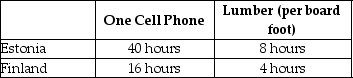 Table 2-16 shows the number of labor hours required to produce a cell phone and a board foot of lumber in Estonia and Finland.
-Refer to Table 2-16. Does either Estonia or Finland have an absolute advantage and if so, in what product?
Table 2-16 shows the number of labor hours required to produce a cell phone and a board foot of lumber in Estonia and Finland.
-Refer to Table 2-16. Does either Estonia or Finland have an absolute advantage and if so, in what product? (Multiple Choice)
4.8/5 (65)
(65) Table 2-10
 Table 2-10 shows the output per month of two people, Fred and Barney. They can either devote their time to making pogo sticks or making unicycles.
-Refer to Table 2-10. What is Fred's opportunity cost of making a unicycle?
Table 2-10 shows the output per month of two people, Fred and Barney. They can either devote their time to making pogo sticks or making unicycles.
-Refer to Table 2-10. What is Fred's opportunity cost of making a unicycle? (Multiple Choice)
5.0/5 (89)
(89) Figure 2-8  Figure 2-8 above shows the production possibilities frontier for Vidalia, a nation that produces two goods, roses and orchids.
-Refer to Figure 2-8. If Vidalia chooses to produce 50 dozen roses, how many orchids can it produce to maximize production?
Figure 2-8 above shows the production possibilities frontier for Vidalia, a nation that produces two goods, roses and orchids.
-Refer to Figure 2-8. If Vidalia chooses to produce 50 dozen roses, how many orchids can it produce to maximize production? (Multiple Choice)
5.0/5 (71)
(71) If a country produces only two goods, then it is not possible to have a comparative advantage in the production of both those goods.
(True/False)
4.8/5 (68)
(68) Table 2-11
 Table 2-11 shows the number of labor hours required to produce a digital camera and a pound of wheat in China and South Korea.
-Refer to Table 2-11. Does either China or South Korea have an absolute advantage and if so, in what product?
Table 2-11 shows the number of labor hours required to produce a digital camera and a pound of wheat in China and South Korea.
-Refer to Table 2-11. Does either China or South Korea have an absolute advantage and if so, in what product? (Multiple Choice)
4.9/5 (81)
(81) Figure 2-6  -Refer to Figure 2-6. If the economy is currently producing at point D, what is the opportunity cost of moving to point B?
 (Multiple Choice)
4.8/5 (69)
(69) Table 2-4
Production Choices for Dina's Diner
-Refer to Table 2-4. Dina faces ________ opportunity costs in the production of sliders and hot wings.
-Refer to Table 2-4. Dina faces ________ opportunity costs in the production of sliders and hot wings. (Multiple Choice)
4.8/5 (80)
(80) Increasing opportunity cost along a bowed out production possibilities frontier occurs because
(Multiple Choice)
4.9/5 (72)
(72) Carmelita can perform either a combination of 35 manicures and 70 pedicures or a combination of 50 manicures and 45 pedicures. If she now performs 35 manicures and 70 pedicures, what is the opportunity cost of performing an additional 15 manicures?
(Multiple Choice)
4.7/5 (89)
(89) 
Filters
- Essay(0)
- Multiple Choice(0)
- Short Answer(0)
- True False(0)
- Matching(0)