



 Chat with AI
Exam 2: Trade-Offs, Comparative Advantage, and the Market System

Exam 1: Economics: Foundations and Models444 Questions
Exam 2: Trade-Offs, Comparative Advantage, and the Market System498 Questions
Exam 3: Where Prices Come From: the Interaction of Demand and Supply475 Questions
Exam 4: Economic Efficiency, Government Price Setting, and Taxes419 Questions
Exam 5: Externalities, Environmental Policy, and Public Goods266 Questions
Exam 6: Elasticity: the Responsiveness of Demand and Supply295 Questions
Exam 7: The Economics of Health Care334 Questions
Exam 8: Firms, the Stock Market, and Corporate Governance278 Questions
Exam 9: Comparative Advantage and the Gains From International Trade379 Questions
Exam 10: Consumer Choice and Behavioral Economics302 Questions
Exam 11: Technology, Production, and Costs330 Questions
Exam 12: Firms in Perfectly Competitive Markets298 Questions
Exam 13: Monopolistic Competition: the Competitive Model in a More Realistic Setting276 Questions
Exam 14: Oligopoly: Firms in Less Competitive Markets262 Questions
Exam 15: Monopoly and Antitrust Policy271 Questions
Exam 16: Pricing Strategy263 Questions
Exam 17: The Markets for Labor and Other Factors of Production286 Questions
Exam 18: Public Choice, Taxes, and the Distribution of Income258 Questions
Exam 19: GDP: Measuring Total Production and Income266 Questions
Exam 20: Unemployment and Inflation292 Questions
Exam 21: Economic Growth, the Financial System, and Business Cycles257 Questions
Exam 22: Long-Run Economic Growth: Sources and Policies268 Questions
Exam 23: Aggregate Expenditure and Output in the Short Run306 Questions
Exam 24: Aggregate Demand and Aggregate Supply Analysis284 Questions
Exam 25: Money, Banks, and the Federal Reserve System280 Questions
Exam 26: Monetary Policy277 Questions
Exam 27: Fiscal Policy303 Questions
Exam 28: Inflation, Unemployment, and Federal Reserve Policy257 Questions
Exam 29: Macroeconomics in an Open Economy278 Questions
Exam 30: The International Financial System262 Questions
Select questions type


Figure 2-19  -All of the following countries come close to the free market benchmark except
 (Multiple Choice)
4.8/5  (66)
(66) Which of the following is not a flow in the circular flow model?
(Multiple Choice)
4.9/5 (72)
(72) Figure 2-11  Mercedes Benz produces a full line of luxury automobiles, including coupes, sedans, and SUVs, at a variety of manufacturing plants across the globe. Assume Mercedes Benz produces both coupes and SUVs at its Tuscaloosa, Alabama factory. Figure 2-11 shows changes to its production possibilities frontier in response to new developments and different strategic production decisions at this factory.
-Refer to Figure 2-11. Suppose Mercedes-Benz has to shut down a portion of its facility as it works on remodeling the facility to merge two of its separate assembly lines in preparation for the production of a new, hybrid models. The production decision to shut down temporarily will result in a
Mercedes Benz produces a full line of luxury automobiles, including coupes, sedans, and SUVs, at a variety of manufacturing plants across the globe. Assume Mercedes Benz produces both coupes and SUVs at its Tuscaloosa, Alabama factory. Figure 2-11 shows changes to its production possibilities frontier in response to new developments and different strategic production decisions at this factory.
-Refer to Figure 2-11. Suppose Mercedes-Benz has to shut down a portion of its facility as it works on remodeling the facility to merge two of its separate assembly lines in preparation for the production of a new, hybrid models. The production decision to shut down temporarily will result in a (Multiple Choice)
4.7/5 (75)
(75) Figure 2-16  -Refer to Figure 2-16. In the circular flow diagram, economic agents M represent
 (Multiple Choice)
4.8/5 (63)
(63) Table 2-20
 Table 2-20 shows the number of labor hours required to produce a wristwatch and a pound of rice in Japan and Thailand.
-Refer to Table 2-20. Does either Japan or Thailand have an absolute advantage and if so, in what product?
Table 2-20 shows the number of labor hours required to produce a wristwatch and a pound of rice in Japan and Thailand.
-Refer to Table 2-20. Does either Japan or Thailand have an absolute advantage and if so, in what product? (Multiple Choice)
4.8/5 (85)
(85) The principle of ________ is that the economic cost of using a factor of production is the alternative use of that factor that is given up.
(Multiple Choice)
4.8/5 (74)
(74) In economics, the term "free market" refers to a market where products are traded but not sold.
(True/False)
4.9/5 (70)
(70) Figure 2-4  Figure 2-4 shows various points on three different production possibilities frontiers for a nation.
-Refer to Figure 2-4. Consider the following events: a. a reduction in the patent protection period to no more than 2 years
B. a war that destroys a substantial portion of a nation's capital stock
C. the lack of secure and enforceable property rights system
Which of the events listed above could cause a movement from W to V?
Figure 2-4 shows various points on three different production possibilities frontiers for a nation.
-Refer to Figure 2-4. Consider the following events: a. a reduction in the patent protection period to no more than 2 years
B. a war that destroys a substantial portion of a nation's capital stock
C. the lack of secure and enforceable property rights system
Which of the events listed above could cause a movement from W to V? (Multiple Choice)
4.8/5 (104)
(104) Figure 2-11 Mercedes Benz produces a full line of luxury automobiles, including coupes, sedans, and SUVs, at a variety of manufacturing plants across the globe. Assume Mercedes Benz produces both coupes and SUVs at its Tuscaloosa, Alabama factory. Figure 2-11 shows changes to its production possibilities frontier in response to new developments and different strategic production decisions at this factory.
-Refer to Figure 2-11. In response to changing consumer demands, Mercedes-Benz cuts back on the production of SUVs and increases its production of coupes. This strategy is best represented by
Mercedes Benz produces a full line of luxury automobiles, including coupes, sedans, and SUVs, at a variety of manufacturing plants across the globe. Assume Mercedes Benz produces both coupes and SUVs at its Tuscaloosa, Alabama factory. Figure 2-11 shows changes to its production possibilities frontier in response to new developments and different strategic production decisions at this factory.
-Refer to Figure 2-11. In response to changing consumer demands, Mercedes-Benz cuts back on the production of SUVs and increases its production of coupes. This strategy is best represented by (Multiple Choice)
4.8/5 (82)
(82) Because the copyright on the L. Frank Baum book The Wonderful Wizard of Oz expired many years ago, the actual written words from the book are in the public domain. Publishers who now choose to sell their own versions of the book
(Multiple Choice)
4.8/5 (75)
(75) Figure 2-2  Figure 2-2 above shows the production possibilities frontier for Mendonca, an agrarian nation that produces two goods, meat and vegetables.
-Refer to Figure 2-2. If Mendonca chooses to produce 160 pounds of vegetables, how much meat can it produce to maximize production?
Figure 2-2 above shows the production possibilities frontier for Mendonca, an agrarian nation that produces two goods, meat and vegetables.
-Refer to Figure 2-2. If Mendonca chooses to produce 160 pounds of vegetables, how much meat can it produce to maximize production? (Multiple Choice)
4.8/5 (74)
(74) Figure 2-8  Figure 2-8 above shows the production possibilities frontier for Vidalia, a nation that produces two goods, roses and orchids.
-Refer to Figure 2-8. What is the opportunity cost of 100 dozen roses?
Figure 2-8 above shows the production possibilities frontier for Vidalia, a nation that produces two goods, roses and orchids.
-Refer to Figure 2-8. What is the opportunity cost of 100 dozen roses? (Multiple Choice)
4.9/5 (86)
(86) How does Adam Smith's idea of the "invisible hand" apply to the various parts, made by many different manufacturers in many different countries, that are used by Apple to produce an iPad?
(Essay)
4.9/5 (70)
(70) Figure 2-17 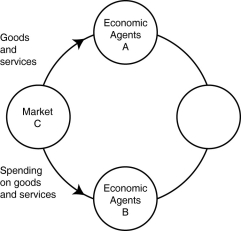 -Refer to Figure 2-17. In the circular flow diagram, who are economic agents A and who are economic agents B?
 (Multiple Choice)
4.9/5 (69)
(69) Should countries specialize in producing goods and services based on having a comparative advantage or an absolute advantage? Why?
(Essay)
4.9/5 (80)
(80) Table 2-14
 Table 2-14 shows the number of labor hours required to produce a motorcycle and a guitar in Ireland and Scotland.
-Refer to Table 2-14. What is Scotland's opportunity cost of producing one motorcycle?
Table 2-14 shows the number of labor hours required to produce a motorcycle and a guitar in Ireland and Scotland.
-Refer to Table 2-14. What is Scotland's opportunity cost of producing one motorcycle? (Multiple Choice)
4.8/5 (84)
(84) a. Draw a production possibilities frontier for a country that produces two goods, beer and pretzels. Assume that resources are equally suited to both tasks.
b. Define opportunity costs.
c. Use your production possibilities frontier graph to demonstrate the principle of opportunity costs.
(Essay)
4.8/5 (80)
(80) 
Filters
- Essay(0)
- Multiple Choice(0)
- Short Answer(0)
- True False(0)
- Matching(0)