



 Chat with AI
Exam 2: Trade-Offs, Comparative Advantage, and the Market System

Exam 1: Economics: Foundations and Models444 Questions
Exam 2: Trade-Offs, Comparative Advantage, and the Market System498 Questions
Exam 3: Where Prices Come From: the Interaction of Demand and Supply475 Questions
Exam 4: Economic Efficiency, Government Price Setting, and Taxes419 Questions
Exam 5: Externalities, Environmental Policy, and Public Goods266 Questions
Exam 6: Elasticity: the Responsiveness of Demand and Supply295 Questions
Exam 7: The Economics of Health Care334 Questions
Exam 8: Firms, the Stock Market, and Corporate Governance278 Questions
Exam 9: Comparative Advantage and the Gains From International Trade379 Questions
Exam 10: Consumer Choice and Behavioral Economics302 Questions
Exam 11: Technology, Production, and Costs330 Questions
Exam 12: Firms in Perfectly Competitive Markets298 Questions
Exam 13: Monopolistic Competition: the Competitive Model in a More Realistic Setting276 Questions
Exam 14: Oligopoly: Firms in Less Competitive Markets262 Questions
Exam 15: Monopoly and Antitrust Policy271 Questions
Exam 16: Pricing Strategy263 Questions
Exam 17: The Markets for Labor and Other Factors of Production286 Questions
Exam 18: Public Choice, Taxes, and the Distribution of Income258 Questions
Exam 19: GDP: Measuring Total Production and Income266 Questions
Exam 20: Unemployment and Inflation292 Questions
Exam 21: Economic Growth, the Financial System, and Business Cycles257 Questions
Exam 22: Long-Run Economic Growth: Sources and Policies268 Questions
Exam 23: Aggregate Expenditure and Output in the Short Run306 Questions
Exam 24: Aggregate Demand and Aggregate Supply Analysis284 Questions
Exam 25: Money, Banks, and the Federal Reserve System280 Questions
Exam 26: Monetary Policy277 Questions
Exam 27: Fiscal Policy303 Questions
Exam 28: Inflation, Unemployment, and Federal Reserve Policy257 Questions
Exam 29: Macroeconomics in an Open Economy278 Questions
Exam 30: The International Financial System262 Questions
Select questions type


Figure 2-12 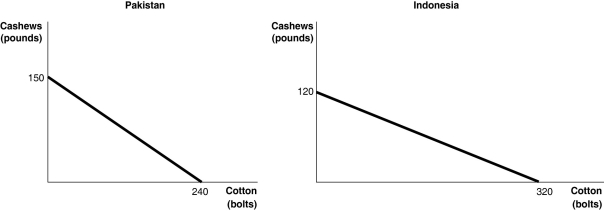 Figure 2-12 shows the production possibilities frontiers for Pakistan and Indonesia. Each country produces two goods, cotton and cashews.
-Refer to Figure 2-12. If the two countries have the same amount of resources and the same technological knowledge, which country has an absolute advantage in the production of cotton?
Figure 2-12 shows the production possibilities frontiers for Pakistan and Indonesia. Each country produces two goods, cotton and cashews.
-Refer to Figure 2-12. If the two countries have the same amount of resources and the same technological knowledge, which country has an absolute advantage in the production of cotton? (Multiple Choice)
4.7/5  (62)
(62) Table 2-15
 Table 2-15 shows the output per day of two gardeners, George and Jack. They can either devote their time to mowing lawns or cultivating gardens.
-For each watch that Switzerland produces, it gives up the opportunity to make 50 pounds of chocolate. Germany can produce 1 watch for every 100 pounds of chocolate it produces. Which of the following is true about the comparative advantage between the two countries?
Table 2-15 shows the output per day of two gardeners, George and Jack. They can either devote their time to mowing lawns or cultivating gardens.
-For each watch that Switzerland produces, it gives up the opportunity to make 50 pounds of chocolate. Germany can produce 1 watch for every 100 pounds of chocolate it produces. Which of the following is true about the comparative advantage between the two countries? (Multiple Choice)
4.9/5 (87)
(87) Figure 2-2  Figure 2-2 above shows the production possibilities frontier for Mendonca, an agrarian nation that produces two goods, meat and vegetables.
-Refer to Figure 2-2. What is the opportunity cost of one pound of vegetables?
Figure 2-2 above shows the production possibilities frontier for Mendonca, an agrarian nation that produces two goods, meat and vegetables.
-Refer to Figure 2-2. What is the opportunity cost of one pound of vegetables? (Multiple Choice)
4.8/5 (74)
(74) Which of the following statements is true about a simple circular flow model?
(Multiple Choice)
4.8/5 (74)
(74) Figure 2-19  -Refer to Figure 2-19. Which two arrows in the diagram depict the following transaction: Myrna earns $450 for working at HempHill's Drug Store.
 (Multiple Choice)
5.0/5 (72)
(72) Stricter laws and regulations to protect intellectual property rights
(Multiple Choice)
4.9/5 (69)
(69) Figure 2-6  -Refer to Figure 2-6. If the economy is currently producing at point C, what is the opportunity cost of moving to point B?
 (Multiple Choice)
5.0/5 (77)
(77) Table 2-4
Production Choices for Dina's Diner
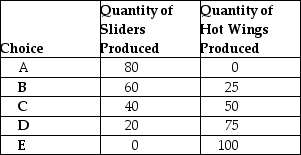 -Refer to Table 2-4. Assume Dina's Diner only produces sliders and hot wings. A combination of 20 sliders and 60 hot wings would appear
 (Multiple Choice)
4.7/5 (90)
(90) Which of the following is an example of spending on factors of production in the circular flow model?
(Multiple Choice)
4.8/5 (79)
(79) Table 2-9
 Table 2-9 shows the output per week of two jewelers, Serena and Haley. They can either devote their time to making bracelets or making necklaces.
-Refer to Table 2-9. What is Haley's opportunity cost of making a necklace?
Table 2-9 shows the output per week of two jewelers, Serena and Haley. They can either devote their time to making bracelets or making necklaces.
-Refer to Table 2-9. What is Haley's opportunity cost of making a necklace? (Multiple Choice)
4.9/5 (76)
(76) Figure 2-1  -Refer to Figure 2-1. ________ is (are) technically efficient.
 (Multiple Choice)
4.8/5 (72)
(72) Table 2-19
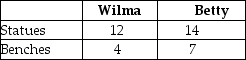 Table 2-19 shows the output per month of two people, Wilma and Betty. They can either devote their time to making marble statues or making marble benches.
-Refer to Table 2-19. What is Betty's opportunity cost of making a bench?
Table 2-19 shows the output per month of two people, Wilma and Betty. They can either devote their time to making marble statues or making marble benches.
-Refer to Table 2-19. What is Betty's opportunity cost of making a bench? (Multiple Choice)
5.0/5 (76)
(76) Entrepreneurs bring together the factors of production to produce goods and services.
(True/False)
4.9/5 (82)
(82) Figure 2-4  Figure 2-4 shows various points on three different production possibilities frontiers for a nation.
-Refer to Figure 2-4. A movement from ________ could occur because of additional government restrictions toward allowing immigrant labor.
Figure 2-4 shows various points on three different production possibilities frontiers for a nation.
-Refer to Figure 2-4. A movement from ________ could occur because of additional government restrictions toward allowing immigrant labor. (Multiple Choice)
4.9/5 (79)
(79) Figure 2-4 Figure 2-4 shows various points on three different production possibilities frontiers for a nation.
-Refer to Figure 2-4. Consider the following movements: a. from point V to point W
B. from point W to point Y
C. from point Y to point Z
Which of the movements listed above represents advancements in technology with respect to only plastic production?
Figure 2-4 shows various points on three different production possibilities frontiers for a nation.
-Refer to Figure 2-4. Consider the following movements: a. from point V to point W
B. from point W to point Y
C. from point Y to point Z
Which of the movements listed above represents advancements in technology with respect to only plastic production? (Multiple Choice)
4.9/5 (72)
(72) Figure 2-8  Figure 2-8 above shows the production possibilities frontier for Vidalia, a nation that produces two goods, roses and orchids.
-Refer to Figure 2-8. What is the opportunity cost of 80 dozen orchids?
Figure 2-8 above shows the production possibilities frontier for Vidalia, a nation that produces two goods, roses and orchids.
-Refer to Figure 2-8. What is the opportunity cost of 80 dozen orchids? (Multiple Choice)
4.8/5 (82)
(82) Table 2-15
Table 2-15 shows the output per day of two gardeners, George and Jack. They can either devote their time to mowing lawns or cultivating gardens.
-Refer to Table 2-15. What is George's opportunity cost of cultivating a garden?
Table 2-15 shows the output per day of two gardeners, George and Jack. They can either devote their time to mowing lawns or cultivating gardens.
-Refer to Table 2-15. What is George's opportunity cost of cultivating a garden? (Multiple Choice)
4.7/5 (83)
(83) Table 2-17
 Table 2-17 shows the output per week of two people, James and Lucy. They can either devote their time to making wagons or making tricycles.
-Refer to Table 2-17. What is James's opportunity cost of making a wagon?
Table 2-17 shows the output per week of two people, James and Lucy. They can either devote their time to making wagons or making tricycles.
-Refer to Table 2-17. What is James's opportunity cost of making a wagon? (Multiple Choice)
4.7/5 (87)
(87) Figure 2-15  Figure 2-15 shows the production possibilities frontiers for Greenland and Iceland. Each country produces two goods, snow cones and popsicles.
-Refer to Figure 2-15. What is the opportunity cost of producing 1 snow cone in Iceland?
Figure 2-15 shows the production possibilities frontiers for Greenland and Iceland. Each country produces two goods, snow cones and popsicles.
-Refer to Figure 2-15. What is the opportunity cost of producing 1 snow cone in Iceland? (Multiple Choice)
4.7/5 (70)
(70) 
Filters
- Essay(0)
- Multiple Choice(0)
- Short Answer(0)
- True False(0)
- Matching(0)