



 Chat with AI
Exam 2: Trade-Offs, Comparative Advantage, and the Market System

Exam 1: Economics: Foundations and Models444 Questions
Exam 2: Trade-Offs, Comparative Advantage, and the Market System498 Questions
Exam 3: Where Prices Come From: the Interaction of Demand and Supply475 Questions
Exam 4: Economic Efficiency, Government Price Setting, and Taxes419 Questions
Exam 5: Externalities, Environmental Policy, and Public Goods266 Questions
Exam 6: Elasticity: the Responsiveness of Demand and Supply295 Questions
Exam 7: The Economics of Health Care334 Questions
Exam 8: Firms, the Stock Market, and Corporate Governance278 Questions
Exam 9: Comparative Advantage and the Gains From International Trade379 Questions
Exam 10: Consumer Choice and Behavioral Economics302 Questions
Exam 11: Technology, Production, and Costs330 Questions
Exam 12: Firms in Perfectly Competitive Markets298 Questions
Exam 13: Monopolistic Competition: the Competitive Model in a More Realistic Setting276 Questions
Exam 14: Oligopoly: Firms in Less Competitive Markets262 Questions
Exam 15: Monopoly and Antitrust Policy271 Questions
Exam 16: Pricing Strategy263 Questions
Exam 17: The Markets for Labor and Other Factors of Production286 Questions
Exam 18: Public Choice, Taxes, and the Distribution of Income258 Questions
Exam 19: GDP: Measuring Total Production and Income266 Questions
Exam 20: Unemployment and Inflation292 Questions
Exam 21: Economic Growth, the Financial System, and Business Cycles257 Questions
Exam 22: Long-Run Economic Growth: Sources and Policies268 Questions
Exam 23: Aggregate Expenditure and Output in the Short Run306 Questions
Exam 24: Aggregate Demand and Aggregate Supply Analysis284 Questions
Exam 25: Money, Banks, and the Federal Reserve System280 Questions
Exam 26: Monetary Policy277 Questions
Exam 27: Fiscal Policy303 Questions
Exam 28: Inflation, Unemployment, and Federal Reserve Policy257 Questions
Exam 29: Macroeconomics in an Open Economy278 Questions
Exam 30: The International Financial System262 Questions
Select questions type


Because the copyright on the L. Frank Baum book The Wonderful Wizard of Oz expired many years ago, the actual written words from the book are in the public domain, which means
(Multiple Choice)
4.9/5  (82)
(82) Figure 2-19  -Refer to Figure 2-19. Which two arrows in the diagram depict the following transaction: Carter earns a $400 commission for selling men's designer shoes at Brooks Brothers.
 (Multiple Choice)
4.9/5 (68)
(68) Table 2-10
 Table 2-10 shows the output per month of two people, Fred and Barney. They can either devote their time to making pogo sticks or making unicycles.
-Refer to Table 2-10. What is Fred's opportunity cost of making a pogo stick?
Table 2-10 shows the output per month of two people, Fred and Barney. They can either devote their time to making pogo sticks or making unicycles.
-Refer to Table 2-10. What is Fred's opportunity cost of making a pogo stick? (Multiple Choice)
5.0/5 (85)
(85) Figure 2-12 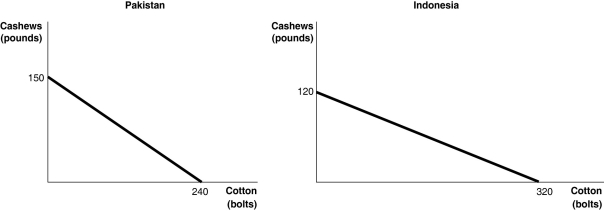 Figure 2-12 shows the production possibilities frontiers for Pakistan and Indonesia. Each country produces two goods, cotton and cashews.
-Refer to Figure 2-12. What is the opportunity cost of producing 1 bolt of cotton in Indonesia?
Figure 2-12 shows the production possibilities frontiers for Pakistan and Indonesia. Each country produces two goods, cotton and cashews.
-Refer to Figure 2-12. What is the opportunity cost of producing 1 bolt of cotton in Indonesia? (Multiple Choice)
4.9/5 (70)
(70) On a diagram of a production possibility frontier, economic decline (negative growth) is represented by the production possibility frontier shifting inward.
(True/False)
4.9/5 (98)
(98) Table 2-12
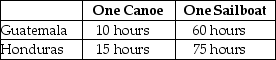 Table 2-12 shows the number of labor hours required to produce a canoe and a sailboat in Guatemala and Honduras.
-Refer to Table 2-12. What is Honduras's opportunity cost of producing one sailboat?
Table 2-12 shows the number of labor hours required to produce a canoe and a sailboat in Guatemala and Honduras.
-Refer to Table 2-12. What is Honduras's opportunity cost of producing one sailboat? (Multiple Choice)
4.8/5 (85)
(85) Table 2-9
 Table 2-9 shows the output per week of two jewelers, Serena and Haley. They can either devote their time to making bracelets or making necklaces.
-Refer to Table 2-9. Which of the following statements is true?
Table 2-9 shows the output per week of two jewelers, Serena and Haley. They can either devote their time to making bracelets or making necklaces.
-Refer to Table 2-9. Which of the following statements is true? (Multiple Choice)
5.0/5 (77)
(77) Figure 2-4  Figure 2-4 shows various points on three different production possibilities frontiers for a nation.
-Refer to Figure 2-4. Consider the following movements: a. from point V to point W
B. from point W to point Y
C. from point Y to point Z
Which of the movements listed above represents advancements in technology with respect to only plastic production?
Figure 2-4 shows various points on three different production possibilities frontiers for a nation.
-Refer to Figure 2-4. Consider the following movements: a. from point V to point W
B. from point W to point Y
C. from point Y to point Z
Which of the movements listed above represents advancements in technology with respect to only plastic production? (Multiple Choice)
4.8/5 (72)
(72) The primary purpose of ________ is to encourage the expenditure of funds on research and development to create new products.
(Multiple Choice)
4.9/5 (76)
(76) The points outside the production possibilities frontier are
(Multiple Choice)
4.8/5 (87)
(87) Figure 2-13  Figure 2-13 shows the production possibilities frontiers for Tahiti and Bora Bora. Each country produces two goods, milk and honey.
-Refer to Figure 2-13. What is the opportunity cost of producing one gallon of honey in Bora Bora?
Figure 2-13 shows the production possibilities frontiers for Tahiti and Bora Bora. Each country produces two goods, milk and honey.
-Refer to Figure 2-13. What is the opportunity cost of producing one gallon of honey in Bora Bora? (Multiple Choice)
4.8/5 (69)
(69) Figure 2-4 Figure 2-4 shows various points on three different production possibilities frontiers for a nation.
-Refer to Figure 2-4. A movement from Y to Z
Figure 2-4 shows various points on three different production possibilities frontiers for a nation.
-Refer to Figure 2-4. A movement from Y to Z (Multiple Choice)
4.8/5 (91)
(91) Which of the following is a flow in the circular flow model?
(Multiple Choice)
4.7/5 (97)
(97) Table 2-15
 Table 2-15 shows the output per day of two gardeners, George and Jack. They can either devote their time to mowing lawns or cultivating gardens.
-Refer to Table 2-15. What is George's opportunity cost of mowing a lawn?
Table 2-15 shows the output per day of two gardeners, George and Jack. They can either devote their time to mowing lawns or cultivating gardens.
-Refer to Table 2-15. What is George's opportunity cost of mowing a lawn? (Multiple Choice)
4.8/5 (85)
(85) For a person to have a comparative advantage in producing a product, he must be able to produce that product at a higher opportunity cost than his competitors.
(True/False)
4.7/5 (76)
(76) The ability to exercise control over one's own resources within the confines of the law refers to
(Multiple Choice)
4.8/5 (93)
(93) The payment received by suppliers of entrepreneurial skills is called wages.
(True/False)
4.7/5 (83)
(83) Increasing opportunity cost is represented by a ________ production possibilities frontier.
(Multiple Choice)
4.9/5 (83)
(83) Table 2-4
Production Choices for Dina's Diner
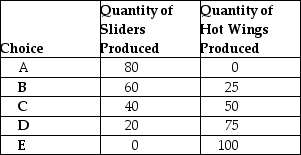 -Without technological advancement, how can a nation achieve economic growth?
 (Multiple Choice)
4.9/5 (69)
(69) 
Filters
- Essay(0)
- Multiple Choice(0)
- Short Answer(0)
- True False(0)
- Matching(0)