



 Chat with AI
Exam 2: Trade-Offs, Comparative Advantage, and the Market System

Exam 1: Economics: Foundations and Models444 Questions
Exam 2: Trade-Offs, Comparative Advantage, and the Market System498 Questions
Exam 3: Where Prices Come From: the Interaction of Demand and Supply475 Questions
Exam 4: Economic Efficiency, Government Price Setting, and Taxes419 Questions
Exam 5: Externalities, Environmental Policy, and Public Goods266 Questions
Exam 6: Elasticity: the Responsiveness of Demand and Supply295 Questions
Exam 7: The Economics of Health Care334 Questions
Exam 8: Firms, the Stock Market, and Corporate Governance278 Questions
Exam 9: Comparative Advantage and the Gains From International Trade379 Questions
Exam 10: Consumer Choice and Behavioral Economics302 Questions
Exam 11: Technology, Production, and Costs330 Questions
Exam 12: Firms in Perfectly Competitive Markets298 Questions
Exam 13: Monopolistic Competition: the Competitive Model in a More Realistic Setting276 Questions
Exam 14: Oligopoly: Firms in Less Competitive Markets262 Questions
Exam 15: Monopoly and Antitrust Policy271 Questions
Exam 16: Pricing Strategy263 Questions
Exam 17: The Markets for Labor and Other Factors of Production286 Questions
Exam 18: Public Choice, Taxes, and the Distribution of Income258 Questions
Exam 19: GDP: Measuring Total Production and Income266 Questions
Exam 20: Unemployment and Inflation292 Questions
Exam 21: Economic Growth, the Financial System, and Business Cycles257 Questions
Exam 22: Long-Run Economic Growth: Sources and Policies268 Questions
Exam 23: Aggregate Expenditure and Output in the Short Run306 Questions
Exam 24: Aggregate Demand and Aggregate Supply Analysis284 Questions
Exam 25: Money, Banks, and the Federal Reserve System280 Questions
Exam 26: Monetary Policy277 Questions
Exam 27: Fiscal Policy303 Questions
Exam 28: Inflation, Unemployment, and Federal Reserve Policy257 Questions
Exam 29: Macroeconomics in an Open Economy278 Questions
Exam 30: The International Financial System262 Questions
Select questions type


Table 2-16
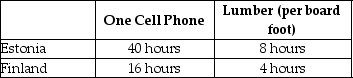 Table 2-16 shows the number of labor hours required to produce a cell phone and a board foot of lumber in Estonia and Finland.
-Refer to Table 2-16. Estonia has a comparative advantage in the production of
Table 2-16 shows the number of labor hours required to produce a cell phone and a board foot of lumber in Estonia and Finland.
-Refer to Table 2-16. Estonia has a comparative advantage in the production of (Multiple Choice)
4.8/5  (82)
(82) Table 2-1
Production choices for Tomaso's Trattoria
 -Refer to Table 2-1. Assume Tomaso's Trattoria only produces pizzas and calzones. A combination of 24 pizzas and 15 calzones would appear
 (Multiple Choice)
4.8/5 (80)
(80) Table 2-16
Table 2-16 shows the number of labor hours required to produce a cell phone and a board foot of lumber in Estonia and Finland.
-Izzy Amador is a highly talented tattoo artist. She has chosen to specialize in tattoo art because of all of the following except
Table 2-16 shows the number of labor hours required to produce a cell phone and a board foot of lumber in Estonia and Finland.
-Izzy Amador is a highly talented tattoo artist. She has chosen to specialize in tattoo art because of all of the following except (Multiple Choice)
4.9/5 (84)
(84) If property rights are not well enforced, all of the following are likely to occur except
(Multiple Choice)
4.9/5 (69)
(69) Figure 2-8  Figure 2-8 above shows the production possibilities frontier for Vidalia, a nation that produces two goods, roses and orchids.
-Refer to Figure 2-8. If Vidalia chooses to produce 60 dozen orchids, how many roses can it produce to maximize production?
Figure 2-8 above shows the production possibilities frontier for Vidalia, a nation that produces two goods, roses and orchids.
-Refer to Figure 2-8. If Vidalia chooses to produce 60 dozen orchids, how many roses can it produce to maximize production? (Multiple Choice)
4.8/5 (81)
(81) Figure 2-5  -Refer to Figure 2-5. If the economy is currently producing at point X, what is the opportunity cost of moving to point Y?
 (Multiple Choice)
4.8/5 (74)
(74) Figure 2-18 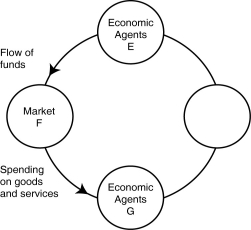 -Refer to Figure 2-18. One segment of the circular flow diagram in the Figure shows the flow of funds from market F to economic agents G. The funds represent spending on goods and services. What is market F and who are economic agents G?
 (Multiple Choice)
4.9/5 (85)
(85) Figure 2-5
-Refer to Figure 2-5. If the economy is currently producing at point W, what is the opportunity cost of moving to point X?
-Refer to Figure 2-5. If the economy is currently producing at point W, what is the opportunity cost of moving to point X? (Multiple Choice)
4.9/5 (78)
(78) Consider a country that produces only two goods: parrots and iguanas. Suppose it is impossible for this country to increase its production of parrots without producing fewer iguanas. In this case, its current output combination is efficient.
(True/False)
4.8/5 (73)
(73) What is a production possibilities frontier? What do points along the frontier represent? What do points inside and outside the frontier represent?
(Essay)
4.8/5 (75)
(75) Suppose your expenses for this term are as follows: tuition: $5,000, room and board: $3,000, books and other educational supplies: $500. Further, during the term, you can only work part-time and earn $4,000 instead of your full-time salary of $10,000. What is the opportunity cost of going to college this term, assuming that your room and board expenses would be the same even if you did not go to college?
(Multiple Choice)
4.9/5 (76)
(76) Article Summary
Since 2008, the United States has been involved in trade negotiations over the Trans-Pacific Partnership (TPP), a free trade agreement with 11 other countries on both sides of the Pacific Ocean. One area of the negotiations involves patents and intellectual property rights in the pharmaceutical industry. A number of developing countries have ignored international agreements concerning patents and intellectual property rights as a way to benefit their domestic pharmaceutical industries, to the detriment of those companies which have spent considerable time and money developing new medicines. For every 5,000 to 10,000 experimental drugs contemplated, only one will typically gain FDA approval, and this occurs only after up to 15 years of research at an average cost of more than $1 billion. Also, 30 percent of the U.S. workforce is either directly or indirectly employed in the pharmaceutical industry, so protection of these intellectual property rights is very important for the U.S. economy.
Source: Doug Schoen, "Intellectual Property Rights Matter," Forbes, September 24, 2013.
-Refer to the Article Summary. If more developing countries began abiding by international agreements which protect intellectual property rights, all of the following would most likely occur except
(Multiple Choice)
4.9/5 (87)
(87) All of the following are examples of spending on factors of production in the circular flow model except
(Multiple Choice)
4.8/5 (66)
(66) Figure 2-1  -Refer to Figure 2-1. ________ is (are) inefficient in that not all resources are being used.
 (Multiple Choice)
5.0/5 (82)
(82) Table 2-4
Production Choices for Dina's Diner
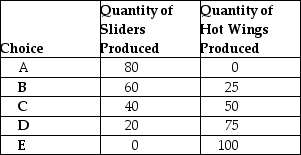 -Which of the following would shift a nation's production possibilities frontier inward?
 (Multiple Choice)
4.8/5 (79)
(79) Suppose your expenses for this term are as follows: tuition: $9,000, room and board: $1,500, books and other educational supplies: $1,000. Further, during the term, you can only work part-time and earn $3,000 instead of your full-time salary of $8,000. What is the opportunity cost of going to college this term, assuming that your room and board expenses would be the same even if you did not go to college?
(Multiple Choice)
4.9/5 (79)
(79) A major factor contributing to the slow growth rate of less developed economies is
(Multiple Choice)
4.9/5 (69)
(69) Figure 2-14  Figure 2-14 shows the production possibilities frontiers for Costa Rica and Guatemala. Each country produces two goods, pineapples and coconuts.
-Refer to Figure 2-14. What is the opportunity cost of producing 1 ton of coconuts in Guatemala?
Figure 2-14 shows the production possibilities frontiers for Costa Rica and Guatemala. Each country produces two goods, pineapples and coconuts.
-Refer to Figure 2-14. What is the opportunity cost of producing 1 ton of coconuts in Guatemala? (Multiple Choice)
4.8/5 (75)
(75) Table 2-16
Table 2-16 shows the number of labor hours required to produce a cell phone and a board foot of lumber in Estonia and Finland.
-Refer to Table 2-16. If the two countries specialize and trade, who should export cell phones?
Table 2-16 shows the number of labor hours required to produce a cell phone and a board foot of lumber in Estonia and Finland.
-Refer to Table 2-16. If the two countries specialize and trade, who should export cell phones? (Multiple Choice)
4.9/5 (68)
(68) 
Filters
- Essay(0)
- Multiple Choice(0)
- Short Answer(0)
- True False(0)
- Matching(0)