



 Chat with AI
Exam 2: Trade-Offs, Comparative Advantage, and the Market System

Exam 1: Economics: Foundations and Models444 Questions
Exam 2: Trade-Offs, Comparative Advantage, and the Market System498 Questions
Exam 3: Where Prices Come From: the Interaction of Demand and Supply475 Questions
Exam 4: Economic Efficiency, Government Price Setting, and Taxes419 Questions
Exam 5: Externalities, Environmental Policy, and Public Goods266 Questions
Exam 6: Elasticity: the Responsiveness of Demand and Supply295 Questions
Exam 7: The Economics of Health Care334 Questions
Exam 8: Firms, the Stock Market, and Corporate Governance278 Questions
Exam 9: Comparative Advantage and the Gains From International Trade379 Questions
Exam 10: Consumer Choice and Behavioral Economics302 Questions
Exam 11: Technology, Production, and Costs330 Questions
Exam 12: Firms in Perfectly Competitive Markets298 Questions
Exam 13: Monopolistic Competition: the Competitive Model in a More Realistic Setting276 Questions
Exam 14: Oligopoly: Firms in Less Competitive Markets262 Questions
Exam 15: Monopoly and Antitrust Policy271 Questions
Exam 16: Pricing Strategy263 Questions
Exam 17: The Markets for Labor and Other Factors of Production286 Questions
Exam 18: Public Choice, Taxes, and the Distribution of Income258 Questions
Exam 19: GDP: Measuring Total Production and Income266 Questions
Exam 20: Unemployment and Inflation292 Questions
Exam 21: Economic Growth, the Financial System, and Business Cycles257 Questions
Exam 22: Long-Run Economic Growth: Sources and Policies268 Questions
Exam 23: Aggregate Expenditure and Output in the Short Run306 Questions
Exam 24: Aggregate Demand and Aggregate Supply Analysis284 Questions
Exam 25: Money, Banks, and the Federal Reserve System280 Questions
Exam 26: Monetary Policy277 Questions
Exam 27: Fiscal Policy303 Questions
Exam 28: Inflation, Unemployment, and Federal Reserve Policy257 Questions
Exam 29: Macroeconomics in an Open Economy278 Questions
Exam 30: The International Financial System262 Questions
Select questions type


Table 2-19
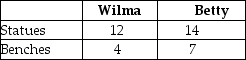 Table 2-19 shows the output per month of two people, Wilma and Betty. They can either devote their time to making marble statues or making marble benches.
-Refer to Table 2-19. What is Wilma's opportunity cost of making a bench?
Table 2-19 shows the output per month of two people, Wilma and Betty. They can either devote their time to making marble statues or making marble benches.
-Refer to Table 2-19. What is Wilma's opportunity cost of making a bench?
Free
(Multiple Choice)
4.7/5  (79)
(79) Correct Answer: Verified
B
________ exists because unlimited wants exceed the limited resources available to fulfill those wants.
Free
(Multiple Choice)
4.8/5 (71)
(71) Correct Answer:Verified
VerifiedA
Table 2-20
 Table 2-20 shows the number of labor hours required to produce a wristwatch and a pound of rice in Japan and Thailand.
-Refer to Table 2-20. If the two countries specialize and trade, who should export wristwatches?
Table 2-20 shows the number of labor hours required to produce a wristwatch and a pound of rice in Japan and Thailand.
-Refer to Table 2-20. If the two countries specialize and trade, who should export wristwatches?Free
(Multiple Choice)
4.8/5 (75)
(75) Correct Answer:Verified
VerifiedC
Table 2-4
Production Choices for Dina's Diner
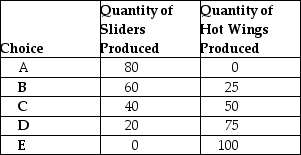 -Refer to Table 2-4. Assume Dina's Diner only produces sliders and hot wings. A combination of 50 sliders and 50 hot wings would appear
 (Multiple Choice)
4.8/5 (85)
(85) A critical function of the government in facilitating the operation of a market economy is
(Multiple Choice)
4.8/5 (78)
(78) If the opportunity cost of producing more of one good increases as more of that good is produced, then the production method is inefficient.
(True/False)
4.8/5 (69)
(69) Table 2-15
 Table 2-15 shows the output per day of two gardeners, George and Jack. They can either devote their time to mowing lawns or cultivating gardens.
-Refer to Table 2-15. Which of the following statements is true?
Table 2-15 shows the output per day of two gardeners, George and Jack. They can either devote their time to mowing lawns or cultivating gardens.
-Refer to Table 2-15. Which of the following statements is true? (Multiple Choice)
4.8/5 (80)
(80) Figure 2-3 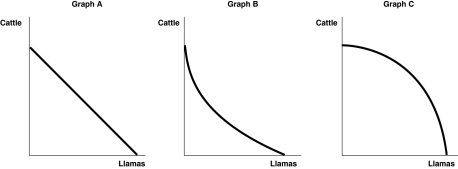 -Refer to Figure 2-3. Sergio Vignetto raises cattle and llamas on his land. A portion of his land is more suitable for raising cattle, and the other portion is better suited for raising llamas. Which of the graphs in Figure 2-3 represent(s) his production possibilities frontier?
 (Multiple Choice)
4.8/5 (78)
(78) In economics, the term "free market" refers to a market where no sales tax is imposed on products sold.
(True/False)
4.8/5 (81)
(81) An inward shift of the production possibilities frontier represents
(Multiple Choice)
4.9/5 (77)
(77) Table 2-20
Table 2-20 shows the number of labor hours required to produce a wristwatch and a pound of rice in Japan and Thailand.
-Refer to Table 2-20. Thailand has a comparative advantage in the production of
Table 2-20 shows the number of labor hours required to produce a wristwatch and a pound of rice in Japan and Thailand.
-Refer to Table 2-20. Thailand has a comparative advantage in the production of (Multiple Choice)
4.9/5 (70)
(70) The unattainable points in a production possibilities diagram are
(Multiple Choice)
4.8/5 (78)
(78) Table 2-3
Production Choices for Dina's Diner
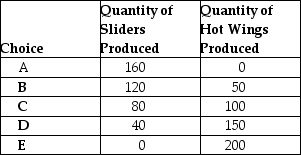 -Refer to Table 2-3. Dina faces ________ opportunity costs in the production of sliders and hot wings.
 (Multiple Choice)
4.9/5 (88)
(88) Figure 2-17 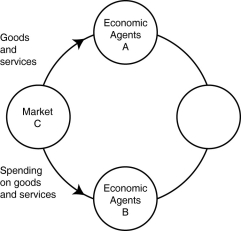 -Refer to Figure 2-17. One segment of the circular flow diagram in the figure shows the flow of goods and services from market C to economic agents A. What is market C and who are economic agents A?
 (Multiple Choice)
4.9/5 (79)
(79) Table 2-12
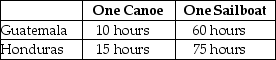 Table 2-12 shows the number of labor hours required to produce a canoe and a sailboat in Guatemala and Honduras.
-Refer to Table 2-12. What is Honduras's opportunity cost of producing one canoe?
Table 2-12 shows the number of labor hours required to produce a canoe and a sailboat in Guatemala and Honduras.
-Refer to Table 2-12. What is Honduras's opportunity cost of producing one canoe? (Multiple Choice)
4.9/5 (83)
(83) Figure 2-18 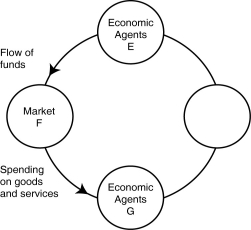 -Refer to Figure 2-18. One segment of the circular flow diagram in the figure shows the flow of funds from economic agents E to market F. Who are economic agents E and what is market F?
 (Multiple Choice)
4.9/5 (82)
(82) Table 2-16
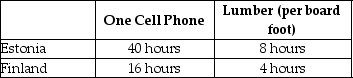 Table 2-16 shows the number of labor hours required to produce a cell phone and a board foot of lumber in Estonia and Finland.
-Refer to Table 2-16. Finland has a comparative advantage in the production of
Table 2-16 shows the number of labor hours required to produce a cell phone and a board foot of lumber in Estonia and Finland.
-Refer to Table 2-16. Finland has a comparative advantage in the production of (Multiple Choice)
4.8/5 (88)
(88) Figure 2-12 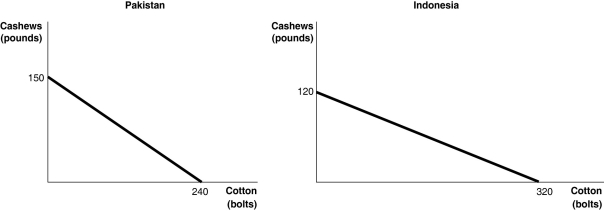 Figure 2-12 shows the production possibilities frontiers for Pakistan and Indonesia. Each country produces two goods, cotton and cashews.
-Refer to Figure 2-12. What is the opportunity cost of producing 1 bolt of cotton in Pakistan?
Figure 2-12 shows the production possibilities frontiers for Pakistan and Indonesia. Each country produces two goods, cotton and cashews.
-Refer to Figure 2-12. What is the opportunity cost of producing 1 bolt of cotton in Pakistan? (Multiple Choice)
4.9/5 (82)
(82) 
Filters
- Essay(0)
- Multiple Choice(0)
- Short Answer(0)
- True False(0)
- Matching(0)