



 Chat with AI
Exam 2: Trade-Offs, Comparative Advantage, and the Market System

Exam 1: Economics: Foundations and Models444 Questions
Exam 2: Trade-Offs, Comparative Advantage, and the Market System498 Questions
Exam 3: Where Prices Come From: the Interaction of Demand and Supply475 Questions
Exam 4: Economic Efficiency, Government Price Setting, and Taxes419 Questions
Exam 5: Externalities, Environmental Policy, and Public Goods266 Questions
Exam 6: Elasticity: the Responsiveness of Demand and Supply295 Questions
Exam 7: The Economics of Health Care334 Questions
Exam 8: Firms, the Stock Market, and Corporate Governance278 Questions
Exam 9: Comparative Advantage and the Gains From International Trade379 Questions
Exam 10: Consumer Choice and Behavioral Economics302 Questions
Exam 11: Technology, Production, and Costs330 Questions
Exam 12: Firms in Perfectly Competitive Markets298 Questions
Exam 13: Monopolistic Competition: the Competitive Model in a More Realistic Setting276 Questions
Exam 14: Oligopoly: Firms in Less Competitive Markets262 Questions
Exam 15: Monopoly and Antitrust Policy271 Questions
Exam 16: Pricing Strategy263 Questions
Exam 17: The Markets for Labor and Other Factors of Production286 Questions
Exam 18: Public Choice, Taxes, and the Distribution of Income258 Questions
Exam 19: GDP: Measuring Total Production and Income266 Questions
Exam 20: Unemployment and Inflation292 Questions
Exam 21: Economic Growth, the Financial System, and Business Cycles257 Questions
Exam 22: Long-Run Economic Growth: Sources and Policies268 Questions
Exam 23: Aggregate Expenditure and Output in the Short Run306 Questions
Exam 24: Aggregate Demand and Aggregate Supply Analysis284 Questions
Exam 25: Money, Banks, and the Federal Reserve System280 Questions
Exam 26: Monetary Policy277 Questions
Exam 27: Fiscal Policy303 Questions
Exam 28: Inflation, Unemployment, and Federal Reserve Policy257 Questions
Exam 29: Macroeconomics in an Open Economy278 Questions
Exam 30: The International Financial System262 Questions
Select questions type


Table 2-2
Production choices for Billie's Bedroom Shop
 -Refer to Table 2-2. Assume Billie's Bedroom Shop only produces pillows and blankets. A combination of 9 pillows and 21 blankets would appear
 (Multiple Choice)
4.8/5  (82)
(82) If a country is producing efficiently and is on the production possibilities frontier, the country can produce more of one good without producing less of the other good.
(True/False)
4.8/5 (77)
(77) Table 2-9
 Table 2-9 shows the output per week of two jewelers, Serena and Haley. They can either devote their time to making bracelets or making necklaces.
-Refer to Table 2-9. What is Serena's opportunity cost of making a bracelet?
Table 2-9 shows the output per week of two jewelers, Serena and Haley. They can either devote their time to making bracelets or making necklaces.
-Refer to Table 2-9. What is Serena's opportunity cost of making a bracelet? (Multiple Choice)
4.8/5 (65)
(65) Table 2-15
 Table 2-15 shows the output per day of two gardeners, George and Jack. They can either devote their time to mowing lawns or cultivating gardens.
-Refer to Table 2-15. What is Jack's opportunity cost of mowing a lawn?
Table 2-15 shows the output per day of two gardeners, George and Jack. They can either devote their time to mowing lawns or cultivating gardens.
-Refer to Table 2-15. What is Jack's opportunity cost of mowing a lawn? (Multiple Choice)
4.8/5 (77)
(77) Table 2-19
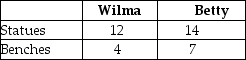 Table 2-19 shows the output per month of two people, Wilma and Betty. They can either devote their time to making marble statues or making marble benches.
-Refer to Table 2-19. What is Wilma's opportunity cost of making a statue?
Table 2-19 shows the output per month of two people, Wilma and Betty. They can either devote their time to making marble statues or making marble benches.
-Refer to Table 2-19. What is Wilma's opportunity cost of making a statue? (Multiple Choice)
4.8/5 (80)
(80) Figure 2-11  Mercedes Benz produces a full line of luxury automobiles, including coupes, sedans, and SUVs, at a variety of manufacturing plants across the globe. Assume Mercedes Benz produces both coupes and SUVs at its Tuscaloosa, Alabama factory. Figure 2-11 shows changes to its production possibilities frontier in response to new developments and different strategic production decisions at this factory.
-Any output combination outside a production possibility frontier is associated with unused or underutilized resources.
Mercedes Benz produces a full line of luxury automobiles, including coupes, sedans, and SUVs, at a variety of manufacturing plants across the globe. Assume Mercedes Benz produces both coupes and SUVs at its Tuscaloosa, Alabama factory. Figure 2-11 shows changes to its production possibilities frontier in response to new developments and different strategic production decisions at this factory.
-Any output combination outside a production possibility frontier is associated with unused or underutilized resources. (True/False)
4.8/5 (92)
(92) Consider a country that produces only two goods: bird feeders and binoculars. Suppose it is possible for this country to increase its production of bird feeders without producing fewer binoculars. In this case, its current output combination is inefficient.
(True/False)
4.9/5 (80)
(80) Table 2-4
Production Choices for Dina's Diner
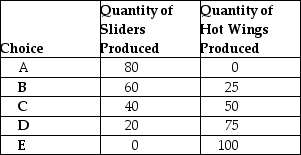 -Refer to Table 2-4. Assume Dina's Diner only produces sliders and hot wings. A combination of 60 sliders and 25 hot wings would appear
 (Multiple Choice)
5.0/5 (80)
(80) Table 2-18
 Table 2-18 shows the output per week of two people, Minnie and Mickey. They can either devote their time to making hats or making umbrellas.
-Refer to Table 2-18. Which of the following statements is true?
Table 2-18 shows the output per week of two people, Minnie and Mickey. They can either devote their time to making hats or making umbrellas.
-Refer to Table 2-18. Which of the following statements is true? (Multiple Choice)
4.9/5 (83)
(83) Rayburn Reed is a highly talented photographer. He has chosen to specialize in photography because of all of the following except
(Multiple Choice)
4.9/5 (87)
(87) The resource income earned by those who supply ________ is called wages.
(Multiple Choice)
4.9/5 (65)
(65) If a country produces only two goods, then it is not possible to have an absolute advantage in the production of both those goods.
(True/False)
4.8/5 (75)
(75) Adam Smith, the father of modern economics, wrote in his book, An Inquiry into the Nature and Causes of the Wealth of Nations, "It is not from the benevolence of the butcher, the brewer, or the baker, that we expect our dinner but from their regard to their own interest." Explain what he meant by that statement and how such behavior promotes the wealth of a nation.
(Essay)
4.9/5 (85)
(85) Table 2-2
Production choices for Billie's Bedroom Shop
-Refer to Table 2-2. Assume Billie's Bedroom Shop only produces pillows and blankets. A combination of 9 pillows and 14 blankets would appear
-Refer to Table 2-2. Assume Billie's Bedroom Shop only produces pillows and blankets. A combination of 9 pillows and 14 blankets would appear (Multiple Choice)
4.9/5 (92)
(92) Figure 2-2  Figure 2-2 above shows the production possibilities frontier for Mendonca, an agrarian nation that produces two goods, meat and vegetables.
-Refer to Figure 2-2. Suppose Mendonca is currently producing 60 pounds of vegetables per period. How much meat is it also producing, assuming that resources are fully utilized?
Figure 2-2 above shows the production possibilities frontier for Mendonca, an agrarian nation that produces two goods, meat and vegetables.
-Refer to Figure 2-2. Suppose Mendonca is currently producing 60 pounds of vegetables per period. How much meat is it also producing, assuming that resources are fully utilized? (Multiple Choice)
4.8/5 (75)
(75) Figure 2-15  Figure 2-15 shows the production possibilities frontiers for Greenland and Iceland. Each country produces two goods, snow cones and popsicles.
-Refer to Figure 2-15. What is the opportunity cost of producing 1 popsicle in Iceland?
Figure 2-15 shows the production possibilities frontiers for Greenland and Iceland. Each country produces two goods, snow cones and popsicles.
-Refer to Figure 2-15. What is the opportunity cost of producing 1 popsicle in Iceland? (Multiple Choice)
4.7/5 (87)
(87) Figure 2-8  Figure 2-8 above shows the production possibilities frontier for Vidalia, a nation that produces two goods, roses and orchids.
-Refer to Figure 2-8. Suppose Vidalia is currently producing 60 dozen orchids per period. How many roses is it also producing, assuming that resources are fully utilized?
Figure 2-8 above shows the production possibilities frontier for Vidalia, a nation that produces two goods, roses and orchids.
-Refer to Figure 2-8. Suppose Vidalia is currently producing 60 dozen orchids per period. How many roses is it also producing, assuming that resources are fully utilized? (Multiple Choice)
4.8/5 (76)
(76) Which of the following statements about an entrepreneur is false?
(Multiple Choice)
4.8/5 (83)
(83) 
Filters
- Essay(0)
- Multiple Choice(0)
- Short Answer(0)
- True False(0)
- Matching(0)