



 Chat with AI
Exam 2: Trade-Offs, Comparative Advantage, and the Market System

Exam 1: Economics: Foundations and Models444 Questions
Exam 2: Trade-Offs, Comparative Advantage, and the Market System498 Questions
Exam 3: Where Prices Come From: the Interaction of Demand and Supply475 Questions
Exam 4: Economic Efficiency, Government Price Setting, and Taxes419 Questions
Exam 5: Externalities, Environmental Policy, and Public Goods266 Questions
Exam 6: Elasticity: the Responsiveness of Demand and Supply295 Questions
Exam 7: The Economics of Health Care334 Questions
Exam 8: Firms, the Stock Market, and Corporate Governance278 Questions
Exam 9: Comparative Advantage and the Gains From International Trade379 Questions
Exam 10: Consumer Choice and Behavioral Economics302 Questions
Exam 11: Technology, Production, and Costs330 Questions
Exam 12: Firms in Perfectly Competitive Markets298 Questions
Exam 13: Monopolistic Competition: the Competitive Model in a More Realistic Setting276 Questions
Exam 14: Oligopoly: Firms in Less Competitive Markets262 Questions
Exam 15: Monopoly and Antitrust Policy271 Questions
Exam 16: Pricing Strategy263 Questions
Exam 17: The Markets for Labor and Other Factors of Production286 Questions
Exam 18: Public Choice, Taxes, and the Distribution of Income258 Questions
Exam 19: GDP: Measuring Total Production and Income266 Questions
Exam 20: Unemployment and Inflation292 Questions
Exam 21: Economic Growth, the Financial System, and Business Cycles257 Questions
Exam 22: Long-Run Economic Growth: Sources and Policies268 Questions
Exam 23: Aggregate Expenditure and Output in the Short Run306 Questions
Exam 24: Aggregate Demand and Aggregate Supply Analysis284 Questions
Exam 25: Money, Banks, and the Federal Reserve System280 Questions
Exam 26: Monetary Policy277 Questions
Exam 27: Fiscal Policy303 Questions
Exam 28: Inflation, Unemployment, and Federal Reserve Policy257 Questions
Exam 29: Macroeconomics in an Open Economy278 Questions
Exam 30: The International Financial System262 Questions
Select questions type


Which of the following is an example of spending on goods and services in the circular flow model?
(Multiple Choice)
4.9/5  (78)
(78) It is possible to have an absolute advantage in producing a good or service without having a comparative advantage.
(True/False)
4.7/5 (75)
(75) Table 2-5
Production choices for Nadia's Neckware
 -Refer to Table 2-5. Assume Nadia's Neckware only produces ascots and bowties. A combination of 16 ascots and 6 bowties would appear
 (Multiple Choice)
4.9/5 (77)
(77) To increase gas mileage, automobile manufacturers make cars small and light. Large cars absorb more of the impact of an accident than small cars but yield lower gas mileage. These facts suggest that a positive relationship exists between safety and gas mileage.
(True/False)
4.8/5 (76)
(76) If additional units of a good could be produced at an increasing opportunity cost, the production possibility frontier would be linear.
(True/False)
4.9/5 (102)
(102) Figure 2-4  Figure 2-4 shows various points on three different production possibilities frontiers for a nation.
-Refer to Figure 2-4. Consider the following events: a. an increase in the patent protection period to 30 years
B. an increase of a nation's capital stock
C. an improved property rights system
Which of the events listed above could cause a movement from V to W?
Figure 2-4 shows various points on three different production possibilities frontiers for a nation.
-Refer to Figure 2-4. Consider the following events: a. an increase in the patent protection period to 30 years
B. an increase of a nation's capital stock
C. an improved property rights system
Which of the events listed above could cause a movement from V to W? (Multiple Choice)
4.9/5 (72)
(72) Table 2-10
 Table 2-10 shows the output per month of two people, Fred and Barney. They can either devote their time to making pogo sticks or making unicycles.
-Refer to Table 2-10. What is Barney's opportunity cost of making a pogo stick?
Table 2-10 shows the output per month of two people, Fred and Barney. They can either devote their time to making pogo sticks or making unicycles.
-Refer to Table 2-10. What is Barney's opportunity cost of making a pogo stick? (Multiple Choice)
4.9/5 (81)
(81) Figure 2-4 Figure 2-4 shows various points on three different production possibilities frontiers for a nation.
-Refer to Figure 2-4. Consider the following events: a. an increase in the unemployment rate
B. general technological advancement
C. a decrease in consumer wealth
Which of the events listed above could cause a movement from X to V?
Figure 2-4 shows various points on three different production possibilities frontiers for a nation.
-Refer to Figure 2-4. Consider the following events: a. an increase in the unemployment rate
B. general technological advancement
C. a decrease in consumer wealth
Which of the events listed above could cause a movement from X to V? (Multiple Choice)
4.9/5 (77)
(77) Figure 2-4 Figure 2-4 shows various points on three different production possibilities frontiers for a nation.
-Refer to Figure 2-4. Consider the following events: a. a decrease in the unemployment rate
B. general technological advancement
C. an increase in consumer wealth
Which of the events listed above could cause a movement from V to X?
Figure 2-4 shows various points on three different production possibilities frontiers for a nation.
-Refer to Figure 2-4. Consider the following events: a. a decrease in the unemployment rate
B. general technological advancement
C. an increase in consumer wealth
Which of the events listed above could cause a movement from V to X? (Multiple Choice)
4.7/5 (80)
(80) In a free market there are virtually no restrictions, or at best few restrictions, on how factors of production can be employed.
(True/False)
4.9/5 (75)
(75) Figure 2-8  Figure 2-8 above shows the production possibilities frontier for Vidalia, a nation that produces two goods, roses and orchids.
-Refer to Figure 2-8. If Vidalia chooses to produce 40 dozen orchids, how many roses can it produce to maximize production?
Figure 2-8 above shows the production possibilities frontier for Vidalia, a nation that produces two goods, roses and orchids.
-Refer to Figure 2-8. If Vidalia chooses to produce 40 dozen orchids, how many roses can it produce to maximize production? (Multiple Choice)
4.9/5 (70)
(70) Table 2-10
Table 2-10 shows the output per month of two people, Fred and Barney. They can either devote their time to making pogo sticks or making unicycles.
-Refer to Table 2-10. Which of the following statements is true?
Table 2-10 shows the output per month of two people, Fred and Barney. They can either devote their time to making pogo sticks or making unicycles.
-Refer to Table 2-10. Which of the following statements is true? (Multiple Choice)
4.8/5 (80)
(80) A successful market economy requires well defined property rights and
(Multiple Choice)
4.9/5 (88)
(88) It is not possible to have a comparative advantage in producing a good or service without having an absolute advantage.
(True/False)
4.7/5 (69)
(69) Table 2-20
 Table 2-20 shows the number of labor hours required to produce a wristwatch and a pound of rice in Japan and Thailand.
-Refer to Table 2-20. Japan has a comparative advantage in the production of
Table 2-20 shows the number of labor hours required to produce a wristwatch and a pound of rice in Japan and Thailand.
-Refer to Table 2-20. Japan has a comparative advantage in the production of (Multiple Choice)
4.8/5 (93)
(93) Table 2-2
Production choices for Billie's Bedroom Shop
 -Refer to Table 2-2. Assume Billie's Bedroom Shop only produces pillows and blankets. A combination of 5 pillows and 21 blankets would appear
 (Multiple Choice)
4.9/5 (69)
(69) Table 2-7
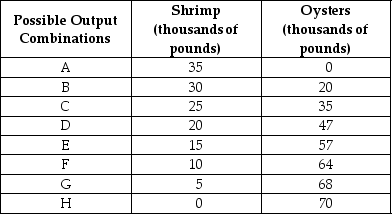 -Refer to Table 2-7. The Shellfish Shack produces only shrimp and oysters. The table above shows the maximum possible output combinations of the two types of shellfish using all resources and currently available technology.
a. Suppose The Shellfish Shack is currently producing at point E. What is the opportunity cost of producing an additional 11,000 pounds of oysters?
b. Suppose The Shellfish Shack is currently producing at point E. What happens to the opportunity cost of producing more and more shrimp? Does it increase, decrease or remain constant? Explain your answer.
c. Suppose The Shellfish Shack is currently producing at point B. What happens to the opportunity cost of producing more and more oysters? Does it increase, decrease or remain constant? Explain your answer.
d. Suppose The Shellfish Shack is plagued by a disease which destroys oyster beds but not shrimp habitats. What would happen to its PPF?
-Refer to Table 2-7. The Shellfish Shack produces only shrimp and oysters. The table above shows the maximum possible output combinations of the two types of shellfish using all resources and currently available technology.
a. Suppose The Shellfish Shack is currently producing at point E. What is the opportunity cost of producing an additional 11,000 pounds of oysters?
b. Suppose The Shellfish Shack is currently producing at point E. What happens to the opportunity cost of producing more and more shrimp? Does it increase, decrease or remain constant? Explain your answer.
c. Suppose The Shellfish Shack is currently producing at point B. What happens to the opportunity cost of producing more and more oysters? Does it increase, decrease or remain constant? Explain your answer.
d. Suppose The Shellfish Shack is plagued by a disease which destroys oyster beds but not shrimp habitats. What would happen to its PPF? (Essay)
4.9/5 (73)
(73) If a country is producing efficiently and is on the production possibilities frontier, the only way to produce more of one good is with an advance in technology.
(True/False)
4.8/5 (74)
(74) Table 2-4
Production Choices for Dina's Diner
 -Economic growth is represented on a production possibilities frontier model by the production possibility frontier
 (Multiple Choice)
4.9/5 (83)
(83) 
Filters
- Essay(0)
- Multiple Choice(0)
- Short Answer(0)
- True False(0)
- Matching(0)