



 Chat with AI
Exam 17: The Markets for Labor and Other Factors of Production

Exam 1: Economics: Foundations and Models444 Questions
Exam 2: Trade-Offs, Comparative Advantage, and the Market System498 Questions
Exam 3: Where Prices Come From: the Interaction of Demand and Supply475 Questions
Exam 4: Economic Efficiency, Government Price Setting, and Taxes419 Questions
Exam 5: Externalities, Environmental Policy, and Public Goods266 Questions
Exam 6: Elasticity: the Responsiveness of Demand and Supply295 Questions
Exam 7: The Economics of Health Care334 Questions
Exam 8: Firms, the Stock Market, and Corporate Governance278 Questions
Exam 9: Comparative Advantage and the Gains From International Trade379 Questions
Exam 10: Consumer Choice and Behavioral Economics302 Questions
Exam 11: Technology, Production, and Costs330 Questions
Exam 12: Firms in Perfectly Competitive Markets298 Questions
Exam 13: Monopolistic Competition: the Competitive Model in a More Realistic Setting276 Questions
Exam 14: Oligopoly: Firms in Less Competitive Markets262 Questions
Exam 15: Monopoly and Antitrust Policy271 Questions
Exam 16: Pricing Strategy263 Questions
Exam 17: The Markets for Labor and Other Factors of Production286 Questions
Exam 18: Public Choice, Taxes, and the Distribution of Income258 Questions
Exam 19: GDP: Measuring Total Production and Income266 Questions
Exam 20: Unemployment and Inflation292 Questions
Exam 21: Economic Growth, the Financial System, and Business Cycles257 Questions
Exam 22: Long-Run Economic Growth: Sources and Policies268 Questions
Exam 23: Aggregate Expenditure and Output in the Short Run306 Questions
Exam 24: Aggregate Demand and Aggregate Supply Analysis284 Questions
Exam 25: Money, Banks, and the Federal Reserve System280 Questions
Exam 26: Monetary Policy277 Questions
Exam 27: Fiscal Policy303 Questions
Exam 28: Inflation, Unemployment, and Federal Reserve Policy257 Questions
Exam 29: Macroeconomics in an Open Economy278 Questions
Exam 30: The International Financial System262 Questions
Select questions type


An increase in the price of grape juice causes an increase in the marginal revenue product of labor used to produce grape juice.

Free
(True/False)
4.8/5  (70)
(70) Correct Answer: Verified
True
If the labor demand curve shifts to the right and the labor supply curve remains unchanged, what will happen to the equilibrium wage and the equilibrium level of employment? Illustrate your answer with a graph.
Free
(Essay)
4.8/5 (79)
(79) Correct Answer:Verified
VerifiedThe equilibrium wage will rise from W1 to W2 and the equilibrium level of employment will rise from L1 to L2. 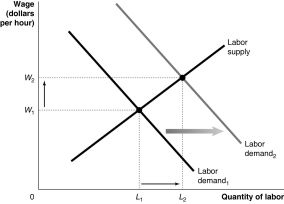
Increases in population shift the market supply curve for labor to the right.
Free
(True/False)
4.8/5 (87)
(87) Correct Answer:Verified
VerifiedTrue
Figure 17-3  -Refer to Figure 17-3. Which of the panels in the diagram best represents an individual's labor supply curve?
 (Multiple Choice)
4.9/5 (78)
(78) Major League Baseball teams are similar to other firms in that they use factors of production to produce a product (baseball games). An example of capital used by teams to produce their products is
(Multiple Choice)
4.8/5 (70)
(70) Table 17-3
 Hotspur Incorporated, a manufacturer of microwave ovens, is a price taker in its input and output markets. The firm hires labor at a constant wage rate of $800 per week and sells microwave ovens at a constant price of $80. Table 17-3 shows the relationship between the quantity of labor it hires and the quantity of microwave ovens it produces.
-Refer to Table 17-3. What is the amount of profit added as a result of hiring the fourth worker?
Hotspur Incorporated, a manufacturer of microwave ovens, is a price taker in its input and output markets. The firm hires labor at a constant wage rate of $800 per week and sells microwave ovens at a constant price of $80. Table 17-3 shows the relationship between the quantity of labor it hires and the quantity of microwave ovens it produces.
-Refer to Table 17-3. What is the amount of profit added as a result of hiring the fourth worker? (Multiple Choice)
4.8/5 (78)
(78) Suppose a competitive firm is paying a wage of $12 an hour. Assume that labor is the only input. If hiring another worker would increase output by four units per hour, then to maximize profits the firm should
(Multiple Choice)
4.9/5 (84)
(84) The demand for labor is different from the demand for final goods and services because
(Multiple Choice)
5.0/5 (85)
(85) The success of Walt Disney's animated film The Lion King in 1994, increased production of animated films, increasing the demand for animators much faster than the supply of animators was increasing. As a result, in the market for animators, the equilibrium wage fell and the equilibrium quantity increased.
(True/False)
4.9/5 (74)
(74) The Equal Pay Act of 1963 requires that men and women be given equal pay for equal work in the same establishment. Most people agree that gender discrimination in the workplace is unfair, but many economists have criticized advocates of comparable worth. Is paying the same wages for jobs that have comparable worth mandated by the Equal Pay Act? Why don't most economists support proposals to force employers to pay their male and female employees based on comparable worth rules?
(Essay)
4.7/5 (64)
(64) Hotspur Incorporated, a manufacturer of microwaves, is a price taker in both the input and output markets. To maximize its profit, Hotspur will hire labor up to the point where
(Multiple Choice)
4.8/5 (86)
(86) Let MP = marginal product, P = output price, and W = wage; then the equation that represents the condition where a competitive firm would hire another worker is
(Multiple Choice)
4.9/5 (85)
(85) Marginal revenue product can be calculated using the formula marginal product × output price
(Multiple Choice)
4.9/5 (83)
(83) If workers in nuclear power plants underestimate the true risk of their jobs,
(Multiple Choice)
4.8/5 (84)
(84) Consider the market for nurses in a given city. In each of the following cases, explain what happens to the equilibrium wage rate and the quantity of nurses hired.
a. One of the major hospitals in the city closes.
b. A record number of students graduate with bachelor's degrees in nursing.
c. Traditionally, nursing is a field that attracts women. However, changes in access to education and to the labor force participation rate by women have led to a greater demand for the services of women in a wide range of occupations. The demand for nurses, however, does not change.
d. Advances in medical technology reduce the amount of time physicians must spend with patients in intensive care and increase the time that nurses spend with patients.
(Essay)
4.8/5 (96)
(96) In the medical profession, pediatricians receive lower salaries than cardiologists. Suppose the government passes comparable worth legislation that requires hospitals to pay pediatricians the same salaries as cardiologists. Explain the effect of this legislation and illustrate your answer with demand and supply graphs for the following two scenarios:
a. Hospitals respond by placing salaries at a level between the two existing salaries.
b. Hospitals respond by placing pediatricians' salaries at the initial level of cardiologists.
(Essay)
4.9/5 (74)
(74) 
Filters
- Essay(0)
- Multiple Choice(0)
- Short Answer(0)
- True False(0)
- Matching(0)