



 Chat with AI
Exam 17: Biological Diversity, Bacteria, and Archaea

Exam 1: The Nature of Science and the Characteristics of Life80 Questions
Exam 2: The Chemistry of Life93 Questions
Exam 3: Cell Structure and Internal Compartments89 Questions
Exam 4: Cell Membranes, Transport, and Communication89 Questions
Exam 5: Energy, Metabolism, and Enzymes85 Questions
Exam 6: Photosynthesis and Cellular Respiration89 Questions
Exam 7: Cell Division84 Questions
Exam 8: Cancer and Human Health86 Questions
Exam 9: Patterns of Inheritance86 Questions
Exam 10: Chromosomes and Human Genetics77 Questions
Exam 11: DNA and Genes83 Questions
Exam 12: From Gene to Protein88 Questions
Exam 13: DNA Technology96 Questions
Exam 14: How Evolution Works72 Questions
Exam 15: The Origin of Species76 Questions
Exam 16: The Evolution of Biodiversity102 Questions
Exam 17: Biological Diversity, Bacteria, and Archaea80 Questions
Exam 18: Protista, Plantae, and Fungi83 Questions
Exam 19: Animalia80 Questions
Exam 20: The Biosphere88 Questions
Exam 21: Growth of Populations70 Questions
Exam 22: Animal Behavior82 Questions
Exam 23: Ecological Communities105 Questions
Exam 24: Ecosystems74 Questions
Exam 25: Global Change73 Questions
Exam 26: Internal Organization and Homeostasis75 Questions
Exam 27: Nutrition and Digestion81 Questions
Exam 28: Circulation and Gas Exchange77 Questions
Exam 29: Animal Hormones79 Questions
Exam 30: Nervous and Sensory Systems76 Questions
Exam 31: Skeletons,Muscles,and Movement77 Questions
Exam 32: The Immune System80 Questions
Exam 33: Reproduction and Development86 Questions
Exam 34: Plant Structure, Nutrition, and Transport80 Questions
Exam 35: Plant Growth and Reproduction81 Questions
Select questions type


Sometimes antiviral drugs stop working because viruses can evolve and become ________ to the drug.
(Short Answer)
5.0/5  (94)
(94) The bacteria Clostridium tetani forms spore in the presence of oxygen.This indicates that these bacteria are
(Multiple Choice)
4.9/5 (80)
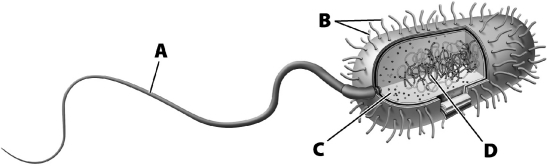
(80) The structure labeled A,below,is cilia,used by both prokaryotes and eukaryotes to move through fluid.
(True/False)
4.8/5 (80)
(80) The organisms found living inside boiling-hot geysers can be described as thermophiles.
(True/False)
4.8/5 (92)
(92) Viruses may rapidly evolve resistance to vaccines and medications by modifying their DNA;what mechanism(s)do they use?
(Multiple Choice)
4.9/5 (70)
(70) The status of viruses has been controversial,but most biologists now agree that the most appropriate description for a virus is a microscopic,________ infective particle.
(Short Answer)
4.9/5 (88)
(88) Using the simplest methods to study the composition of intestinal microbial flora,it is necessary to collect a ________ sample from the subject.
(Short Answer)
4.9/5 (81)
(81) A disproportionate number of viral infections occur in the respiratory and digestive systems;how might this be explained?
(Multiple Choice)
4.8/5 (83)
(83) Wetland soils are saturated with water and devoid of oxygen,creating a habitat ideally suited for ________ organisms.
(Short Answer)
4.8/5 (94)
(94) Which of the following pairs of kingdoms would be included exclusively in the domain Eukarya?
(Multiple Choice)
4.9/5 (81)
(81) Which of the following is NOT part of the modern system of biological classification?
(Multiple Choice)
4.8/5 (74)
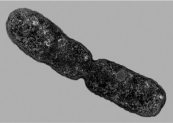
(74) The following figure shows a bacterium dividing by binary fission.The DNA in the daughter cell formed on the left is ________ to the DNA in the daughter cell to the right.
(Short Answer)
4.9/5 (89)
(89) A disease-causing cellular organism is found in the lungs of a patient with a respiratory infection.This cellular organism in most likely a(n)
(Multiple Choice)
4.8/5 (74)
(74) The infective strategy seen in the retroviruses does not involve ________ the host cell.
(Multiple Choice)
4.9/5 (71)
(71) New bacteria are identified in the large intestines of a healthy person.Are the bacteria likely to be a human pathogen?
(Multiple Choice)
4.9/5 (80)
(80) In addition to the Bacteria,which other kingdom is composed exclusively of prokaryotic organisms?
(Multiple Choice)
4.8/5 (95)
(95) Drugs that are produced by living organisms that are effective against bacteria,but not viruses,are known as ________.
(Short Answer)
4.8/5 (87)
(87) 
Filters
- Essay(0)
- Multiple Choice(0)
- Short Answer(0)
- True False(0)
- Matching(0)