



 Chat with AI
Exam 8: Cancer and Human Health

Exam 1: The Nature of Science and the Characteristics of Life80 Questions
Exam 2: The Chemistry of Life93 Questions
Exam 3: Cell Structure and Internal Compartments89 Questions
Exam 4: Cell Membranes, Transport, and Communication89 Questions
Exam 5: Energy, Metabolism, and Enzymes85 Questions
Exam 6: Photosynthesis and Cellular Respiration89 Questions
Exam 7: Cell Division84 Questions
Exam 8: Cancer and Human Health86 Questions
Exam 9: Patterns of Inheritance86 Questions
Exam 10: Chromosomes and Human Genetics77 Questions
Exam 11: DNA and Genes83 Questions
Exam 12: From Gene to Protein88 Questions
Exam 13: DNA Technology96 Questions
Exam 14: How Evolution Works72 Questions
Exam 15: The Origin of Species76 Questions
Exam 16: The Evolution of Biodiversity102 Questions
Exam 17: Biological Diversity, Bacteria, and Archaea80 Questions
Exam 18: Protista, Plantae, and Fungi83 Questions
Exam 19: Animalia80 Questions
Exam 20: The Biosphere88 Questions
Exam 21: Growth of Populations70 Questions
Exam 22: Animal Behavior82 Questions
Exam 23: Ecological Communities105 Questions
Exam 24: Ecosystems74 Questions
Exam 25: Global Change73 Questions
Exam 26: Internal Organization and Homeostasis75 Questions
Exam 27: Nutrition and Digestion81 Questions
Exam 28: Circulation and Gas Exchange77 Questions
Exam 29: Animal Hormones79 Questions
Exam 30: Nervous and Sensory Systems76 Questions
Exam 31: Skeletons,Muscles,and Movement77 Questions
Exam 32: The Immune System80 Questions
Exam 33: Reproduction and Development86 Questions
Exam 34: Plant Structure, Nutrition, and Transport80 Questions
Exam 35: Plant Growth and Reproduction81 Questions
Select questions type


The chance of developing cervical cancer is reduced by ________ against the human papillomavirus.

Free
(Short Answer)
4.9/5  (90)
(90) Correct Answer: Verified
vaccination
Cancer cells can ________,or spread,to other organs where they can form new tumors.
Free
(Short Answer)
4.9/5 (70)
(70) Correct Answer:Verified
Verifiedmetastasize
A harmless proliferation of cells in a human colon would be called a(n)________ polyp.
(Short Answer)
4.9/5 (70)
(70) A protein is identified that starts a signal cascade leading to the activation of a gene that promotes cell division.This protein is coded for by a
(Multiple Choice)
4.9/5 (81)
(81) The binding of a growth factor to a receptor protein on the surface of a cell results in signal transduction that affects gene expression in the cell.
(True/False)
4.7/5 (77)
(77) Examine the following diagram.The Y-shaped anticancer antibodies in the diagram do not cause cell death in healthy cells because healthy cells do not
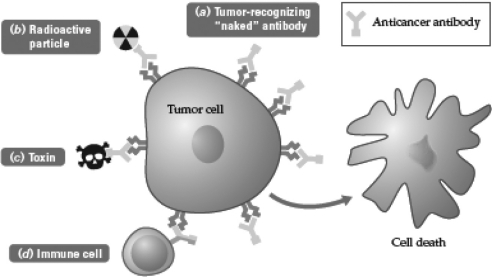
(Multiple Choice)
4.7/5 (73)
(73) Examine the following diagram.Which is most likely to have occurred in panel 2,depicting tumor formation?
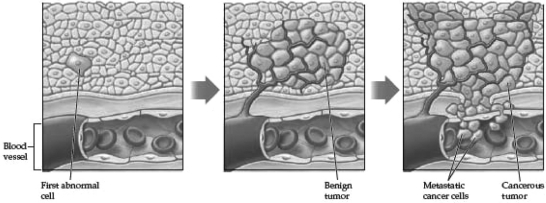
(Multiple Choice)
4.8/5 (88)
(88) The fact that the human genome contains proto-oncogenes means that
(Multiple Choice)
4.7/5 (83)
(83) For a virus to reproduce,it must insert its DNA into the host cell's genome,sometimes leading to activation of host cell genes.Which of the following host cell genes,when activated,would most likely result in cancer?
(Multiple Choice)
4.9/5 (71)
(71) For cancer to form in the presence of a tumor suppressor gene,which of the following is necessary?
(Multiple Choice)
4.8/5 (85)
(85) The cells in many late-stage precancerous polyps in the human colon usually contain
(Multiple Choice)
4.8/5 (81)
(81) Growth factors,which often participate in signal cascades,are typically active
(Multiple Choice)
4.7/5 (93)
(93) Proto-oncogenes,which produce many of the proteins used in a signal cascade,are found
(Multiple Choice)
4.9/5 (74)
(74) One reason the Federal Drug Administration recommends Gardasil for males is that the human papillomavirus can cause penile cancer.
(True/False)
4.7/5 (79)
(79) 
Filters
- Essay(0)
- Multiple Choice(0)
- Short Answer(0)
- True False(0)
- Matching(0)