



 Chat with AI
Exam 29: Animal Hormones

Exam 1: The Nature of Science and the Characteristics of Life80 Questions
Exam 2: The Chemistry of Life93 Questions
Exam 3: Cell Structure and Internal Compartments89 Questions
Exam 4: Cell Membranes, Transport, and Communication89 Questions
Exam 5: Energy, Metabolism, and Enzymes85 Questions
Exam 6: Photosynthesis and Cellular Respiration89 Questions
Exam 7: Cell Division84 Questions
Exam 8: Cancer and Human Health86 Questions
Exam 9: Patterns of Inheritance86 Questions
Exam 10: Chromosomes and Human Genetics77 Questions
Exam 11: DNA and Genes83 Questions
Exam 12: From Gene to Protein88 Questions
Exam 13: DNA Technology96 Questions
Exam 14: How Evolution Works72 Questions
Exam 15: The Origin of Species76 Questions
Exam 16: The Evolution of Biodiversity102 Questions
Exam 17: Biological Diversity, Bacteria, and Archaea80 Questions
Exam 18: Protista, Plantae, and Fungi83 Questions
Exam 19: Animalia80 Questions
Exam 20: The Biosphere88 Questions
Exam 21: Growth of Populations70 Questions
Exam 22: Animal Behavior82 Questions
Exam 23: Ecological Communities105 Questions
Exam 24: Ecosystems74 Questions
Exam 25: Global Change73 Questions
Exam 26: Internal Organization and Homeostasis75 Questions
Exam 27: Nutrition and Digestion81 Questions
Exam 28: Circulation and Gas Exchange77 Questions
Exam 29: Animal Hormones79 Questions
Exam 30: Nervous and Sensory Systems76 Questions
Exam 31: Skeletons,Muscles,and Movement77 Questions
Exam 32: The Immune System80 Questions
Exam 33: Reproduction and Development86 Questions
Exam 34: Plant Structure, Nutrition, and Transport80 Questions
Exam 35: Plant Growth and Reproduction81 Questions
Select questions type


Human growth hormone can decrease body fat and increase muscle mass.

Free
(True/False)
4.8/5  (89)
(89) Correct Answer: Verified
True
The high levels of progesterone seen after ovulation in the human female are produced by a specific region of the ovary known as the ________,which disappears if pregnancy does NOT occur.
Free
(Short Answer)
4.9/5 (82)
(82) Correct Answer:Verified
Verifiedcorpus luteum
The graph below shows the levels of estrogen and progesterone over the course of the menstrual cycle.
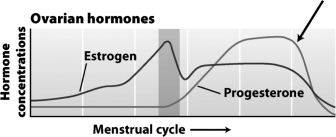 What event is caused by the rapid decrease in hormones in the region indicated by the arrow in the upper right portion of the graph?
Free
(Multiple Choice)
5.0/5 (74)
(74) Correct Answer:Verified
VerifiedB
Which of the following choices best explains how one hormone can regulate several different developmental events?
(Multiple Choice)
4.8/5 (88)
(88) When blood glucose levels drop to a set point,the production of insulin drops off.This is an example of
(Multiple Choice)
4.8/5 (84)
(84) Four to six weeks after conception,sex hormones trigger the production of the appropriate male or female ________,or sex organs,in an embryo.
(Short Answer)
4.7/5 (86)
(86) A(n)________ is a specialized organ in which hormones are produced.
(Short Answer)
4.9/5 (83)
(83) In human females,the release of an egg from its follicle is called ________.
(Short Answer)
4.8/5 (73)
(73) A single hormone can have different effects on different tissues.
(True/False)
4.9/5 (92)
(92) The pancreas regulates ________ levels in the blood by producing a pair of antagonistic hormones.
(Short Answer)
4.9/5 (79)
(79) Which of the following statements about the human reproductive system is true?
(Multiple Choice)
4.9/5 (77)
(77) Inadequate amounts of one hormone does NOT affect production of another hormone.
(True/False)
5.0/5 (80)
(80) Antidiuretic hormone (ADH)is produced by the pituitary gland when the brain detects lower than optimum levels of water in the body.In the kidneys,ADH promotes the uptake of water,creating more concentrated urine.ADH travels from the pituitary gland to the kidney through the ________ system.
(Multiple Choice)
4.8/5 (81)
(81) 
Filters
- Essay(0)
- Multiple Choice(0)
- Short Answer(0)
- True False(0)
- Matching(0)