



 Chat with AI
Exam 32: The Immune System

Exam 1: The Nature of Science and the Characteristics of Life80 Questions
Exam 2: The Chemistry of Life93 Questions
Exam 3: Cell Structure and Internal Compartments89 Questions
Exam 4: Cell Membranes, Transport, and Communication89 Questions
Exam 5: Energy, Metabolism, and Enzymes85 Questions
Exam 6: Photosynthesis and Cellular Respiration89 Questions
Exam 7: Cell Division84 Questions
Exam 8: Cancer and Human Health86 Questions
Exam 9: Patterns of Inheritance86 Questions
Exam 10: Chromosomes and Human Genetics77 Questions
Exam 11: DNA and Genes83 Questions
Exam 12: From Gene to Protein88 Questions
Exam 13: DNA Technology96 Questions
Exam 14: How Evolution Works72 Questions
Exam 15: The Origin of Species76 Questions
Exam 16: The Evolution of Biodiversity102 Questions
Exam 17: Biological Diversity, Bacteria, and Archaea80 Questions
Exam 18: Protista, Plantae, and Fungi83 Questions
Exam 19: Animalia80 Questions
Exam 20: The Biosphere88 Questions
Exam 21: Growth of Populations70 Questions
Exam 22: Animal Behavior82 Questions
Exam 23: Ecological Communities105 Questions
Exam 24: Ecosystems74 Questions
Exam 25: Global Change73 Questions
Exam 26: Internal Organization and Homeostasis75 Questions
Exam 27: Nutrition and Digestion81 Questions
Exam 28: Circulation and Gas Exchange77 Questions
Exam 29: Animal Hormones79 Questions
Exam 30: Nervous and Sensory Systems76 Questions
Exam 31: Skeletons,Muscles,and Movement77 Questions
Exam 32: The Immune System80 Questions
Exam 33: Reproduction and Development86 Questions
Exam 34: Plant Structure, Nutrition, and Transport80 Questions
Exam 35: Plant Growth and Reproduction81 Questions
Select questions type


Which of the following would explain why organ donors and organ recipients are genetically matched before an organ transplant is performed?

Free
(Multiple Choice)
4.8/5  (74)
(74) Correct Answer: Verified
B
Which of the following immune cells is likely to be the first to encounter the pathogen during a bacterial infection?
Free
(Multiple Choice)
4.8/5 (74)
(74) Correct Answer:Verified
VerifiedB
Some individuals may share one or more self-antigen components with one another;if so,they are much better candidates for tissue transplants (donor-recipient)than those with no similarities at all.
Free
(True/False)
4.9/5 (69)
(69) Correct Answer:Verified
VerifiedTrue
The immune system can recognize almost all foreign cells because they lack the genetically determined pattern of ________ and ________ found on the plasma membrane of its own cells.
(Short Answer)
4.9/5 (80)
(80) Macrophages are smaller than neutrophils but have a similar function.
(True/False)
4.8/5 (81)
(81) Which of the following areas of the human body is NOT the location of a major concentration of white blood cells?
(Multiple Choice)
4.9/5 (89)
(89) A variety of strategies have been utilized for the preparation of vaccines,but regardless of the method used to prepare it,one feature shared in common by all vaccines is that each contains one or more ________ from the targeted pathogen.
(Short Answer)
4.8/5 (74)
(74) 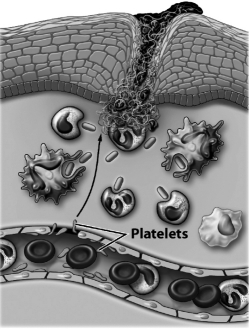
Which of the following statements about an adaptive response to an invasive single-celled pathogen or virus is FALSE?
(Multiple Choice)
4.8/5 (75)
(75) Folklore has produced this advice: "Starve a cold,feed a fever." Based on your knowledge of immune action,how would you evaluate the suggestion of eating less?
(Multiple Choice)
4.8/5 (79)
(79) The diagnosis of cancer represents a failure of the body's cancer ________ system.
(Short Answer)
4.8/5 (69)
(69) HIV attacks B lymphocytes;this lowers the effectiveness of the antibody-mediated response but leaves cell-mediated immunity entirely intact.
(True/False)
5.0/5 (85)
(85) During a major infection a fever often develops.What best explains the origin of this change in body temperature?
(Multiple Choice)
4.7/5 (80)
(80) The graph below depicts the change in antibody concentration following an initial and a later pathogen exposure.
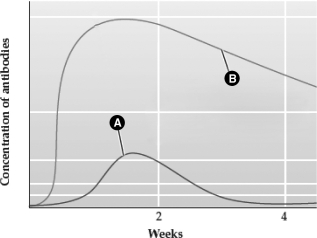 The line labeled with the letter ________ represents the response after the initial exposure.
 (Short Answer)
4.9/5 (74)
(74) Vaccinations are required prior to traveling to many foreign locations;the goal of vaccination is to create populations of memory cells,so that any future exposure to the pathogen produces a secondary rather than primary response.
(True/False)
4.9/5 (79)
(79) On occasion the immune response in inappropriate;for example,an allergy occurs when the immune system
(Multiple Choice)
4.7/5 (92)
(92) After the initial exposure to a pathogen,subsequent infections with the same pathogen are unlikely because the initial response produced a small population of fast-acting lymphocytes known as ________.
(Short Answer)
4.9/5 (78)
(78) 
Filters
- Essay(0)
- Multiple Choice(0)
- Short Answer(0)
- True False(0)
- Matching(0)