



 Chat with AI
Exam 34: Plant Structure, Nutrition, and Transport

Exam 1: The Nature of Science and the Characteristics of Life80 Questions
Exam 2: The Chemistry of Life93 Questions
Exam 3: Cell Structure and Internal Compartments89 Questions
Exam 4: Cell Membranes, Transport, and Communication89 Questions
Exam 5: Energy, Metabolism, and Enzymes85 Questions
Exam 6: Photosynthesis and Cellular Respiration89 Questions
Exam 7: Cell Division84 Questions
Exam 8: Cancer and Human Health86 Questions
Exam 9: Patterns of Inheritance86 Questions
Exam 10: Chromosomes and Human Genetics77 Questions
Exam 11: DNA and Genes83 Questions
Exam 12: From Gene to Protein88 Questions
Exam 13: DNA Technology96 Questions
Exam 14: How Evolution Works72 Questions
Exam 15: The Origin of Species76 Questions
Exam 16: The Evolution of Biodiversity102 Questions
Exam 17: Biological Diversity, Bacteria, and Archaea80 Questions
Exam 18: Protista, Plantae, and Fungi83 Questions
Exam 19: Animalia80 Questions
Exam 20: The Biosphere88 Questions
Exam 21: Growth of Populations70 Questions
Exam 22: Animal Behavior82 Questions
Exam 23: Ecological Communities105 Questions
Exam 24: Ecosystems74 Questions
Exam 25: Global Change73 Questions
Exam 26: Internal Organization and Homeostasis75 Questions
Exam 27: Nutrition and Digestion81 Questions
Exam 28: Circulation and Gas Exchange77 Questions
Exam 29: Animal Hormones79 Questions
Exam 30: Nervous and Sensory Systems76 Questions
Exam 31: Skeletons,Muscles,and Movement77 Questions
Exam 32: The Immune System80 Questions
Exam 33: Reproduction and Development86 Questions
Exam 34: Plant Structure, Nutrition, and Transport80 Questions
Exam 35: Plant Growth and Reproduction81 Questions
Select questions type


Which plant does NOT capture prey?

Free
(Multiple Choice)
4.8/5  (78)
(78) Correct Answer: Verified
D
A flowering plant with leaves containing parallel veins is most likely a dicot.
Free
(True/False)
4.8/5 (80)
(80) Correct Answer:Verified
VerifiedFalse
Dermal hairs are more common on plants living at high elevations because at higher elevations
Free
(Multiple Choice)
4.8/5 (65)
(65) Correct Answer:Verified
VerifiedD
________ is the evaporation of water from the surface of a leaf.
(Short Answer)
5.0/5 (71)
(71) Worldwide,humans obtain more than 80 percent of their calories from
(Multiple Choice)
5.0/5 (77)
(77) The cells of the xylem are dead at functional maturity.This allows
(Multiple Choice)
5.0/5 (77)
(77) Why do some plants,like beans and peas,contain bacteria in compartments in their roots?
(Multiple Choice)
4.9/5 (72)
(72) Sieve pores are a modification seen in vascular tissue that facilitate the movement of
(Multiple Choice)
4.7/5 (90)
(90) Aristotle showed that plants get most of what they need to grow from the air.
(True/False)
4.9/5 (67)
(67) Examine the plant in the figure below.
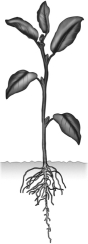 The plant shown is most likely a dicot because of the presence of
 (Multiple Choice)
4.8/5 (80)
(80) The difference in ________ between the sugar-loading zone and the sugar-unloading zone drives the long-distance transport of sugars through the phloem.
(Short Answer)
4.9/5 (66)
(66) Carnivorous plants are often found in habitats deficient in nitrogen and phosphorus.
(True/False)
4.9/5 (81)
(81) In the diagram below of a leaf,which letter indicates dermal tissue?
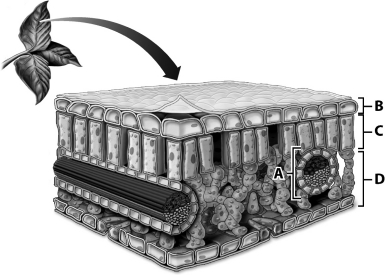
(Multiple Choice)
4.9/5 (79)
(79) When tension is produced during ________,a column of water is able to extend and move all the way from the roots through the xylem.
(Short Answer)
4.8/5 (80)
(80) Root caps are aided by mucilage in order to move in abrasive soil.
(True/False)
4.8/5 (80)
(80) 
Filters
- Essay(0)
- Multiple Choice(0)
- Short Answer(0)
- True False(0)
- Matching(0)