



 Chat with AI
Exam 34: Plant Structure, Nutrition, and Transport

Exam 1: The Nature of Science and the Characteristics of Life80 Questions
Exam 2: The Chemistry of Life93 Questions
Exam 3: Cell Structure and Internal Compartments89 Questions
Exam 4: Cell Membranes, Transport, and Communication89 Questions
Exam 5: Energy, Metabolism, and Enzymes85 Questions
Exam 6: Photosynthesis and Cellular Respiration89 Questions
Exam 7: Cell Division84 Questions
Exam 8: Cancer and Human Health86 Questions
Exam 9: Patterns of Inheritance86 Questions
Exam 10: Chromosomes and Human Genetics77 Questions
Exam 11: DNA and Genes83 Questions
Exam 12: From Gene to Protein88 Questions
Exam 13: DNA Technology96 Questions
Exam 14: How Evolution Works72 Questions
Exam 15: The Origin of Species76 Questions
Exam 16: The Evolution of Biodiversity102 Questions
Exam 17: Biological Diversity, Bacteria, and Archaea80 Questions
Exam 18: Protista, Plantae, and Fungi83 Questions
Exam 19: Animalia80 Questions
Exam 20: The Biosphere88 Questions
Exam 21: Growth of Populations70 Questions
Exam 22: Animal Behavior82 Questions
Exam 23: Ecological Communities105 Questions
Exam 24: Ecosystems74 Questions
Exam 25: Global Change73 Questions
Exam 26: Internal Organization and Homeostasis75 Questions
Exam 27: Nutrition and Digestion81 Questions
Exam 28: Circulation and Gas Exchange77 Questions
Exam 29: Animal Hormones79 Questions
Exam 30: Nervous and Sensory Systems76 Questions
Exam 31: Skeletons,Muscles,and Movement77 Questions
Exam 32: The Immune System80 Questions
Exam 33: Reproduction and Development86 Questions
Exam 34: Plant Structure, Nutrition, and Transport80 Questions
Exam 35: Plant Growth and Reproduction81 Questions
Select questions type


The basic plant body consists of a root system and a ________ system.
(Short Answer)
4.8/5  (92)
(92) Venus flytraps are known to have captured and consumed small mammals.
(True/False)
4.8/5 (83)
(83) Most aboveground plant growth occurs with the repeated addition of ________ units.
(Short Answer)
5.0/5 (90)
(90) What process powers water transport from the root to shoot of a plant?
(Multiple Choice)
4.9/5 (86)
(86) Fibrous root systems have one predominant root and many smaller roots near the top of the main root.
(True/False)
4.8/5 (99)
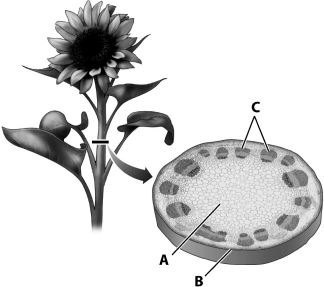
(99) The type of plant tissue indicated by the letter A in the diagram below of a plant stem is ground tissue.
(True/False)
4.8/5 (78)
(78) Leafhoppers feed on the contents of tracheids and vessels.The concentration of organic material in these plant components is
(Multiple Choice)
4.8/5 (77)
(77) Trees,although immobile,can take defensive measures against harmful insects.
(True/False)
4.8/5 (74)
(74) Some plants house bacteria in compartments in their roots.These bacteria benefit the plant because they are capable of performing ________,making the macronutrient nitrogen available to the plant.
(Short Answer)
4.8/5 (90)
(90) In the figure below,the line with the arrows indicates the cell-wall pathway for an absorbed nutrient.
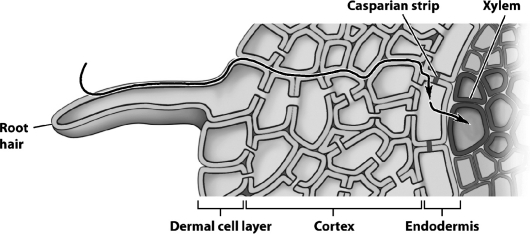 What structure actually regulates the entry of nutrients into the plant's interior?
 (Multiple Choice)
4.9/5 (81)
(81) What best explains why sugar maple trees are tapped on the sun-warmed south side of the trunk?
(Multiple Choice)
4.9/5 (94)
(94) The vascular tissue responsible for transporting sugars is known as
(Multiple Choice)
4.9/5 (88)
(88) Like other organisms,plants are composed of proteins,lipids,carbohydrates,and nucleic acids.Based on this,which of the following would be a macronutrient?
(Multiple Choice)
4.8/5 (80)
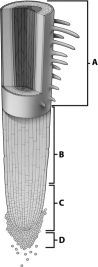
(80) Examine the diagram below of a root tip.Which letter in the diagram indicates the zone of cell division?
(Multiple Choice)
4.8/5 (66)
(66) Why is it important that the cells of the phloem remain alive?
(Multiple Choice)
4.8/5 (85)
(85) The uptake of nutrients by roots requires energy because the
(Multiple Choice)
4.8/5 (75)
(75) 
Filters
- Essay(0)
- Multiple Choice(0)
- Short Answer(0)
- True False(0)
- Matching(0)