



 Chat with AI
Exam 26: Internal Organization and Homeostasis

Exam 1: The Nature of Science and the Characteristics of Life80 Questions
Exam 2: The Chemistry of Life93 Questions
Exam 3: Cell Structure and Internal Compartments89 Questions
Exam 4: Cell Membranes, Transport, and Communication89 Questions
Exam 5: Energy, Metabolism, and Enzymes85 Questions
Exam 6: Photosynthesis and Cellular Respiration89 Questions
Exam 7: Cell Division84 Questions
Exam 8: Cancer and Human Health86 Questions
Exam 9: Patterns of Inheritance86 Questions
Exam 10: Chromosomes and Human Genetics77 Questions
Exam 11: DNA and Genes83 Questions
Exam 12: From Gene to Protein88 Questions
Exam 13: DNA Technology96 Questions
Exam 14: How Evolution Works72 Questions
Exam 15: The Origin of Species76 Questions
Exam 16: The Evolution of Biodiversity102 Questions
Exam 17: Biological Diversity, Bacteria, and Archaea80 Questions
Exam 18: Protista, Plantae, and Fungi83 Questions
Exam 19: Animalia80 Questions
Exam 20: The Biosphere88 Questions
Exam 21: Growth of Populations70 Questions
Exam 22: Animal Behavior82 Questions
Exam 23: Ecological Communities105 Questions
Exam 24: Ecosystems74 Questions
Exam 25: Global Change73 Questions
Exam 26: Internal Organization and Homeostasis75 Questions
Exam 27: Nutrition and Digestion81 Questions
Exam 28: Circulation and Gas Exchange77 Questions
Exam 29: Animal Hormones79 Questions
Exam 30: Nervous and Sensory Systems76 Questions
Exam 31: Skeletons,Muscles,and Movement77 Questions
Exam 32: The Immune System80 Questions
Exam 33: Reproduction and Development86 Questions
Exam 34: Plant Structure, Nutrition, and Transport80 Questions
Exam 35: Plant Growth and Reproduction81 Questions
Select questions type


In our kidneys,blood gets filtered in

Free
(Multiple Choice)
4.8/5  (90)
(90) Correct Answer: Verified
A
The smallest branches of arteries and veins merge with each other in a fine network of tiny tubes called a
Free
(Multiple Choice)
4.8/5 (89)
(89) Correct Answer:Verified
VerifiedA
Despite its large size,an elephant can conserve heat energy longer than a hummingbird.
(True/False)
4.9/5 (73)
(73) Medications can increase the risk of heat cramps and heat exhaustion because the medications
(Multiple Choice)
4.9/5 (89)
(89) Examine the table below.
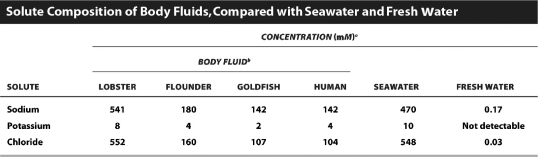 Based on the data in this table,which organism is most likely to be an osmoconformer? (Note that lobsters and flounders live in seawater and goldfish live in fresh water. )
 (Multiple Choice)
4.8/5 (84)
(84) The circulation of blood through the body eventually increases the rate of heat transfers from the skin's surface to the external environment by
(Multiple Choice)
4.9/5 (77)
(77) An iguana swimming in water colder than its body temperature
(Multiple Choice)
4.9/5 (78)
(78) Animals can gain or lose heat by conduction and radiation,but the process of ________ only results in heat loss.
(Short Answer)
4.8/5 (81)
(81) Animal A has a surface area of 6 cm2 and a volume of 1 cm3.Animal B has a surface area of 24 cm2 and a volume of 8 cm3.If each animal were in the same environment,
(Multiple Choice)
4.9/5 (78)
(78) Blood pH is relatively neutral in order to allow enzymes to function properly.
(True/False)
4.8/5 (83)
(83) ________ feedback keeps the internal environment in a constant state within a range of external conditions.
(Short Answer)
4.9/5 (91)
(91) A person getting chills or "goosebumps" when cold is part of a(n)
(Multiple Choice)
4.7/5 (63)
(63) Due to the vast amount of neurons,the nervous system is the largest organ system in the human body.
(True/False)
5.0/5 (97)
(97) The process of regulating internal conditions so that they remain constant even when the physical environment does NOT match them is called ________.
(Short Answer)
4.8/5 (78)
(78) Insulin is a protein hormone that helps cells use glucose.In type I diabetes,insulin-making cells of the pancreas are attacked and destroyed.The preceding information is an example of the
(Multiple Choice)
4.9/5 (69)
(69) When a dog pants (breathes in and out rapidly through the mouth),evaporative cooling is enhanced by
(Multiple Choice)
4.9/5 (90)
(90) 
Filters
- Essay(0)
- Multiple Choice(0)
- Short Answer(0)
- True False(0)
- Matching(0)