



 Chat with AI
Exam 26: Internal Organization and Homeostasis

Exam 1: The Nature of Science and the Characteristics of Life80 Questions
Exam 2: The Chemistry of Life93 Questions
Exam 3: Cell Structure and Internal Compartments89 Questions
Exam 4: Cell Membranes, Transport, and Communication89 Questions
Exam 5: Energy, Metabolism, and Enzymes85 Questions
Exam 6: Photosynthesis and Cellular Respiration89 Questions
Exam 7: Cell Division84 Questions
Exam 8: Cancer and Human Health86 Questions
Exam 9: Patterns of Inheritance86 Questions
Exam 10: Chromosomes and Human Genetics77 Questions
Exam 11: DNA and Genes83 Questions
Exam 12: From Gene to Protein88 Questions
Exam 13: DNA Technology96 Questions
Exam 14: How Evolution Works72 Questions
Exam 15: The Origin of Species76 Questions
Exam 16: The Evolution of Biodiversity102 Questions
Exam 17: Biological Diversity, Bacteria, and Archaea80 Questions
Exam 18: Protista, Plantae, and Fungi83 Questions
Exam 19: Animalia80 Questions
Exam 20: The Biosphere88 Questions
Exam 21: Growth of Populations70 Questions
Exam 22: Animal Behavior82 Questions
Exam 23: Ecological Communities105 Questions
Exam 24: Ecosystems74 Questions
Exam 25: Global Change73 Questions
Exam 26: Internal Organization and Homeostasis75 Questions
Exam 27: Nutrition and Digestion81 Questions
Exam 28: Circulation and Gas Exchange77 Questions
Exam 29: Animal Hormones79 Questions
Exam 30: Nervous and Sensory Systems76 Questions
Exam 31: Skeletons,Muscles,and Movement77 Questions
Exam 32: The Immune System80 Questions
Exam 33: Reproduction and Development86 Questions
Exam 34: Plant Structure, Nutrition, and Transport80 Questions
Exam 35: Plant Growth and Reproduction81 Questions
Select questions type


Ectotherms depend more on heat from their environment than on ________ heat from internal chemical reactions.
(Short Answer)
4.7/5  (84)
(84) The lack of water,otherwise known as ________,can lead to heatstroke.
(Short Answer)
4.7/5 (87)
(87) Having hundreds of different types of cells in the human body promotes efficiency of bodily processes.
(True/False)
4.7/5 (75)
(75) To maintain homeostasis of its body fluids,a frog in fresh water would have to actively transport
(Multiple Choice)
5.0/5 (91)
(91) A turtle lying on a warm rock on a sunny day is gaining heat from the sun by radiation and heat from the rock by ________.
(Short Answer)
4.8/5 (86)
(86) Analyze the tissue images below and select which statement is true.
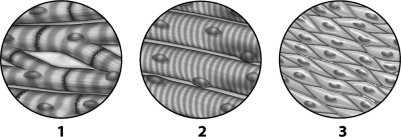
(Multiple Choice)
4.7/5 (73)
(73) Which of the following would be the best way to avoid heatstroke on a very hot day?
(Multiple Choice)
4.9/5 (90)
(90) A large glass of ice water and a small glass of ice water are sitting on a table in the same room.The small glass of water would reach room temperature before the large glass of water.
(True/False)
4.8/5 (70)
(70) Which of the following statements about temperature regulation is FALSE?
(Multiple Choice)
4.9/5 (85)
(85) The physical movement of heat that results from the movement of air or water is known as
(Multiple Choice)
4.8/5 (79)
(79) An animal can lose heat by ________ even when the environmental temperature is greater than its internal temperature.
(Short Answer)
4.9/5 (73)
(73) Which of the following compounds allows animals to lose the LEAST amount of water during the process of removing toxic waste?
(Multiple Choice)
4.8/5 (82)
(82) A person whose hands are being warmed by holding a hot cup of tea is gaining heat by
(Multiple Choice)
4.9/5 (82)
(82) 
Filters
- Essay(0)
- Multiple Choice(0)
- Short Answer(0)
- True False(0)
- Matching(0)