



 Chat with AI
Exam 32: The Immune System

Exam 1: The Nature of Science and the Characteristics of Life80 Questions
Exam 2: The Chemistry of Life93 Questions
Exam 3: Cell Structure and Internal Compartments89 Questions
Exam 4: Cell Membranes, Transport, and Communication89 Questions
Exam 5: Energy, Metabolism, and Enzymes85 Questions
Exam 6: Photosynthesis and Cellular Respiration89 Questions
Exam 7: Cell Division84 Questions
Exam 8: Cancer and Human Health86 Questions
Exam 9: Patterns of Inheritance86 Questions
Exam 10: Chromosomes and Human Genetics77 Questions
Exam 11: DNA and Genes83 Questions
Exam 12: From Gene to Protein88 Questions
Exam 13: DNA Technology96 Questions
Exam 14: How Evolution Works72 Questions
Exam 15: The Origin of Species76 Questions
Exam 16: The Evolution of Biodiversity102 Questions
Exam 17: Biological Diversity, Bacteria, and Archaea80 Questions
Exam 18: Protista, Plantae, and Fungi83 Questions
Exam 19: Animalia80 Questions
Exam 20: The Biosphere88 Questions
Exam 21: Growth of Populations70 Questions
Exam 22: Animal Behavior82 Questions
Exam 23: Ecological Communities105 Questions
Exam 24: Ecosystems74 Questions
Exam 25: Global Change73 Questions
Exam 26: Internal Organization and Homeostasis75 Questions
Exam 27: Nutrition and Digestion81 Questions
Exam 28: Circulation and Gas Exchange77 Questions
Exam 29: Animal Hormones79 Questions
Exam 30: Nervous and Sensory Systems76 Questions
Exam 31: Skeletons,Muscles,and Movement77 Questions
Exam 32: The Immune System80 Questions
Exam 33: Reproduction and Development86 Questions
Exam 34: Plant Structure, Nutrition, and Transport80 Questions
Exam 35: Plant Growth and Reproduction81 Questions
Select questions type


Examine the figure below.
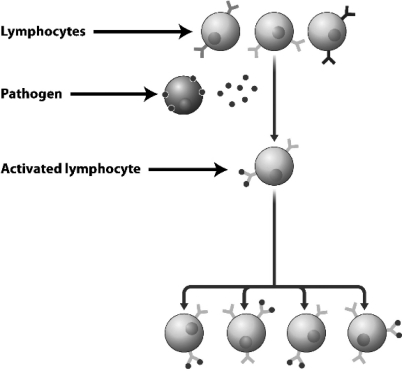 Why is only one of the lymphocytes in this diagram activated by the pathogen?
 (Multiple Choice)
4.9/5  (73)
(73) Macrophages may be unable to digest the pathogens they phagocytize.If so,the pathogen can still be prevented from affecting healthy tissues by
(Multiple Choice)
4.8/5 (83)
(83) To verify the successfulness of a vaccination procedure,researchers could either challenge the individual with an exposure to the pathogen or demonstrate the presence of ________ in the bloodstream.
(Short Answer)
4.9/5 (85)
(85) ________ proteins attach to antibodies bound to antigens on the surfaces of invading cells.This helps macrophages bind to these cells in preparation for phagocytosis.
(Short Answer)
4.8/5 (76)
(76) Lymphocytes surround and digest any damaged host cells and any cell marked with antibody and/or complement.
(True/False)
4.9/5 (86)
(86) Which of the following both prevents blood loss and the invasion of pathogens in vertebrates?
(Multiple Choice)
4.8/5 (82)
(82) Cells infected with virus almost never survive,but they may aid neighboring cells by releasing ________,a protein that attaches to the membrane of a healthy cell and inhibits viral entry.
(Short Answer)
4.9/5 (73)
(73) A ________ can be a very challenging injury for the immune system to respond to because ________.
(Multiple Choice)
4.9/5 (88)
(88) Examine the figure below.
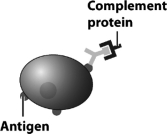 Which of the following could happen to the bacterium depicted in this figure?
 (Multiple Choice)
4.9/5 (88)
(88) Examine the figure below.
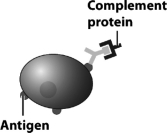 Which events have occurred previously to create the situation depicted with the bacterium shown in this figure?
 (Multiple Choice)
4.8/5 (70)
(70) Individuals with HIV often experience infections that most individuals are easily able to resist;their vulnerability to infection arises because HIV targets the ________,a cell that plays an essential role in the activation of both antibody- and cellular-mediated immunity.
(Short Answer)
4.8/5 (73)
(73) Despite its suitability as an infection site,the surface of the eye is rarely infected because tears release lysozyme,an antibacterial enzyme.
(True/False)
4.9/5 (73)
(73) Several types of immunity are recognized.Which experience would produce an artificial passive immunity to the virus that causes hepatitis A?
(Multiple Choice)
4.9/5 (77)
(77) After their activation following an encounter with antigen,B cells undergo cloning and become either effector or memory cells.Effector cells
(Multiple Choice)
4.8/5 (88)
(88) The site of an injury like a scratch or a splinter initially becomes red and painful.In some instances a yellowish thickened fluid may be present at the injury site.Commonly called pus,this fluid is
(Multiple Choice)
4.8/5 (72)
(72) Which of the following statements correctly describes the immune response when the infectious pathogen is a virus?
(Multiple Choice)
4.8/5 (90)
(90) 
Filters
- Essay(0)
- Multiple Choice(0)
- Short Answer(0)
- True False(0)
- Matching(0)