



 Chat with AI
Exam 8: Cancer and Human Health

Exam 1: The Nature of Science and the Characteristics of Life80 Questions
Exam 2: The Chemistry of Life93 Questions
Exam 3: Cell Structure and Internal Compartments89 Questions
Exam 4: Cell Membranes, Transport, and Communication89 Questions
Exam 5: Energy, Metabolism, and Enzymes85 Questions
Exam 6: Photosynthesis and Cellular Respiration89 Questions
Exam 7: Cell Division84 Questions
Exam 8: Cancer and Human Health86 Questions
Exam 9: Patterns of Inheritance86 Questions
Exam 10: Chromosomes and Human Genetics77 Questions
Exam 11: DNA and Genes83 Questions
Exam 12: From Gene to Protein88 Questions
Exam 13: DNA Technology96 Questions
Exam 14: How Evolution Works72 Questions
Exam 15: The Origin of Species76 Questions
Exam 16: The Evolution of Biodiversity102 Questions
Exam 17: Biological Diversity, Bacteria, and Archaea80 Questions
Exam 18: Protista, Plantae, and Fungi83 Questions
Exam 19: Animalia80 Questions
Exam 20: The Biosphere88 Questions
Exam 21: Growth of Populations70 Questions
Exam 22: Animal Behavior82 Questions
Exam 23: Ecological Communities105 Questions
Exam 24: Ecosystems74 Questions
Exam 25: Global Change73 Questions
Exam 26: Internal Organization and Homeostasis75 Questions
Exam 27: Nutrition and Digestion81 Questions
Exam 28: Circulation and Gas Exchange77 Questions
Exam 29: Animal Hormones79 Questions
Exam 30: Nervous and Sensory Systems76 Questions
Exam 31: Skeletons,Muscles,and Movement77 Questions
Exam 32: The Immune System80 Questions
Exam 33: Reproduction and Development86 Questions
Exam 34: Plant Structure, Nutrition, and Transport80 Questions
Exam 35: Plant Growth and Reproduction81 Questions
Select questions type


Which of the following kinds of molecules are NOT likely to be produced by a proto-oncogene?
(Multiple Choice)
4.9/5  (84)
(84) Examine the following diagram.What will most likely happen if an antibody blocks the EGF receptor such that EGF can no longer bind to it?
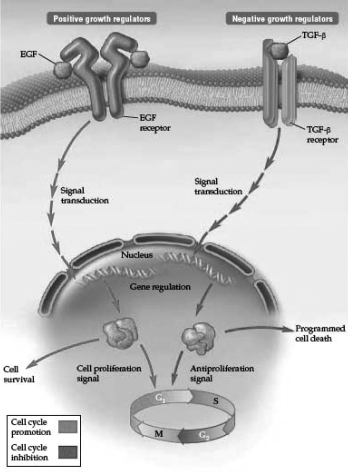
(Multiple Choice)
4.9/5 (75)
(75) Examine the following diagram.Which is most likely to have occurred in panel 3,depicting invasion?
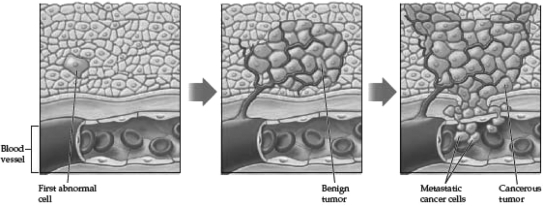
(Multiple Choice)
4.9/5 (70)
(70) A physical,chemical,or biological agent that causes cancer is a ________.
(Short Answer)
4.9/5 (82)
(82) A person's risk for cancer remains stable throughout his or her life.
(True/False)
5.0/5 (88)
(88) A woman who has already had children develops skin cancer from overexposure to the sun.Is it likely that her children have inherited this cancer from her?
(Multiple Choice)
5.0/5 (86)
(86) Immune molecules that can specifically target proteins on cancer cells are called ________.
(Short Answer)
4.8/5 (81)
(81) Both BRCA1 and BRCA2 are tumor suppressor genes that repair damaged DNA.How do mutations in these genes predispose women for breast cancer?
(Multiple Choice)
4.8/5 (87)
(87) If exposure to sunlight causes a mutation in a single proto-oncogene in a diploid cell so that it becomes hyperactive,then
(Multiple Choice)
4.9/5 (87)
(87) When a mutant receptor protein no longer requires a positive growth factor to activate it,the result is
(Multiple Choice)
5.0/5 (80)
(80) Mutations that cause an inherited risk for cancer occur in the ________ cells.
(Short Answer)
4.9/5 (84)
(84) A benign polyp in the colon always progresses to malignant colon cancer.
(True/False)
4.8/5 (85)
(85) Cancers that spread throughout the body with life-threatening consequences are called ________.
(Short Answer)
4.8/5 (79)
(79) The best reason for males to receive the Gardasil vaccine,which protects against human papillomavirus (HPV)infections,is to prevent
(Multiple Choice)
4.9/5 (74)
(74) Which of the following statements about the p53 protein is FALSE?
(Multiple Choice)
4.8/5 (67)
(67) Normal cell division requires ________ proto-oncogenes and ________ tumor suppressor genes.
(Multiple Choice)
5.0/5 (73)
(73) A gene that repairs double-stranded DNA breaks is a proto-oncogene.
(True/False)
5.0/5 (80)
(80) 
Filters
- Essay(0)
- Multiple Choice(0)
- Short Answer(0)
- True False(0)
- Matching(0)