



 Chat with AI
Exam 8: Cancer and Human Health

Exam 1: The Nature of Science and the Characteristics of Life80 Questions
Exam 2: The Chemistry of Life93 Questions
Exam 3: Cell Structure and Internal Compartments89 Questions
Exam 4: Cell Membranes, Transport, and Communication89 Questions
Exam 5: Energy, Metabolism, and Enzymes85 Questions
Exam 6: Photosynthesis and Cellular Respiration89 Questions
Exam 7: Cell Division84 Questions
Exam 8: Cancer and Human Health86 Questions
Exam 9: Patterns of Inheritance86 Questions
Exam 10: Chromosomes and Human Genetics77 Questions
Exam 11: DNA and Genes83 Questions
Exam 12: From Gene to Protein88 Questions
Exam 13: DNA Technology96 Questions
Exam 14: How Evolution Works72 Questions
Exam 15: The Origin of Species76 Questions
Exam 16: The Evolution of Biodiversity102 Questions
Exam 17: Biological Diversity, Bacteria, and Archaea80 Questions
Exam 18: Protista, Plantae, and Fungi83 Questions
Exam 19: Animalia80 Questions
Exam 20: The Biosphere88 Questions
Exam 21: Growth of Populations70 Questions
Exam 22: Animal Behavior82 Questions
Exam 23: Ecological Communities105 Questions
Exam 24: Ecosystems74 Questions
Exam 25: Global Change73 Questions
Exam 26: Internal Organization and Homeostasis75 Questions
Exam 27: Nutrition and Digestion81 Questions
Exam 28: Circulation and Gas Exchange77 Questions
Exam 29: Animal Hormones79 Questions
Exam 30: Nervous and Sensory Systems76 Questions
Exam 31: Skeletons,Muscles,and Movement77 Questions
Exam 32: The Immune System80 Questions
Exam 33: Reproduction and Development86 Questions
Exam 34: Plant Structure, Nutrition, and Transport80 Questions
Exam 35: Plant Growth and Reproduction81 Questions
Select questions type


Under normal conditions,growth factors activate ________ and inactivate ________ genes.
(Short Answer)
5.0/5  (82)
(82) The p53 protein is a ________ because it halts the cell cycle and allows the cell to repair DNA damage.
(Short Answer)
4.7/5 (82)
(82) HeLa cells display a variety of abnormalities.Which is most associated with their ability to divide repeatedly?
(Multiple Choice)
4.8/5 (93)
(93) A tumor cell has lost ________ when it breaks off from the primary tumor.
(Short Answer)
4.7/5 (73)
(73) Even though all people are exposed to potential carcinogens on a daily basis,we do not all develop cancer.Why?
(Multiple Choice)
4.8/5 (81)
(81) A pesticide was found to cause cancer in laboratory mice.Which of the following would be the most reasonable hypothesis to pursue?
(Multiple Choice)
4.8/5 (80)
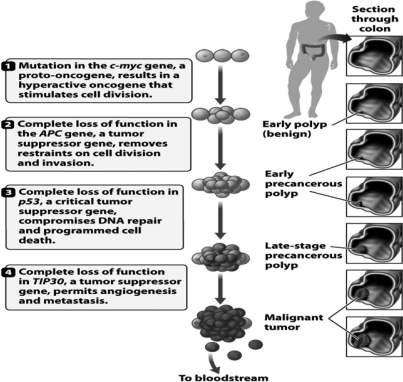
(80) As indicated in the following diagram,in many human colon tumors,true malignancy is the result of
(Multiple Choice)
4.8/5 (87)
(87) Which of the following is NOT likely to cause a cell to become cancerous?
(Multiple Choice)
4.8/5 (89)
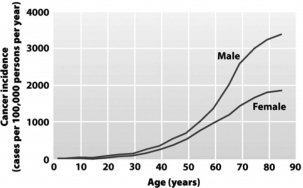
(89) As an individual ages,cancer risk increases over the course of a life because
(Multiple Choice)
4.9/5 (74)
(74) To be healthy,an organism must stop all cell division activities.
(True/False)
4.8/5 (76)
(76) Genes that increase the rate of cell division are ________ growth regulators.
(Short Answer)
4.9/5 (80)
(80) Malignant colon cancer cells enter the bloodstream and move to the liver where they form ________ tumors.
(Short Answer)
4.9/5 (78)
(78) If a normally dividing cell gains anchorage dependence,it will cause a secondary tumor.
(True/False)
4.9/5 (67)
(67) 
In colon cancer,the complete loss of function of the p53 gene requires
(Multiple Choice)
4.8/5 (80)
(80) 
Filters
- Essay(0)
- Multiple Choice(0)
- Short Answer(0)
- True False(0)
- Matching(0)