



 Chat with AI
Exam 19: Archaeal Diversity

Exam 1: Microbial Life: Origin and Discovery69 Questions
Exam 2: Observing the Microbial Cell69 Questions
Exam 3: Cell Structure and Function72 Questions
Exam 4: Bacterial Culture, Growth, and Development70 Questions
Exam 5: Environmental Influences and Control of Microbial Growth70 Questions
Exam 6: Viruses70 Questions
Exam 7: Genomes and Chromosomes70 Questions
Exam 8: Transcription, Translation, and Bioinformatics76 Questions
Exam 9: Gene Transfer, Mutations, and Genome Evolution72 Questions
Exam 10: Molecular Regulation73 Questions
Exam 11: Viral Molecular Biology70 Questions
Exam 12: Biotechniques and Synthetic Biology72 Questions
Exam 13: Energetics and Catabolism77 Questions
Exam 14: Electron Flow in Organotrophy, Lithotrophy, and Phototrophy70 Questions
Exam 15: Biosynthesis70 Questions
Exam 16: Food and Industrial Microbiology73 Questions
Exam 17: Origins and Evolution70 Questions
Exam 18: Bacterial Diversity71 Questions
Exam 19: Archaeal Diversity70 Questions
Exam 20: Eukaryotic Diversity70 Questions
Exam 21: Microbial Ecology70 Questions
Exam 22: Microbes in Global Elemental Cycles70 Questions
Exam 23: Human Microbiota and Innate Immunity70 Questions
Exam 24: The Adaptive Immune Response70 Questions
Exam 25: Microbial Pathogenesis70 Questions
Exam 26: Microbial Diseases69 Questions
Exam 27: Antimicrobial Therapy72 Questions
Exam 28: Clinical Microbiology and Epidemiology75 Questions
Select questions type


Describe two possible explanations for the deep branching position of multiple methanogenic clades in the euryarchaeotes.
(Essay)
4.9/5  (77)
(77) Describe the physiological adaptations found in haloarchaea that compensate for the high internal potassium chloride concentrations.
(Essay)
4.8/5 (63)
(63) Which of the following Crenarchaeota grows as disks linked by cannulae?
(Multiple Choice)
4.8/5 (74)
(74) The energy-yielding process of ________ occurs only in the archaea.
(Multiple Choice)
4.7/5 (84)
(84) Which of the following uses light to generate a proton gradient in the haloarchaeotes?
(Multiple Choice)
4.9/5 (75)
(75) If a species of Ferroplasma is cultured on pyrite ore, what will they do to their surrounding environment?
(Essay)
4.8/5 (84)
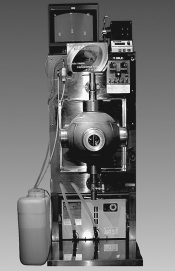
(84) What is the function of the device shown in the following figure? Describe what major challenges this instrument overcomes.
(Essay)
4.8/5 (79)
(79) The Sulfolobus species maintains an internal pH ________ that of its habitat.
(Multiple Choice)
4.9/5 (84)
(84) In methanogenesis from CO₂ and H₂, the initial incorporation of H₂ requires a coupled gradient of which ion?
(Multiple Choice)
4.9/5 (70)
(70) With respect to pH, the ________ show the widest range of any clade.
(Multiple Choice)
4.8/5 (86)
(86) The thaumarcheal ammonia oxidizers contribute to the global cycling of
(Multiple Choice)
4.8/5 (73)
(73) Most organisms of the order ________ lack both a cell wall and an S-layer.
(Multiple Choice)
4.9/5 (80)
(80) Members of order ________ in the human gut may couple with methanogens to provide the hydrogen gas for methanogenesis.
(Multiple Choice)
4.9/5 (73)
(73) Which organism has a periplasmic space containing membrane vesicles?
(Multiple Choice)
4.8/5 (83)
(83) Pyrodictium species grow as networks interconnected by glycoprotein tubules called 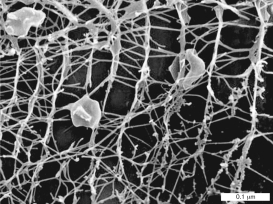
(Multiple Choice)
4.9/5 (80)
(80) Thermococcales can utilize elemental sulfur as a terminal electron acceptor for anaerobic respiration, yielding ________ as a by-product.
(Multiple Choice)
4.9/5 (79)
(79) All of the rhodopsins in the haloarchaeotes have how many alpha helical transmembrane domains?
(Multiple Choice)
4.7/5 (76)
(76) 
Filters
- Essay(0)
- Multiple Choice(0)
- Short Answer(0)
- True False(0)
- Matching(0)