



 Chat with AI
Exam 13: Energetics and Catabolism

Exam 1: Microbial Life: Origin and Discovery69 Questions
Exam 2: Observing the Microbial Cell69 Questions
Exam 3: Cell Structure and Function72 Questions
Exam 4: Bacterial Culture, Growth, and Development70 Questions
Exam 5: Environmental Influences and Control of Microbial Growth70 Questions
Exam 6: Viruses70 Questions
Exam 7: Genomes and Chromosomes70 Questions
Exam 8: Transcription, Translation, and Bioinformatics76 Questions
Exam 9: Gene Transfer, Mutations, and Genome Evolution72 Questions
Exam 10: Molecular Regulation73 Questions
Exam 11: Viral Molecular Biology70 Questions
Exam 12: Biotechniques and Synthetic Biology72 Questions
Exam 13: Energetics and Catabolism77 Questions
Exam 14: Electron Flow in Organotrophy, Lithotrophy, and Phototrophy70 Questions
Exam 15: Biosynthesis70 Questions
Exam 16: Food and Industrial Microbiology73 Questions
Exam 17: Origins and Evolution70 Questions
Exam 18: Bacterial Diversity71 Questions
Exam 19: Archaeal Diversity70 Questions
Exam 20: Eukaryotic Diversity70 Questions
Exam 21: Microbial Ecology70 Questions
Exam 22: Microbes in Global Elemental Cycles70 Questions
Exam 23: Human Microbiota and Innate Immunity70 Questions
Exam 24: The Adaptive Immune Response70 Questions
Exam 25: Microbial Pathogenesis70 Questions
Exam 26: Microbial Diseases69 Questions
Exam 27: Antimicrobial Therapy72 Questions
Exam 28: Clinical Microbiology and Epidemiology75 Questions
Select questions type


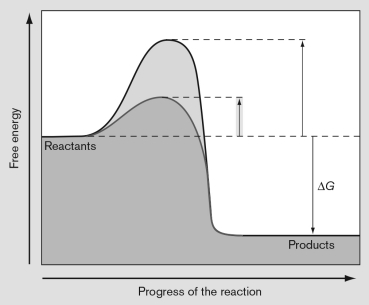

How does the efficiency of energy capture by ATP formation in bacterial tricarboxylic acid cycle compare with that of mitochondria?
(Essay)
4.9/5  (73)
(73) Which of the following statements is NOT true regarding the electron donors in prokaryotic metabolism?
(Multiple Choice)
4.9/5 (66)
(66) The DG for a reaction can be calculated by using DG⁰ and adding in
(Multiple Choice)
4.9/5 (91)
(91) All oxidative catabolism of toluene and other benzene derivatives proceeds through
(Multiple Choice)
4.9/5 (78)
(78) All nucleotide triphosphates carry energy. Provide examples of reactions that are driven by the release of energy from GTP, CTP, and TTP.
(Essay)
4.9/5 (83)
(83) Soils and waters become contaminated with industrial aromatic compounds and efforts are made to use bacteria to clean up these areas. Describe the experiment and finding from phenanthrene metabolism in the Antarctic.
(Essay)
4.9/5 (76)
(76) Fatty acids enter the TCA cycle after being degraded to what molecule?
(Multiple Choice)
5.0/5 (68)
(68) Which of the diagrammed molecules is a global signal of nutritional status? 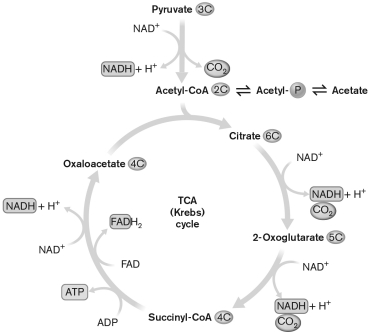
(Multiple Choice)
4.9/5 (98)
(98) A bacterium capable of producing methane and water from carbon dioxide and hydrogen performs a type of metabolism called ________ and, given its sources of electrons, it is a ________.
(Multiple Choice)
4.7/5 (75)
(75) Which of the following is NOT an end product of fermentation?
(Multiple Choice)
4.8/5 (84)
(84) The figure shown below diagrams three pathways for the metabolism of glucose. Pathway ________ is most likely to be used for biosynthesis because it can be used to ________. 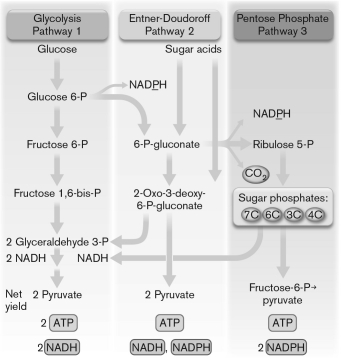
(Multiple Choice)
5.0/5 (76)
(76) Which of the following phenomena is sufficient to transport nutrients to cells that lack chemotactic motility?
(Multiple Choice)
4.9/5 (69)
(69) Oxidative catabolism of benzoate and other aromatic compounds is catalyzed by
(Multiple Choice)
4.7/5 (87)
(87) The flavor and other properties of cheeses derive from the type of fermenting microorganisms used. How do the "eyes" and the characteristic flavor of Swiss cheese originate?
(Essay)
4.9/5 (74)
(74) 
Filters
- Essay(0)
- Multiple Choice(0)
- Short Answer(0)
- True False(0)
- Matching(0)