



 Chat with AI
Exam 13: Energetics and Catabolism

Exam 1: Microbial Life: Origin and Discovery69 Questions
Exam 2: Observing the Microbial Cell69 Questions
Exam 3: Cell Structure and Function72 Questions
Exam 4: Bacterial Culture, Growth, and Development70 Questions
Exam 5: Environmental Influences and Control of Microbial Growth70 Questions
Exam 6: Viruses70 Questions
Exam 7: Genomes and Chromosomes70 Questions
Exam 8: Transcription, Translation, and Bioinformatics76 Questions
Exam 9: Gene Transfer, Mutations, and Genome Evolution72 Questions
Exam 10: Molecular Regulation73 Questions
Exam 11: Viral Molecular Biology70 Questions
Exam 12: Biotechniques and Synthetic Biology72 Questions
Exam 13: Energetics and Catabolism77 Questions
Exam 14: Electron Flow in Organotrophy, Lithotrophy, and Phototrophy70 Questions
Exam 15: Biosynthesis70 Questions
Exam 16: Food and Industrial Microbiology73 Questions
Exam 17: Origins and Evolution70 Questions
Exam 18: Bacterial Diversity71 Questions
Exam 19: Archaeal Diversity70 Questions
Exam 20: Eukaryotic Diversity70 Questions
Exam 21: Microbial Ecology70 Questions
Exam 22: Microbes in Global Elemental Cycles70 Questions
Exam 23: Human Microbiota and Innate Immunity70 Questions
Exam 24: The Adaptive Immune Response70 Questions
Exam 25: Microbial Pathogenesis70 Questions
Exam 26: Microbial Diseases69 Questions
Exam 27: Antimicrobial Therapy72 Questions
Exam 28: Clinical Microbiology and Epidemiology75 Questions
Select questions type


In many bacteria, the electron carrier ________ is used for biosynthesis, whereas ________ feeds the electron transport system.
(Multiple Choice)
4.8/5  (68)
(68) The enzyme pyruvate kinase catalyzes the conversion of phosphoenolpyruvate to pyruvate; the phosphate group is transferred to ADP to form ATP. This reaction is an example of
(Multiple Choice)
4.8/5 (91)
(91) The dye ________ turns ________ in the presence of acid products and is included in fermentation broth for some diagnostic tests.
(Multiple Choice)
4.8/5 (81)
(81) The Gibbs equation describes the relationship between the components of free energy change and can be generally expressed as
(Multiple Choice)
4.9/5 (89)
(89) Glycolytic reactions with a near-zero DG°' can participate in the overall pathway of gluconeogenesis because they
(Multiple Choice)
4.8/5 (90)
(90) Hydrolysis of ATP with the release of pyrophosphate is the driving force of which of the following reactions?
(Multiple Choice)
4.8/5 (80)
(80) Pathways involving both anabolic and catabolic reactions are referred to as
(Multiple Choice)
4.9/5 (78)
(78) Disparate animal groups, such as ruminants and humans, can digest a variety of plant fibers because they harbor cellulase-producing bacteria such as
(Multiple Choice)
4.9/5 (83)
(83) The laws of thermodynamics indicate that systems tend to become less ordered and that ________, a measure of disorder or randomness of the universe, always increases.
(Multiple Choice)
4.8/5 (77)
(77) The process of prioritized consumption of substrates is known as catabolite
(Multiple Choice)
4.8/5 (74)
(74) Pyruvate dehydrogenase complex connects glycolysis to respiration. Which is a correct mechanism for how the activity of this enzyme complex is regulated?
(Multiple Choice)
4.8/5 (63)
(63) The activity of the enzyme below is controlled in various ways using several of the binding sites shown. The two sites are the ________ site and the ________ site. 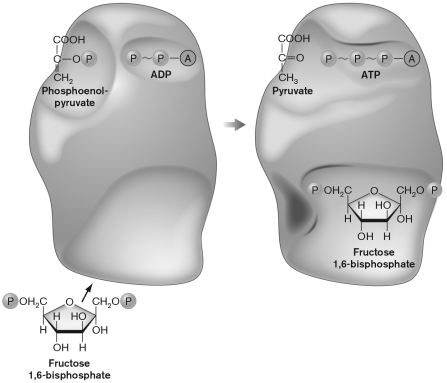
(Multiple Choice)
4.8/5 (90)
(90) Not all enzymes are proteins; in some enzymes, the catalytic properties depend on
(Multiple Choice)
4.7/5 (70)
(70) Which of the following is FALSE with respect to enzymes that use the reducing equivalents NADH and NADPH?
(Multiple Choice)
4.9/5 (65)
(65) Ethanolic fermentation is used in making beverages such as beer, wine, and pulque. It is carried out by yeast and
(Multiple Choice)
4.9/5 (98)
(98) Treponema pallidum, the causative agent of syphilis, was shown to be lacking a TCA cycle. Explain the significance of this finding.
(Essay)
4.8/5 (88)
(88) What metabolic pathway does Mycobacterium tuberculosis use that allows it to grow slowly inside macrophages? What led to this discovery, and what practical application can further analysis of this pathway have?
(Essay)
4.8/5 (72)
(72) In the pentose phosphate shunt, glucose 6-phosphate is oxidized to 6-phosphogluconate, which is then decarboxylated to ribulose 5-phosphate. What is the main metabolic role of this pathway?
(Multiple Choice)
4.8/5 (88)
(88) What is mixed-acid fermentation? Provide examples of industrial uses of its products.
(Essay)
4.9/5 (78)
(78) 
Filters
- Essay(0)
- Multiple Choice(0)
- Short Answer(0)
- True False(0)
- Matching(0)