



 Chat with AI
Exam 1: Early Western Civilization, 400,000-1000 B.C.E

Exam 1: Early Western Civilization, 400,000-1000 B.C.E65 Questions
Exam 2: Near East Empires and the Reemergence of Civilization in Greece, 1000-500 B.C.E64 Questions
Exam 3: The Greek Golden Age, C 500-C 400 B.C.E65 Questions
Exam 4: From the Classical to the Hellenistic World, 400-30 B.C.E65 Questions
Exam 5: The Rise of Rome and Its Republic, 753-44 B.C.E64 Questions
Exam 6: The Creation of the Roman Empire, 44 B.C.E-284 C.E65 Questions
Exam 7: The Transformation of the Roman Empire, 284-600 C.E64 Questions
Exam 8: The Heirs of Rome: Islam, Byzantium, and Europe, 600-75065 Questions
Exam 9: From Centralization to Fragmentation, 750-105065 Questions
Exam 10: Commercial Quickening and Religious Reform, 1050-115065 Questions
Exam 11: The Flowering of the Middle Ages, 1150-121565 Questions
Exam 12: The Medieval Synthesis and Its Cracks, 1215-134065 Questions
Exam 13: Crisis and Renaissance, 1340-149265 Questions
Exam 14: Global Encounters and the Shock of the Reformation, 1492-156065 Questions
Exam 15: Wars of Religion and the Clash of Worldviews, 1560-164865 Questions
Exam 16: Absolutism, Constitutionalism, and the Search for Order, 1640-170065 Questions
Exam 17: The Atlantic System and Its Consequences, 1700-175065 Questions
Exam 18: The Promise of Enlightenment, 1750-178965 Questions
Exam 19: The Cataclysm of Revolution, 1789-179965 Questions
Exam 20: Napoleon and the Revolutionary Legacy, 1800-183065 Questions
Exam 21: Industrialization and Social Ferment, 1830-185064 Questions
Exam 22: Politics and Culture of the Nation-State, 1850-187065 Questions
Exam 23: Empire, Industry, and Everyday Life, 1870-189065 Questions
Exam 24: Modernity and the Road to War, 1890-191465 Questions
Exam 25: World War I and Its Aftermath, 1914-192965 Questions
Exam 26: The Great Depression and World War II, 1929-194565 Questions
Exam 27: The Cold War and the Remaking of Europe, 1945-1960s64 Questions
Exam 28: Postindustrial Society and the End of the Cold War Order, 1960s-198965 Questions
Exam 29: A New Globalism, 1989 to the Present65 Questions
Select questions type


Explain how the Middle Kingdom of Egypt was able to restore unity that was lost during the Old Kingdom. What happened that led to the loss of that unity once again from 1664 through 1570 B.C.E.?
(Essay)
4.8/5  (90)
(90) Queen Hatshepsut's reign as Egypt's "female king" demonstrates that women in the New Kingdom
(Multiple Choice)
4.8/5 (73)
(73) The development of agriculture and the domestication of animals were key elements in which of the following?
(Multiple Choice)
4.8/5 (83)
(83) According to this map, which geographical feature appears to have been the most important to ancient Egyptian civilizations?
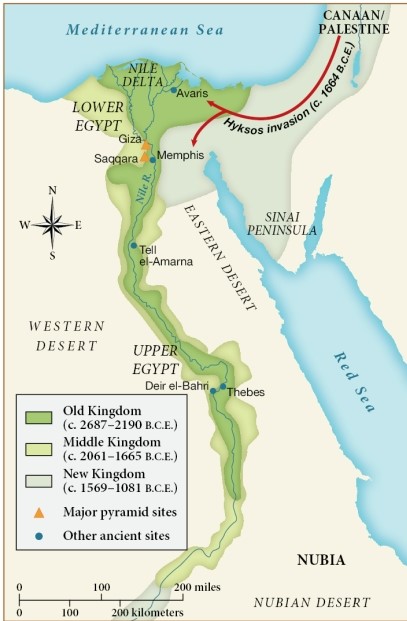
(Multiple Choice)
4.9/5 (79)
(79) Who served as slaves in the Near East, and what role did they play economically and socially?
(Essay)
4.7/5 (90)
(90) By the time of the New Kingdom, religious practices in Egypt for the wealthy and poor alike were often centered on which of the following?
(Multiple Choice)
4.9/5 (83)
(83) The Babylonians created some of the earliest written laws, the most famous being the code of Hammurabi, which was written primarily in response to which of the following?
(Multiple Choice)
4.8/5 (98)
(98) Beginning about 2000 B.C.E., what man-made environmental crisis wreaked havoc on Mesopotamian political stability?
(Multiple Choice)
4.9/5 (80)
(80) Based on this map, why were the Egyptian and Mycenaean Greek civilizations especially susceptible to invasion by the Sea Peoples?
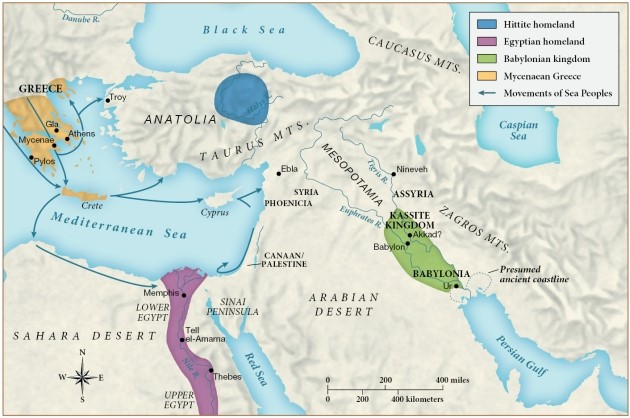
(Multiple Choice)
5.0/5 (92)
(92) What do recent archaeological discoveries of graves from the Hittite kingdom reveal?
(Multiple Choice)
4.7/5 (89)
(89) How did Near Eastern peoples explain and deal with a harsh climate and unexpected, devastating floods?
(Essay)
4.8/5 (87)
(87) Which of the following statements is justified by this map?
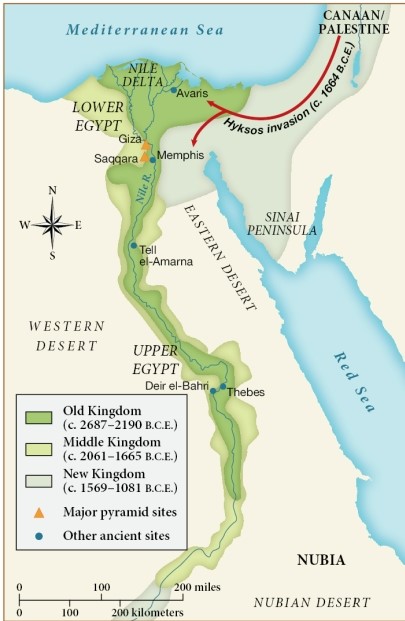
(Multiple Choice)
4.8/5 (76)
(76) The Mediterranean polyculture that the Minoans pioneered was based on
(Multiple Choice)
4.9/5 (87)
(87) Archaeologists and anthropologists are able to distinguish between the Paleolithic and the Neolithic parts of the Stone Age through which means?
(Multiple Choice)
4.8/5 (77)
(77) What were Linear A and Linear B, and what does the presence on Crete of palace records written in Linear B tell us?
(Essay)
4.7/5 (85)
(85) What did the Linear B tablets found in the palace at Knossos reveal about the relationship between the Minoans and the Mycenaean Greeks?
(Multiple Choice)
4.8/5 (73)
(73) Why were Egyptian deities portrayed with both human and animal features?
(Multiple Choice)
4.9/5 (73)
(73) The development of irrigation contributed to the growth of centralized authority because of the need to do which of the following?
(Multiple Choice)
4.8/5 (93)
(93) 
Filters
- Essay(0)
- Multiple Choice(0)
- Short Answer(0)
- True False(0)
- Matching(0)