



 Chat with AI
Exam 4: From the Classical to the Hellenistic World, 400-30 B.C.E

Exam 1: Early Western Civilization, 400,000-1000 B.C.E65 Questions
Exam 2: Near East Empires and the Reemergence of Civilization in Greece, 1000-500 B.C.E64 Questions
Exam 3: The Greek Golden Age, C 500-C 400 B.C.E65 Questions
Exam 4: From the Classical to the Hellenistic World, 400-30 B.C.E65 Questions
Exam 5: The Rise of Rome and Its Republic, 753-44 B.C.E64 Questions
Exam 6: The Creation of the Roman Empire, 44 B.C.E-284 C.E65 Questions
Exam 7: The Transformation of the Roman Empire, 284-600 C.E64 Questions
Exam 8: The Heirs of Rome: Islam, Byzantium, and Europe, 600-75065 Questions
Exam 9: From Centralization to Fragmentation, 750-105065 Questions
Exam 10: Commercial Quickening and Religious Reform, 1050-115065 Questions
Exam 11: The Flowering of the Middle Ages, 1150-121565 Questions
Exam 12: The Medieval Synthesis and Its Cracks, 1215-134065 Questions
Exam 13: Crisis and Renaissance, 1340-149265 Questions
Exam 14: Global Encounters and the Shock of the Reformation, 1492-156065 Questions
Exam 15: Wars of Religion and the Clash of Worldviews, 1560-164865 Questions
Exam 16: Absolutism, Constitutionalism, and the Search for Order, 1640-170065 Questions
Exam 17: The Atlantic System and Its Consequences, 1700-175065 Questions
Exam 18: The Promise of Enlightenment, 1750-178965 Questions
Exam 19: The Cataclysm of Revolution, 1789-179965 Questions
Exam 20: Napoleon and the Revolutionary Legacy, 1800-183065 Questions
Exam 21: Industrialization and Social Ferment, 1830-185064 Questions
Exam 22: Politics and Culture of the Nation-State, 1850-187065 Questions
Exam 23: Empire, Industry, and Everyday Life, 1870-189065 Questions
Exam 24: Modernity and the Road to War, 1890-191465 Questions
Exam 25: World War I and Its Aftermath, 1914-192965 Questions
Exam 26: The Great Depression and World War II, 1929-194565 Questions
Exam 27: The Cold War and the Remaking of Europe, 1945-1960s64 Questions
Exam 28: Postindustrial Society and the End of the Cold War Order, 1960s-198965 Questions
Exam 29: A New Globalism, 1989 to the Present65 Questions
Select questions type


Which of the following kingdoms or empires likely posed the greatest threat of potential invasion and conquering to the Ptolemaic kingdom?
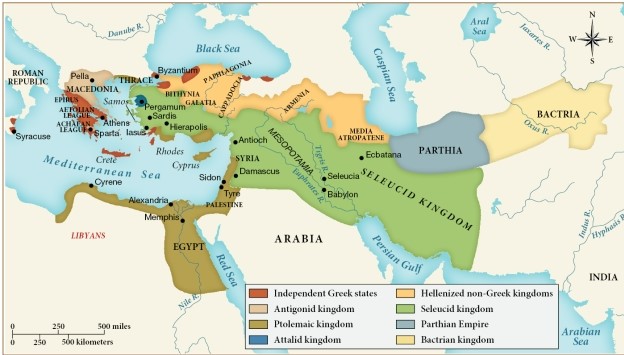
(Multiple Choice)
4.8/5  (66)
(66) Athens's return to economic health benefited from which of the following?
(Multiple Choice)
4.9/5 (88)
(88) How did Alexander the Great rule the territories he conquered?
(Multiple Choice)
4.8/5 (73)
(73) The King's Peace (386 B.C.E.) represented which of the following?
(Multiple Choice)
4.8/5 (79)
(79) Though non-Greeks came to occupy important positions in the administration of the Hellenistic kingdoms, they were rarely admitted to the highest rungs of Hellenistic society because
(Multiple Choice)
4.7/5 (87)
(87) How did the Peloponnesian War affect moderately well-off women who lost male family members during the war? How did these women cope with their changed circumstances?
(Essay)
4.9/5 (87)
(87) Which of Plato's beliefs established the concept of dualism?
(Multiple Choice)
4.9/5 (82)
(82) The Hellenistic era inaugurated widespread social and political changes in the eastern Mediterranean world, including
(Multiple Choice)
4.9/5 (90)
(90) How did the lives of the local populations change once Alexander expanded his empire from mainland Greece to Persia?
(Multiple Choice)
4.9/5 (86)
(86) Why did the Athenians ally with the Spartans in the battle of Mantinea (362 B.C.E.)?
(Multiple Choice)
4.8/5 (73)
(73) Historians generally consider the Hellenistic period the golden age of ancient science. Advancements were made in the fields of geometry and mathematics, astronomy, military technology, and medicine. Provide an example of an advancement made by a Hellenistic scientist in each of the categories just listed.
(Essay)
5.0/5 (82)
(82) Why was Socrates put on trial by his fellow citizens in 399 B.C.E.?
(Multiple Choice)
4.9/5 (79)
(79) What was one reason that Alexander the Great (r. 336-323 B.C.E.) was able to inspire his soldiers?
(Multiple Choice)
4.8/5 (74)
(74) Which of the following statements demonstrates the importance of Jews in the Hellenistic world?
(Multiple Choice)
4.8/5 (80)
(80) Which of the following statements best describes the condition of the poorer local populations in Hellenistic kingdoms?
(Multiple Choice)
4.8/5 (80)
(80) What historical evidence suggests that the average Athenian workingman had a very poor standard of living?
(Multiple Choice)
4.8/5 (81)
(81) Which of the following statements characterizes the political state of the Greek world by the 350s B.C.E.?
(Multiple Choice)
4.8/5 (71)
(71) 
Filters
- Essay(0)
- Multiple Choice(0)
- Short Answer(0)
- True False(0)
- Matching(0)