



 Chat with AI
Exam 1: Anatomy

Exam 1: Anatomy265 Questions
Exam 2: Behavioral Sciences178 Questions
Exam 3: Biochemistry102 Questions
Exam 4: Embryology59 Questions
Exam 5: Epidemiology, Biostatistics, and Medical Informatics94 Questions
Exam 6: Genetics88 Questions
Exam 7: Histology46 Questions
Exam 8: Immunology147 Questions
Exam 9: Microbiology and Virology330 Questions
Exam 10: Pathology817 Questions
Exam 11: Pharmacology and Toxicology509 Questions
Exam 12: Physiology339 Questions
Exam 13: Psychiatry and Psychotherapy23 Questions
Select questions type


A 55-year-old postmenopausal woman presented to the clinic complaining of left-sided abdominal pain for the last 4 months. The patient has no associated gastrointestinal symptoms. On examination, there is moderate tenderness on the left lower quadrant of the abdomen. Pelvix examination showed slight enlargement in the left adnexa. Transvaginal ultrasound shows a left-sided mass in the ovary, with solid and soft components. An oophorectomy is planned for the left ovary. To manage bleeding, ligation of which of the following structures is necessary?
(Multiple Choice)
4.8/5  (76)
(76) A 72-year-old man was admitted to the hospital diagnosed with non-ST elevation MI. The patient is scheduled for cardiac catheterization in the following murmur. During the night round, the attending doctor notices a new-onset mobitz 1 atrioventricular block. what is the affected artery?
(Multiple Choice)
4.7/5 (73)
(73) A 58-year-old man had a descending thoracic aortic aneurysm repaired surgically. There are no intraoperative problems, but the patient develops new-onset neurologic impairments after surgery. The brain imaging is normal, but an MRI of the lower thoracic spinal cord indicates an ischemic infarction in the locations depicted in the example below. 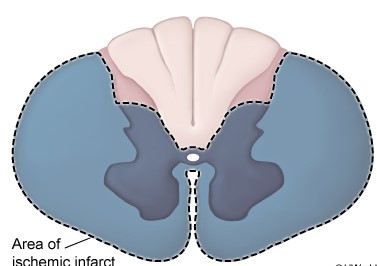 Lower extremity examination of this patient is most likely to show which of the following neurologic findings?
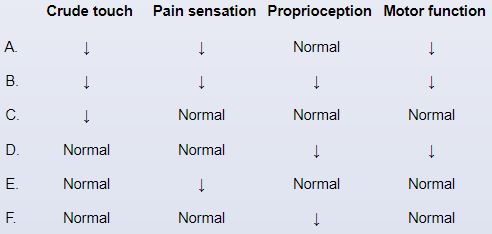
Lower extremity examination of this patient is most likely to show which of the following neurologic findings? (Multiple Choice)
4.8/5 (78)
(78) A right-handed 43-year-old woman is assessed in the clinic for increasingly deteriorating neurologic complaints. The patient has diabetes and hyperlipidemia, for which she takes metformin and a statin. There is no history of brain trauma or seizures in her family. The patient consumes wine on occasion but does not use cigarettes or illegal substances. Her mother has a family history of migraines. An MRI of the brain is acquired, as illustrated in the figure below: 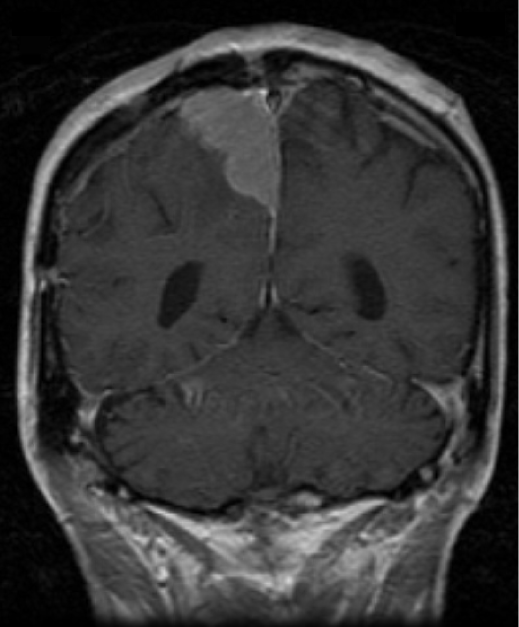 This patient is most likely to have which of the following additional findings?
 (Multiple Choice)
4.9/5 (73)
(73) A 65-year-old man with a history of coronary artery disease visits his doctor with complaints of exertional shortness of breath, weariness, and lower limb edema. His medical history is notable for a myocardial infarction 5 years ago and the placement of an electronic pacemaker 2 years ago. The x-ray of his chest is seen below. One of the leaders' segments is highlighted (arrow). 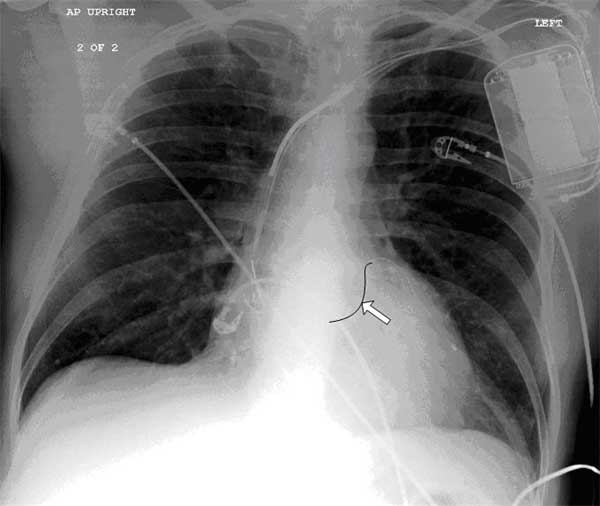 The highlighted segment most likely lies within which of the following structures?
 (Multiple Choice)
5.0/5 (95)
(95) A 35-year-old woman is evaluated in the office due to left buttock pain of 6 months duration. She has no history of previous trauma. She has no previous medical or surgical history. Physical examination shows pain upon adduction of the flexed thigh with resistance and internal rotation of the extended thigh against resistance. The evaluation shows entrapment of the sciatic nerve in the greater sciatic foramen. The greater sciatic foramen is occupied mostly by which of the following structures?
(Multiple Choice)
4.8/5 (75)
(75) A 71-year-old man was admitted to the emergency department due to severe substernal chest pain that started suddenly for the last hour. The pain started while the patient was working in the yard. He has a history of dyslipidemia and uncontrolled hypertension. ECG shows ST elevation in leads II, III, and AvF. Cardiac enzymes are elevated. Cardiac evaluation of this patient would reveal stenosis in which of the following arteries?
(Multiple Choice)
4.8/5 (93)
(93) A 50-year-old woman is evaluated due to left shoulder pain. The pain started after lifting heavy objects in the house last week. Physical examination shows painful external rotation with preserved strength. Radiological imaging shows the completion of the left infraspinatus muscle. The preserved strength is explained by compensatory hypertrophy of which of the following muscles?
(Multiple Choice)
4.8/5 (76)
(76) A 58-year-old woman is admitted to the hospital due to pleural effusion. She was diagnosed with oropharyngeal carcinoma, and multiple anterior cervical lymph nodes were detected. Yesterday, she had surgery to remove cancer and the anterior cervical lymph nodes. Today she complains of dyspnea, and radiological imaging shows a large right pleural effusion. Which of the following is most likely injured?
(Multiple Choice)
4.8/5 (71)
(71) A 55-year-old right-handed man arrives at the emergency department complaining of continuous right arm tingling and numbness for many hours. There is no headache, muscular weakness, slurred speech, or trouble walking in this patient. He has a history of hypertension, paroxysmal atrial fibrillation, and ischemic stroke, all of which have resolved. He was taken off anticoagulants two months ago after suffering a gastrointestinal hemorrhage. The blood pressure is 150/90 mm Hg, and the pulse rate is 92 beats per minute. During the examination, the patient's right arm paresthesia extends to the full right side of his body, and he experiences right-sided convulsions, which are followed by a bilateral tonic-clonic seizure. Which of the following structures in the left cerebral hemisphere is most likely to be the source of this patient's seizure? 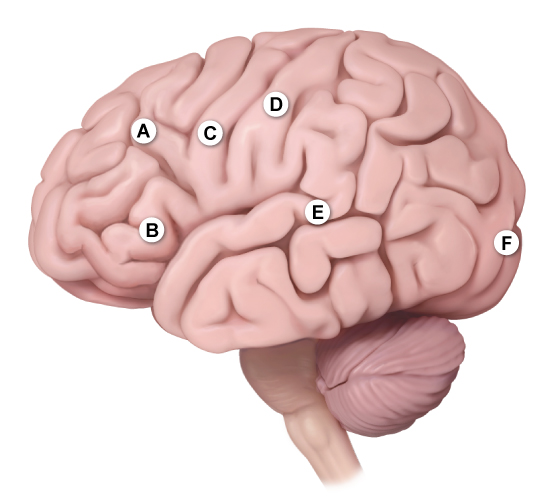
(Multiple Choice)
4.7/5 (81)
(81) A 35-year-old man is brought to the emergency department due to a left groin mass. He works as a builder. He has been smoking two packs per day for the last 10 years. His blood pressure is 160/100 mm Hg and his pulse is 90/min. During the evaluation, the patient is asked to sit up from the supine position without using his hands. Which of the following muscles acted during this action?
(Multiple Choice)
4.9/5 (71)
(71) A 25-year-old man is evaluated in the emergency department after a motor vehicle collision. The physical assessment shows intact airways, normal breathing, and the pulse is 108/min. The blood pressure is 120/80 mm Hg and the respirations are 20/min. There is a bluish discoloration in the central lower abdomen, associated with tenderness in the suprapubic area. Chest and pelvic x-ray do not show any fractures. Ultrasound reveals free intraperitoneal fluid. Urinalysis is positive for blood. CT scan of the abdomen would most likely show?
(Multiple Choice)
4.8/5 (81)
(81) A 49-year-old woman presented to the clinic due to a painless swelling in the left groin area. The patient first noticed the mass while showering several weeks ago, it has grown since that time. The patient has multiple sexual partners, which she has been doing illegal sexual work. On physical examination, there are several hard lymph nodes palpated below the left inguinal ligament. A biopsy was taken from these nodes, which revealed malignant transformation. Which of the following sites is the origin of the malignancy?
(Multiple Choice)
4.8/5 (61)
(61) Following an attack, a 21-year-old man is transported to the emergency room. He was trying to flee and turned aside just as his assailant came at him from behind with a knife. The patient had a 4-cm-wide penetrating wound with severe blood loss. He is taken to the surgery room after basic stabilization. An injury to a muscle that aids in internal rotation of the arm and is innervated by the thoracodorsal nerve is discovered during surgical investigation. Which of the muscles seen in the cadaveric specimen is most likely damaged in this patient? 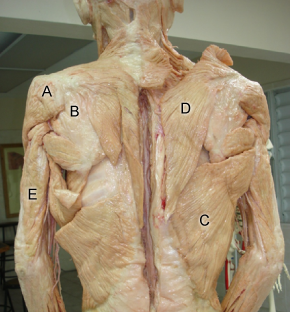
(Multiple Choice)
4.7/5 (71)
(71) A 74-year-old man presented to the emergency department due to an episode of bloody vomiting. He also complains of dark tarry stool and abdominal pain in the past week. The patient is known to have pancreatic cancer. Physical examination shows tenderness in the epigastric area. Digital rectal examination shows black tarry stool. The patient is referred for an upper gastrointestinal endoscopy, which shows bleeding enlarged veins in the gastric fundus. Other parts of the gastrointestinal tract appear normal. An abnormality in which of the following veins describe this patient's presentation?
(Multiple Choice)
4.8/5 (72)
(72) During the surgical repair for a rotator cuff tear, a 65-year-old man received anesthesia injected between the left anterior and middle scalene muscle. C3-C7 roots are blocked through this process. Which of the following muscles would be affected by this procedure?
(Multiple Choice)
4.9/5 (74)
(74) An 81-year-old man presented to the emergency department due to recurrent bleeding per rectum. The last colonoscopy revealed several diverticula across the colon. His hemoglobin is 8 g/dL, with a normal coagulation profile. An abdominal angiogram shows active bleeding in the sigmoid colon. Catheter embolization is decided. During the catheterization process, the catheter will pass through which of the following blood vessels?
(Multiple Choice)
4.9/5 (84)
(84) A 32-year-old man comes to the office complaining of back pain for the last month. The patient describes the pain as severe and wakes him up at night. Physical examination does not illustrate any abnormalities. Spinal MRI is done, and it shows meningioma at the C5 Spinal level compressing the medial segment of the dorsal column. Which of the following would be the earliest clinical manifestation?
(Multiple Choice)
5.0/5 (82)
(82) The patient is decided to have an appendectomy. Which of the following anatomical landmarks is most useful in identifying the appendix?
(Multiple Choice)
4.8/5 (85)
(85) A 52-year-old man arrives at the hospital after experiencing nonspecific back and stomach discomfort for four weeks. He has also had episodes of fever, anorexia, and a 2-kg (4.4-lb) weight loss. The patient was diagnosed with HIV recently and has not yet started antiretroviral medication. He has a history of using intravenous drugs. An infection involving the structure indicated by the arrow in the figure below is shown by a CT scan of the abdomen. 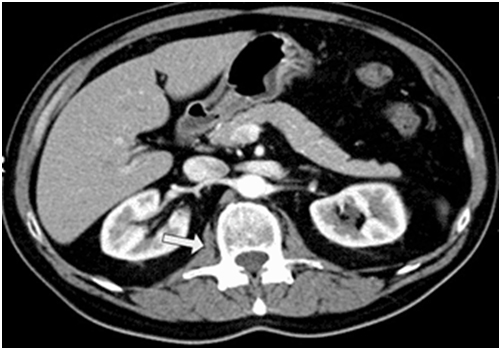 Which of the following structures is involved by this patient's infectious process?
 (Multiple Choice)
4.9/5 (75)
(75) 
Filters
- Essay(0)
- Multiple Choice(0)
- Short Answer(0)
- True False(0)
- Matching(0)