



 Chat with AI
Exam 1: Anatomy

Exam 1: Anatomy265 Questions
Exam 2: Behavioral Sciences178 Questions
Exam 3: Biochemistry102 Questions
Exam 4: Embryology59 Questions
Exam 5: Epidemiology, Biostatistics, and Medical Informatics94 Questions
Exam 6: Genetics88 Questions
Exam 7: Histology46 Questions
Exam 8: Immunology147 Questions
Exam 9: Microbiology and Virology330 Questions
Exam 10: Pathology817 Questions
Exam 11: Pharmacology and Toxicology509 Questions
Exam 12: Physiology339 Questions
Exam 13: Psychiatry and Psychotherapy23 Questions
Select questions type


A 65-year-old man comes to the office due to worsening lower extremity weakness. Over the past year, the patient complained of red urine discoloration. The patient has been smoking 2 packs of cigarettes for the past 20 years. His urine culture is negative for microbial growth. The patient underwent cystoscopy which confirmed the diagnosis of transitional cell carcinoma. An abdominal CT scan revealed that the tumor is compressing the nerve that passes through the obturator canal. Which of the following functions would be affected in this patient?
(Multiple Choice)
4.8/5  (72)
(72) A 48-year-old woman comes to the office due to recurrent postprandial abdominal pain. The pain is epigastric, with gradual onset after meals. It is exacerbated by certain types of food like fried food and sour food. The patient has a previous medical history of hypertension and diabetes mellitus. Examination shows epigastric tenderness. The patient is sent for an upper endoscopy, which shows a deep ulcer on the lesser curvature of the stomach. Which of the following structures is at risk of penetration?
(Multiple Choice)
4.8/5 (88)
(88) A 58-year-old woman is evaluated in the office for urinary incontinence. Overactivity in the bladder was detected in the urodynamic studies. Behavioral interventions were not effective, and the patient refuses medical treatment. Electrical stimulation of the nerve fibers controlling pelvic floor muscles and urethral sphincter and bladder muscle is planned. The electrical stimulation should be introduced in which of the following structures?
(Multiple Choice)
4.9/5 (78)
(78) A 15-year-old boy is brought to the office complaining of low back pain of 2 months duration. He is a basketball player, and the pain is exacerbated after training sessions. He does not have a history of trauma and does not complain of motor or sensory deficits Vital signs are within normal limits. On examinations, there is point tenderness over the L5 region, otherwise, the neurological examination is free without any deficits. A spine X-ray shows displacement of L5 relatively vertebrae over S1. This patient's condition is most likely caused by injury to which of the following structures?
(Multiple Choice)
4.8/5 (79)
(79) A 65-year-old man is sent to the emergency room with extreme right-sided weakness and slurred speech. He is also suffering from a strong headache and nausea. For poorly managed hypertension and persistent cigarette use, medical history is important. The blood pressure is 240/120 mm Hg, and the pulse rate is 104 bpm. The patient is sluggish on physical examination, with right hemiparesis and lower facial weakness, right hemisensory loss, and dysarthria. The picture below depicts a noncontrast CT scan of the head. 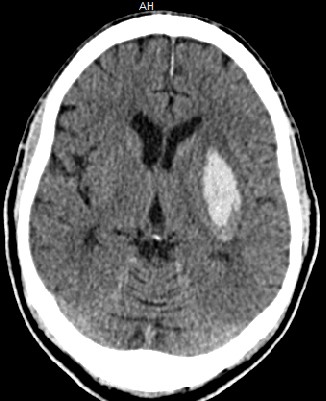 Which of the following cerebral blood vessels is most likely affected in this patient?
 (Multiple Choice)
4.8/5 (79)
(79) A 21-year-old woman was evaluated in the office for fecal retention. The patient fell from a 5-meter building 6 months ago, and she suffered from multiple fractures. She is now undergoing physical therapy for rehabilitation after the hospitalization. During the last six months, the patient had severe constipation. The family reports multiple episodes of fecal incontinence. Examinations show stool retention in the distal colon. Anal examination shows decreased tone. Injury at which of the following structures would explain this patient's presentation?
(Multiple Choice)
4.9/5 (89)
(89) A 51-year-old woman was admitted for thyroid surgery. During endotracheal intubation, the jaw is left open. The jaw deviates to the left side, and the right mandibular condyle is prominent, with a space felt posterior to it. The patient has right-sided anterior jaw dislocation. Which of the following muscles is responsible for maintaining the joint dislocated?
(Multiple Choice)
4.9/5 (68)
(68) A 7-month-old boy is brought to the pediatric urology clinic due to undescended left testis. The physical examination shows an empty scrotum on the left side. The testis is not felt in the inguinal canal. During the descent of the testis in the fetus, the testis must pass through a physiological opening in which of the following structures?
(Multiple Choice)
4.9/5 (81)
(81) A 45-year-old woman is evaluated for numbness and painful tingling of the right hand. The symptoms began 2 months ago and progressed over this time. The symptoms tend to worsen at night. She has noticed that house chores now are more difficult due to hand achiness and burning sensation. Physical examination shows decreased strength of thumb opposition and thenar eminence atrophy. Conservative treatment has been attempted with no significant effect, and she is now referred for surgery. During surgery, incision of which of the following structures is most likely to improve this patient's symptoms?
(Multiple Choice)
4.8/5 (84)
(84) A 62-year-old man is brought to the emergency department 40 minutes after his wife noticed that the right side of his face was drooping during breakfast. He had difficulty putting on his shirt and shoes before coming to the hospital. He has type 2 diabetes mellitus, hypertension, and hypercholesterolemia. His medications are metformin, enalapril, and atorvastatin. He has smoked one pack of cigarettes daily for 35 years. a CT scan shows signs of ischemia. Which of the following areas is most likely to be affected first by ischemic damage in this patient?
(Multiple Choice)
4.9/5 (90)
(90) A 29-year-old pregnant woman presented to the office complaining of left leg pain. The pain has been present for the last month but progressed in the last two weeks. It is exacerbated after sitting for a long time. There is burning, tingling, and numbness on the lateral surface of the left thigh. She has no prior medical or surgical history. She has a BMI of 36 kg/m2. Bilateral motor examination shows no abnormalities. A localized area of numbness and pain is present on the left thigh. The pain doesn't worsen when the leg is raised straight. The reflexes are normal on both sides. Compression of which of the following nerves is the cause of this patient's presentation?
(Multiple Choice)
4.8/5 (79)
(79) A 66-year-old right-handed man is brought to the ER with left-sided numbness and weakness. The patient awoke with clumsiness in his left hand, which quickly developed to significant left-sided weakness, impacting his left arm more than his left leg. He has hypertension and has smoked a pack of cigarettes every day for the past 40 years. The blood pressure is 175/90 mm Hg, and the pulse rate is 82 bpm. A neurologic evaluation indicates poor touch discrimination in the left arm, as well as left facial weakness sparing the forehead, 2/5 muscle strength in the left upper limb and 4/5 muscular strength in the left bottom limb. Examinations of right-sided strength and visual field are normal. Which of the following indicated arteries in this patient is most likely occluded? 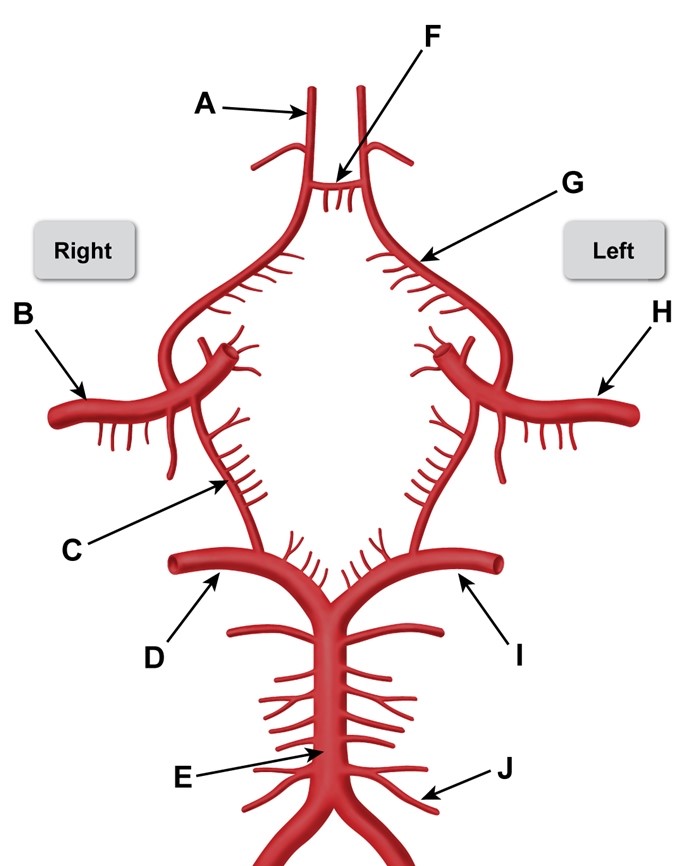
(Multiple Choice)
4.9/5 (67)
(67) A 20-year-old man is admitted to the ward due to a high fever, headache, and lethargy for the last week. The patient complains of nausea and multiple times of vomiting. Her temperature is 39.2 C (102.56 F), blood pressure is 120/80 mm Hg, and pulse is 120/min. Physical examination shows that the patient is not alert, has excessive sweating, and has a rash spread on the trunk. He has positive signs of meningeal irritation. Radiological imaging excludes any space-occupying lesions. He is sent for a lumbar puncture for cerebrospinal fluid collection. Which of the following anatomical landmarks would help in localizing the proper location of lumbar puncture?
(Multiple Choice)
4.9/5 (91)
(91) A 65-year-old man was brought to the emergency department due to sudden onset right-sided facial droop. The patient was sitting with his wife when she noticed a facial droop on the right side. Additionally, the patient was unable to produce appropriate words. When he was asked to write down his name, he was able to grasp the pen but was unable to write down his name. He can comprehend sentences and commands, but he can not name objects. A lesion affecting which of the following regions is the most likely cause in this patient? 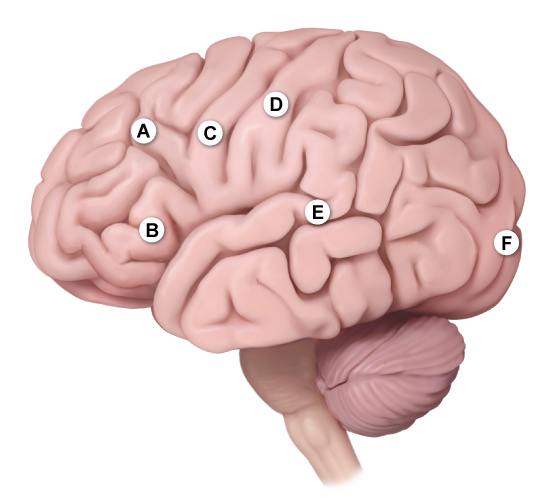
(Multiple Choice)
5.0/5 (77)
(77) A 64-year-old man was brought to the emergency department due to sudden onset agitation. The patient was sitting watching his favorite TV show, he started acting in an agitated way. The patient speaks clearly, but his words and sentences are not understandable. The patient is unable to understand or repeat commands. He does not understand the doctor's queries, and can not repeat phrases. An occlusion in which of the following arteries will explain the patient's presentation?
(Multiple Choice)
4.9/5 (66)
(66) Which of the following sentences described the mentioned structure? 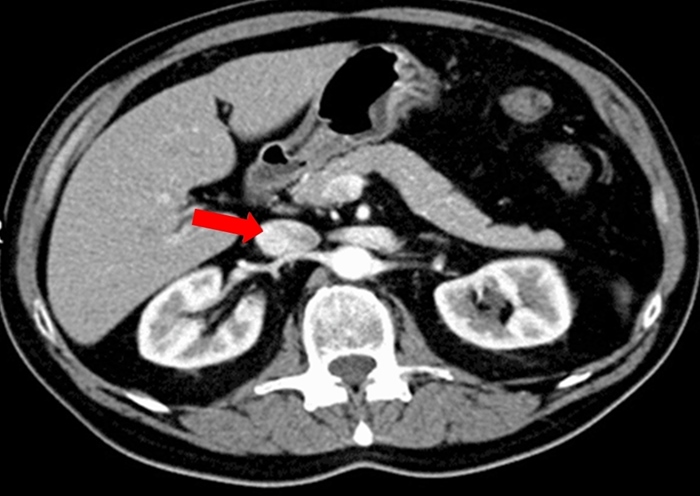
(Multiple Choice)
4.9/5 (87)
(87) After falling from a jungle gym, a 3-year-old boy is taken to the emergency room. The child landed on his outstretched arms after attempting to catch himself. He did not pass out and has been weeping uncontrollably since he collapsed. The pulse rate is 140 beats per minute, and all other vital indicators are within normal ranges. Physical examination indicates soreness and swelling across the anterior region of his right shoulder, as well as crepitus. Below is an x-ray of his right shoulder. 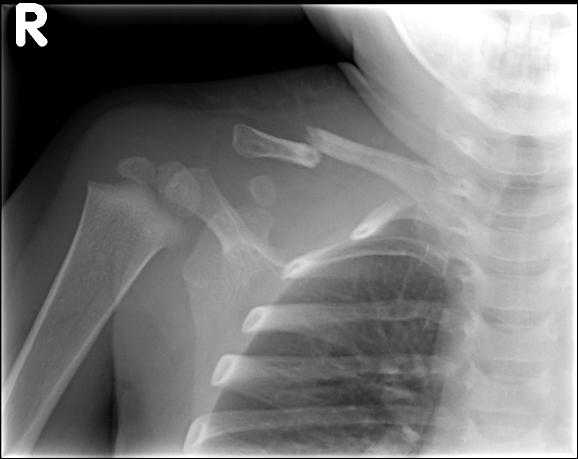 Tension from which of the following muscles is most likely responsible for displacement of the distal bone fragment?
 (Multiple Choice)
4.7/5 (69)
(69) A 52-year-old woman presented to the emergency department complaining of progressive headaches for the last two days. In addition, she is complaining of high-grade fever and vision problems. She describes that she has been seeing objects doubled. She has been experiencing headaches and purulent drainage for the past week. She has a history of chronic hypertension and diabetes mellitus type 2. Her temperature is 38.9 C (102 F), blood pressure is 120/80 mm Hg, and pulse is 98/min. Physical examination shows ptosis, mydriasis, mild exophthalmos, and corneal reflex loss in the left eye. Visual acuity is not affected, but the patient has ophthalmoplegia in the left eye. She can not move her eye in any direction. Additionally, she has diminished sensation in the left upper face. Which of the following structures is the origin of these symptoms?
(Multiple Choice)
4.7/5 (71)
(71) A 52-year-old woman presented to the office complaining of knee pain of 4 days duration. The pain is exacerbated with kneeling and responds minimally to acetaminophen. Most of her chores require her to kneel. Her past medical and surgical histories are clean. She experiences sharp pain on the anterior side of the left knee upon examination. Which of the following bursae is most likely affected in this patient?
(Multiple Choice)
4.8/5 (85)
(85) A 34-year-old man visits the clinic after experiencing chronic buzzing in his right ear for the previous 6 months. In addition, the patient's hearing on the right side is impaired. He hasn't experienced a fever, earache, a runny nose, a sore throat, or a cough. The patient has not been exposed to loud noises or used cotton swabs. He tried over-the-counter oral pseudoephedrine, but it had little effect on his symptoms. There is no sinus discomfort on physical examination, and the mucous membranes are moist without erythema or exudate. Otoscopic examination reveals bilaterally normal external auditory canals with pinkish-grey tympanic membranes. An intracranial tumor is discovered during a brain MRI. Which of the following structures is most likely to have caused this patient's lesion? 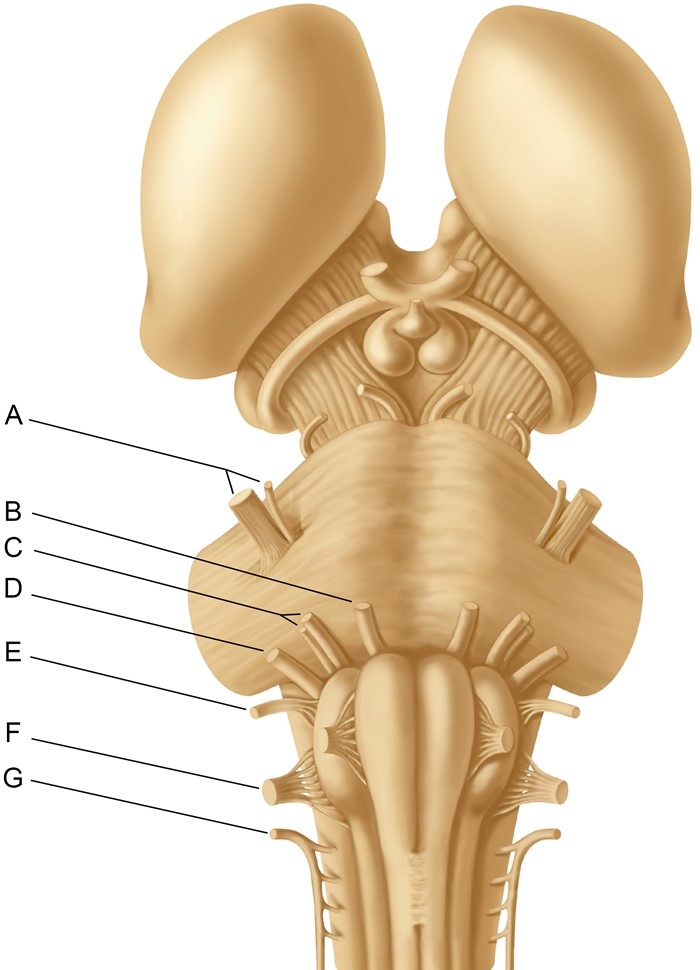
(Multiple Choice)
4.8/5 (78)
(78) 
Filters
- Essay(0)
- Multiple Choice(0)
- Short Answer(0)
- True False(0)
- Matching(0)