



 Chat with AI
Exam 1: Anatomy

Exam 1: Anatomy265 Questions
Exam 2: Behavioral Sciences178 Questions
Exam 3: Biochemistry102 Questions
Exam 4: Embryology59 Questions
Exam 5: Epidemiology, Biostatistics, and Medical Informatics94 Questions
Exam 6: Genetics88 Questions
Exam 7: Histology46 Questions
Exam 8: Immunology147 Questions
Exam 9: Microbiology and Virology330 Questions
Exam 10: Pathology817 Questions
Exam 11: Pharmacology and Toxicology509 Questions
Exam 12: Physiology339 Questions
Exam 13: Psychiatry and Psychotherapy23 Questions
Select questions type


A 38-year-old man is evaluated for tingling and numbness in the left hand. The patient has been complaining of pain for the past two months, especially at work times. He works as a car mechanic. Physical examination shows decreased sensation in the palmar side of the lateral 3 and a half digits of the left hand, thenar eminence, and the lateral palm. This patient most likely has an injury in the course of the nerve between which of the following structures?
(Multiple Choice)
4.9/5  (75)
(75) A 23-year-old man comes to the emergency department due to fever, chills, cough, and shortness of breath over the last week. The patient is alcoholic, and takes heroin IV 4-5 times weekly. His temperature is 39 C, and tachycardiac.On examination, the patient has painful red lsions on the finger pads, with splinter hemorrhages found in both hands. Blood cultres grow staphylococcus aureus. What is the best site for auscultation of the affected valve? 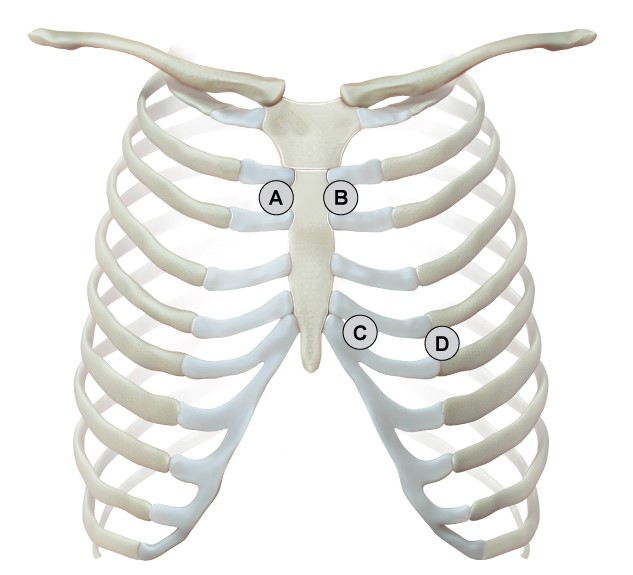
(Multiple Choice)
4.8/5 (79)
(79) A 62-year-old woman presented to the office complaining of left arm weakness for the last month. The patient noticed that left arm weakness is exacerbated by over-the-head movements. The weakness is associated with neck pain radiating to the left arm. She has no history of trauma or medical illnesses. Physical examination shows loss of shoulder abduction and biceps reflex on the left side. Additionally, there is decreased pinprick sensation over the left lateral arm and forearm. Which of the following is the pathophysiology underlying the patient's symptoms?
(Multiple Choice)
5.0/5 (81)
(81) A 56-year-old man visits the emergency room with recurrent left wrist discomfort. He slid forward onto the ground and landed on his outstretched hand while walking his dog 5 hours ago. The examination reveals modest edema of the left wrist with intact range of motion. There is dorsolateral wrist discomfort between the tendons of the extensor pollicis longus and extensor pollicis brevis. The picture below depicts an x-ray of the left wrist: 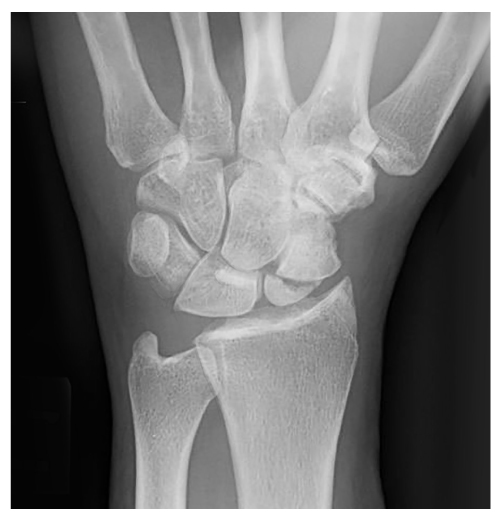 This patient is at greatest risk for developing which of the following complications?
 (Multiple Choice)
4.8/5 (77)
(77) A 3-month-old boy is evaluated in the clinic due to a fever in the past few days. The patient has unilateral cleft lip and palate and has been feeding with specialized care and bottles. Otoscopy revealed swollen and erythematous tympanic membrane. The patient is diagnosed with otitis media. A dysfunction in which of the following muscles has predisposed to this condition?
(Multiple Choice)
4.9/5 (99)
(99) A 49-year-old woman arrives at the office complaining of muscular weakness. The patient's right hand has been weakening for the previous three months. She's also been hallucinating. The patient's arms and legs are twitching and cramping. She has no sensory issues. The lower extremities muscles have increased tone and fasciculations on examination. There is atrophy of the interosseus muscles of the right hand as well as the bilateral intrinsic muscles of the foot. When the doctor touches the chin with the mouth slightly open, the jaw jerks up quickly. This response is mediated by which of the following cranial nerves? 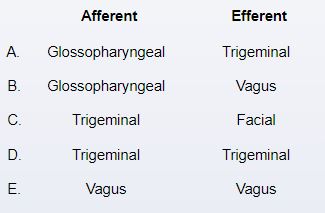
(Multiple Choice)
4.9/5 (67)
(67) A 20-year-old man is evaluated due to weakness in the left hand. The patient has a motor vehicle collision, where he injured his left arm. Since that day, he has been complaining of numbness in the left hand and weakness. On examination, there is a loss of sensation over the 5th digit and hypothenar muscles atrophy. Triceps reflexes are 2+ and symmetric bilaterally. This patient's nerve injury is most likely at which of the following levels?
(Multiple Choice)
4.9/5 (67)
(67) During a carotid endarterectomy surgery, the surgeon accidentally transected the right glossopharyngeal nerve. Which of the following would be the result of this patient's injury?
(Multiple Choice)
4.8/5 (83)
(83) A 37-year-old obese multiparous woman was admitted to the emergency department complaining of sudden left lower-sided abdominal pain. The pain is associated with vomiting and nausea. The patient has delivered a 3500-g healthy boy a week ago. Her temperature is 39 C, her blood pressure is 140/90 and her pulse is 120/min. Ultrasound was done to exclude retained products of conception. Computerized tomography with contrast has revealed left-sided ovarian thrombosis. Blood cultures and sensitivity showed group A Beta-hemolytic streptococci. If this patient is untreated, she has a risk of thrombus extension in which of the following veins?
(Multiple Choice)
4.8/5 (67)
(67) An autopsy is done for an 82-year-old man who has died after having a brainstem stroke. During the autopsy, there is destruction in a group of pigmented neurons in the posterior rostral pons, at the lateral floor of the fourth ventricle. These neurons function to release which of the following compounds?
(Multiple Choice)
4.8/5 (90)
(90) A 4-year-old girl is brought to the emergency department due to an inability to move her left arm. She was playing with her sibling and pulled her from her hand. She started crying after this incident and refused to move her hand. Physical examination shows her left arm held flexed with a pronated forearm. The patient has pain with any movement of the elbow. No swelling or deformity is noticed. This patient's presentation is due to an abnormality affecting which of the following structures?
(Multiple Choice)
4.9/5 (65)
(65) A 30-year-old woman presented to the office complaining of ankle pain of 3 days duration. The patient was running following her child when she twisted her ankle inward. The patient walks without help, but she complains of pain and swelling in the left ankle. Physical examination shows bluish discoloration on the lateral side of the ankle. The Maximal point of tenderness is found over the anterolateral side of the left ankle. The pain is exacerbated by forceful inversion. The patient has injured which of the following structures?
(Multiple Choice)
4.9/5 (87)
(87) A 6-year-old girl with cerebral palsy has selective dorsal rhizotomy surgery performed. The patient was born early and with a low birth weight, and he suffered periventricular cerebral white matter damage. Dorsal rootlets of lumbosacral spinal nerves are selectively cut during the surgery, as seen in the figure below: 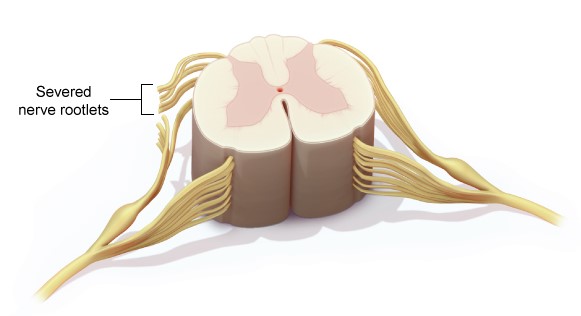 Which of the following is the most likely effect of this intervention in this patient's lower extremities?
 (Multiple Choice)
4.9/5 (69)
(69) A 70-year-old right-handed woman arrives at the ER with left-sided sight loss that she noticed when she awoke in the morning. She has no headaches, impaired speech, swallowing difficulties, weakness, or trouble walking. Her additional medical issues include high blood pressure, atrial fibrillation, and hyperlipidemia. The blood pressure is 170/102 mm Hg, and the pulse rate is 90 beats per minute and irregular. She is aware and oriented to person, location, and time during a neurologic assessment. Her voice is clear, and she understands and executes complex orders. Her visual fields reveal left homonymous hemianopia with macular sparing. Her feeling on the left side of her body is diminished. The rest of the neurologic evaluation is within normal norms. As depicted in the picture, a non-contrast head CT shows an area of focal parenchymal hypoattenuation. 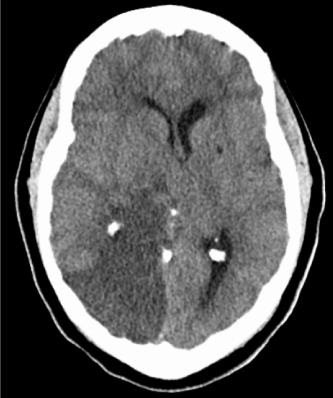 Which of the following cerebral arteries is most likely to be compromised in this patient?
 (Multiple Choice)
4.9/5 (76)
(76) A 28-year-old man presented to the office with the feeling of loss of interest in usual activities for the past two weeks. The patient has had guilt feelings and continuous sadness for the past two weeks. He lost interest in most activities, and he has anorexia. He can not sleep well due to insomnia. He does not have suicidal thoughts. The patient has no previous history of medical or surgical problems. Physical examination, CBC, TSH, and B12 levels are all within normal ranges. The patient is diagnosed with major depressive disorder and fluoxetine is prescribed. You are explaining to the patient that the drug stops the reuptake of a neurotransmitter specifically released by a set of neurons. These neurons are most likely localized in which of the following structures?
(Multiple Choice)
4.8/5 (75)
(75) A 65-year-old man was admitted to the gastroenterology clinic for endoscopic evaluation. Flexible rectosigmoidoscopy reveals a large mass in the middle part of the rectum extending up to the rectosigmoid junction. The patient was sent for surgical resection of the colon, which reveals a metastasis in the pararectal lymph nodes. Which of the following lymph node groups should be biopsied for the assessment of metastasis?
(Multiple Choice)
4.7/5 (72)
(72) A 60-year-old man presented to the emergency department due to a sudden onset of visual abnormality. He has been complaining of a visual defect, and today a shadow developed in the visual field of his right eye. He does not complain of headache, double vision, unsteadiness, photophobia, nausea, or vomiting. Physical examination shows an area of decreased vision in the right eye. A flame-shaped hemorrhage is seen in the right temporal hemiretina. The visual signal transmission would be affected in which of the following structures?
(Multiple Choice)
4.8/5 (84)
(84) A 72-year-old man presented to the clinic complaining of ear pain of 3 months duration. The pain started with minimal intensity and progressed through the course of the previous months. The patient complains of difficulty swallowing solid food. The patient is a heavy smoker and has been smoking 2 packs of cigarettes per day for the last 20 years. The otoscopic examination did not reveal any abnormalities in the ear. Neck examination reveals an enlarged lymph node in the right anterior neck. Laryngoscopy reveals an ulcerative mass found in the hypopharynx. Which of the following nerves is the origin of the earache in this patient?
(Multiple Choice)
4.8/5 (76)
(76) A 45-year-old man comes to the office complaining of snoring. The patient complains of tiredness around the day. His wife complains of his loud snoring, and he gasps for breath recurrently. He has diabetes mellitus type 2. His blood pressure is 160/98 mm Hg and his BMI is 39 kg/m2. On examination, the oropharynx is narrow and crowded with a large tongue. Electrical stimulation of which of the following nerves could relieve the patient's symptoms?
(Multiple Choice)
4.9/5 (71)
(71) During the procedure of total thyroidectomy for a patient diagnosed with papillary thyroid cancer, the surgeon is trying to ligate the artery found at the superior pole of the thyroid gland. a nerve found in close contact with the artery has been injured. Which of the following muscles is at risk for malfunction due to this injury?
(Multiple Choice)
4.9/5 (86)
(86) 
Filters
- Essay(0)
- Multiple Choice(0)
- Short Answer(0)
- True False(0)
- Matching(0)