



 Chat with AI
Exam 1: Anatomy

Exam 1: Anatomy265 Questions
Exam 2: Behavioral Sciences178 Questions
Exam 3: Biochemistry102 Questions
Exam 4: Embryology59 Questions
Exam 5: Epidemiology, Biostatistics, and Medical Informatics94 Questions
Exam 6: Genetics88 Questions
Exam 7: Histology46 Questions
Exam 8: Immunology147 Questions
Exam 9: Microbiology and Virology330 Questions
Exam 10: Pathology817 Questions
Exam 11: Pharmacology and Toxicology509 Questions
Exam 12: Physiology339 Questions
Exam 13: Psychiatry and Psychotherapy23 Questions
Select questions type


A 20-year-old man is brought to the emergency department after he was stabbed in the left arm in a street fight. The patient presented with diffuse bleeding, that stopped with direct pressure. A deep stab is found in the proximal part of the left cubital fossa, at the lateral side of the medial epicondyle. Physical examination shows impaired sensation in the lateral palm and the palmar surface of the first 3 1/2 digits at the palmar side, abnormality with flexing the proximal interphalangeal joints, and inability to pronate the forearm. Which of the following additional structures do you expect to be injured?
(Multiple Choice)
4.8/5  (93)
(93) A 25-year-old man is brought to the emergency department after he lost consciousness after a street fight. The patient has no previous medical or surgical history. His temperature is 36.7 C (98 F), blood pressure is 160/90 mm Hg, the pulse is 64/min, and respirations are 11/min. A Head CT scan shows a linear skull fracture at the conjunction of the frontal, parietal, temporal, and sphenoid bones. The patient has a most likely injury in a branch of which of the following arteries?
(Multiple Choice)
4.9/5 (63)
(63) A 27-year-old man was brought to the emergency department after he had a motor vehicle accident. The patient's car was struck forcefully at the rear side. The patient was able to ambulate after the injury but has since had severe pain worsened by deep breaths. His blood pressure is 100/60 mm Hg, his pulse is 120/min, and respirations are 19/min. On examination, there is bruising and tenderness over the left posterior chest wall. There is a normal spinal range of motion and no midline tenderness. Gait and lower extremity neurologic examination are normal. The CT scan shows a fracture in the left 12th rib. Which of the following structures would be affected by this injury?
(Multiple Choice)
5.0/5 (78)
(78) A 50-year-old female was brought to the emergency department after a car accident. The collided cars were traveling at high-speed. The patient was wearing her seatbelt, restrained. On presentation, the patient complains of severe chest pain associated with breathing difficulty. On examination, her blood pressure was 90/50 and pulse is 160/min. Later, the patient lost consciousness and died 20 minutes later. She was diagnosed with traumatic aortic rupture, what is the location of the primary injury?
(Multiple Choice)
4.9/5 (63)
(63) A 15-year-old boy is brought to the office for the evaluation of an enlarged mass in the neck. He has a 6-week history of expanding discrete masses in the neck that are associated with night sweats, fever, and fatigue. On examination, the patient has cervical lymphadenopathy. He underwent an excisional biopsy of the lymph nodes on the right side of the neck, particularly in the right posterior triangle of the neck. One month later, the patient presented for follow-up he complains of difficulty raising the arm overhead. Examination showed decreased right arm abduction above 100 degrees with right shoulder droop. This patient's presentation is consistent with paralysis affecting which of the following nerves?
(Multiple Choice)
4.9/5 (77)
(77) A 15-year-old girl is being assessed for recurring occurrences of focal onset seizures that have progressed to bilateral tonic-clonic seizures in recent months. She has also experienced severe headaches that have kept her from going to school. The patient has no previous medical history. The exhibit depicts an MRI of the brain. 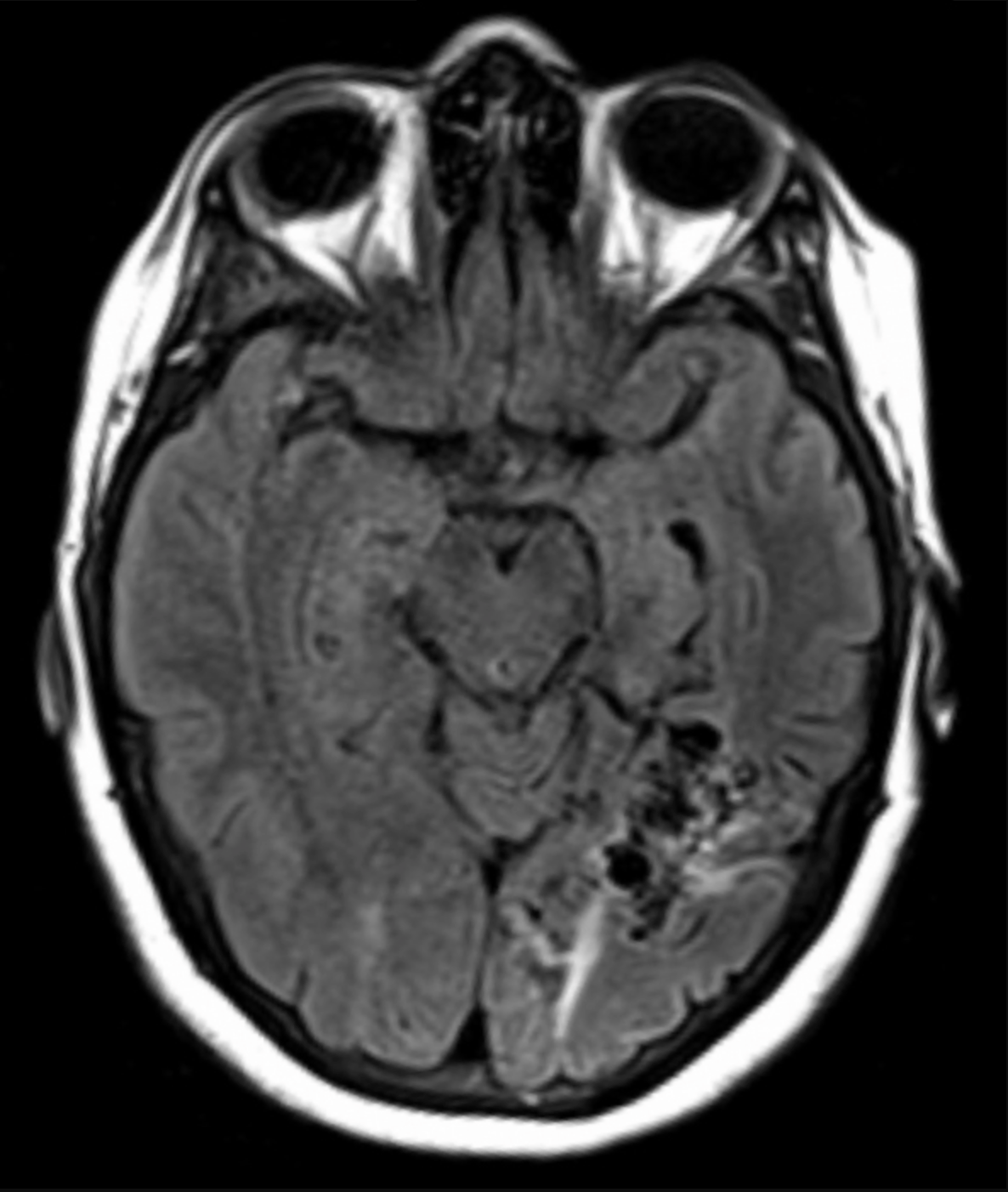 Which of the following histopathological findings are most likely present in the abnormal lesion?
 (Multiple Choice)
4.9/5 (71)
(71) A 49-year-old man is brought to the emergency department after a motor vehicle collision. The patient did not lose consciousness, and there are no bruises or trauma marks over the head. He has severe abdominal pain, nausea and vomited once. The patient's blood pressure is 110/50mm Hg and pulse is101/min and regular. On examination, he has abdominal tenderness, and ecchymosis is found over the anterior abdominal wall. CT scan shows blood collection in the retroperitoneal area. The patient has suffered from which of the following injuries?
(Multiple Choice)
4.9/5 (83)
(83) A 43-year-old man is undergoing fundoplication surgery due to persistent gastroesophageal reflux disease. The patient has tried several therapies that did not work. During the surgery, a nerve penetrating the abdomen through the esophageal hiatus was injured. What is the effect of this nerve injury?
(Multiple Choice)
5.0/5 (88)
(88) A 22-year-old woman is evaluated due to left thigh pain. She does not have any medical or surgical history. Physical examination shows impaired hip flexion and knee extension. All other actions on the hip and the knee are intact with full strength. The patient has an injury at which of the following muscles?
(Multiple Choice)
4.9/5 (85)
(85) A 32-year-old man comes to the office complaining of left arm weakness. The patient had a humerus fracture two months ago. Since his fracture, the patient has had difficulty elevating his arm. Physical examination shows decreased sensation over is at the left upper arm, with deltoid atrophy. Additionally, the patient has weakness in arm abduction. The patient has a most likely injury in which of the following nerves?
(Multiple Choice)
4.9/5 (80)
(80) A 28-year-old man is brought to the emergency department after a motorcycle accident. While he is conscious, oriented, and alert, he is complaining of facial pain and has an apparent deformity. Vital signs are stable. No obvious trauma or bleeding. A full-body CT scan was clear except for a mandibular fracture that needs surgical fixation. An injury to the inferior alveolar nerve was evident during the surgery. Which of the following would be observed as a result of the injury?
(Multiple Choice)
4.8/5 (85)
(85) A 15-year-old girl is brought to the office for a postoperative check-up. One month ago, she has acute abdominal pain and was diagnosed with acute appendicitis. She had an appendectomy, which went well without complications. A week after the surgery, she started feeling a burning sensation in the surgical incision radiating to the inguinal and suprapubic region. On examination, the surgical scar is healthy without any nodules or drainage, or color changes. The sensation is lost over the right suprapubic area. Which of the following nerves has been injured?
(Multiple Choice)
4.9/5 (67)
(67) A 46-year-old man comes to the office due to acute back pain after lifting heavy weights at the gym. The pain is localized in the lower back, radiating to the left posterior thigh, calf, and the lateral side of the foot. Bowel and bladder function is normal. Over-the-counter analgesics did not relieve the pain. Physical examination shows a positive straight leg test on the left. There is a weakness in the left hip extension compared to the right side. In addition, there is a loss of ankle jerk reflex on the left side. Which of the following nerve roots is most likely affected in this patient?
(Multiple Choice)
4.8/5 (78)
(78) A 55-year-old man arrives at the office complaining of headaches that have worsened during the last two months. The throbbing headaches are commonly accompanied by nausea and increase anytime the patient coughs or bears down during a bowel movement. For episodic migraine without aura, medical history is important. A cystic mass is shown by gadolinium MRI of the brain, as demonstrated in the figure below: 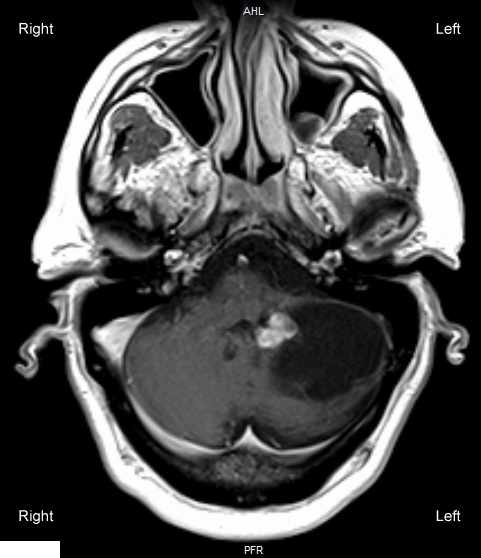 Which of the following findings is most likely to be seen on physical examination of this patient?
 (Multiple Choice)
4.8/5 (74)
(74) A 40-year-old woman presented to the office due to shortness of breath for a one-week duration. The patient complains of left-sided chest pain, exacerbated by deep inspiration. Physical examination shows diminished tactile fremitus, dullness on percussion, and diminished breath sounds over the left lower lung. Imaging shows left-sided effusion with a left lower lobe consolidation. Thoracentesis is done, where the needle is inserted at the upper border of the 10th rib in the midaxillary line. Which of the following structures is most at risk for injury in this procedure?
(Multiple Choice)
4.8/5 (75)
(75) An 8-month old boy is presented to the pediatric emergency department due to breathlessness. In the last previous days, the patient had a runny stuffy nose. She started coughing this evening with breathing noises. The patient has met all his developmental stages and received all of her immunizations. The patient has a barking cough, inspiratory stridor, and intercostal retractions. Which part of the airway is the most likely affected in this patient? 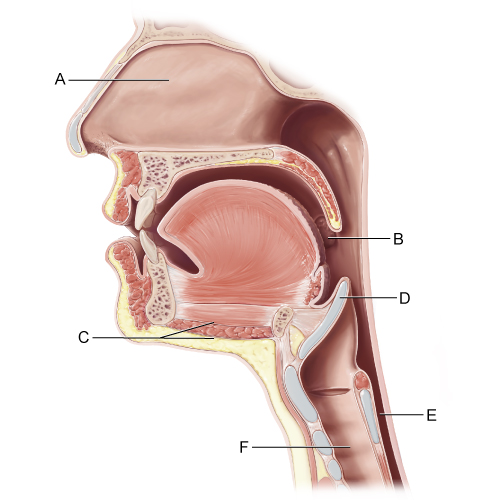
(Multiple Choice)
5.0/5 (82)
(82) A 29-year-old man comes to the office due to left-hand weakness. The patient has started his job as an electrician. He uses the screwdriver at work. Physical examination does not show any sensory deficits, but there is a loss of extension of fingers and thumb extension of the left hand. Triceps is found bilaterally to be normal. The nerve injury in this patient is most likely at which of the following levels?
(Multiple Choice)
4.8/5 (71)
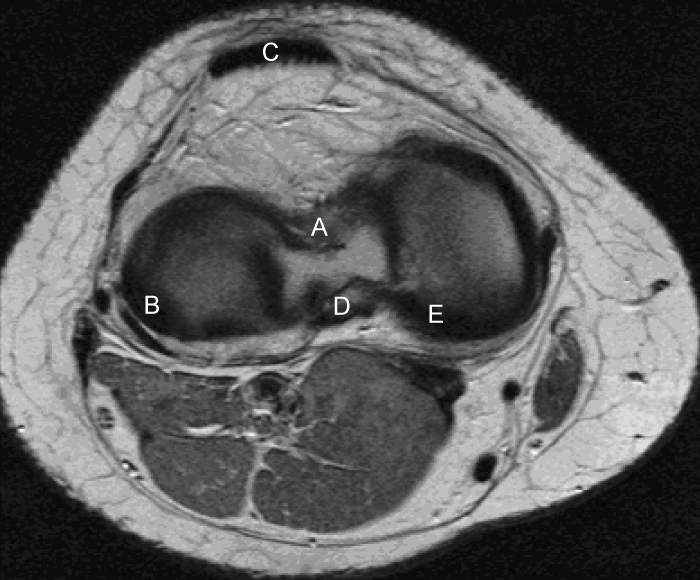
(71) A 20-year-old man arrives at the hospital complaining of knee discomfort after tripping and landing on his right knee during a soccer game. He has been unable to bear weight since the incident since the anterior area of his tibia struck straight against the ground. The patient's knee seems swollen on physical examination, and there is significant posterior displacement of the tibia when pressure is given to his anterior tibia with the knee flexed. The image below shows an axial MRI cross section of the right knee at the tibial plateau level. Which of the following structures in this patient is most likely injured?
(Multiple Choice)
4.8/5 (77)
(77) A 53-year-old man presented to the office due to urinary frequency. The patient that he has to wake up several times each night to urinate. He has difficulty with the initiation of urination. He describes that sometimes he has vague discomfort during voiding. The patient has a medical history of chronic hypertension. He has smoked a pack of cigarettes a day for 30 years. He was started on finasteride, which of the following organs would be affected by finasteride? 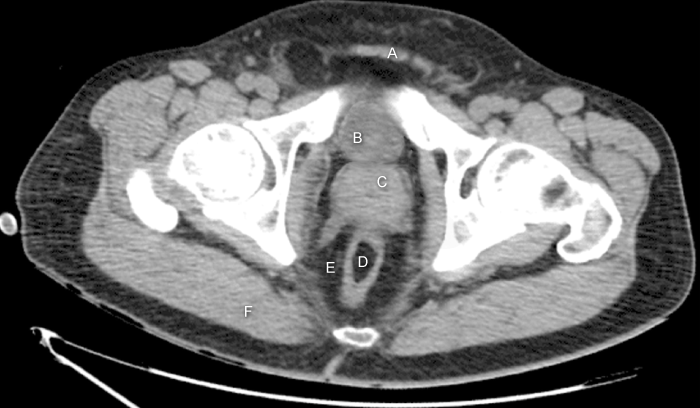
(Multiple Choice)
4.9/5 (75)
(75) A 32-year-old woman has a vaginal delivery for a 4200-g baby. The patient has a second-degree laceration, and it needs repair. During the procedure of repair, a bony prominence is palpated, the anesthetic agent is introduced around the bony prominence. The surgeon is trying to block which of the following nerves?
(Multiple Choice)
4.9/5 (79)
(79) 
Filters
- Essay(0)
- Multiple Choice(0)
- Short Answer(0)
- True False(0)
- Matching(0)