



 Chat with AI
Exam 1: Anatomy

Exam 1: Anatomy265 Questions
Exam 2: Behavioral Sciences178 Questions
Exam 3: Biochemistry102 Questions
Exam 4: Embryology59 Questions
Exam 5: Epidemiology, Biostatistics, and Medical Informatics94 Questions
Exam 6: Genetics88 Questions
Exam 7: Histology46 Questions
Exam 8: Immunology147 Questions
Exam 9: Microbiology and Virology330 Questions
Exam 10: Pathology817 Questions
Exam 11: Pharmacology and Toxicology509 Questions
Exam 12: Physiology339 Questions
Exam 13: Psychiatry and Psychotherapy23 Questions
Select questions type


During cardiac catheterization, an artery indicated by the arrow in the picture was visualized after injecting the contrast material, What is the origin of this artery? 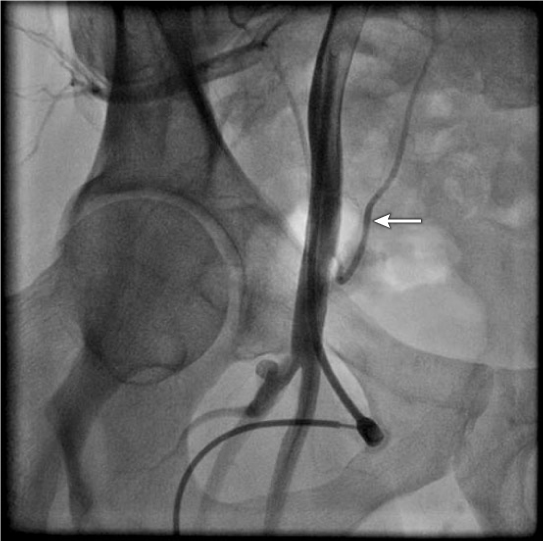
(Multiple Choice)
4.8/5  (91)
(91) An 81-year-old man was referred to the cardiology center for PCI after presenting with excruciating chest pain associated with breathing difficulty. PCI was done using femoral access. After the procedure, the pressure was used to maintain hemostasis. 30 minutes later, the patient became hypotensive with cold extremities. The patient is suspected to have internal bleeding. Ecchymosis was found at the site of the femoral artery. What is the location of blood collection?
(Multiple Choice)
4.8/5 (76)
(76) A 63-year-old woman presented to the office due to eye asymmetry that was noticed by her husband. The patient does not complain of any other symptoms. She has a positive medical history of hypertension and diabetes mellitus type 2. Blood pressure is 135/85 mm Hg and pulse is 96/min. Physical examination reveals pupillary asymmetry, the right pupil is 3 mm and the left pupil is 5 mm. The asymmetry increases when the light is dimmed. Which of the following is the most likely location of the lesion?
(Multiple Choice)
4.8/5 (83)
(83) A 22-year-old woman is brought to the emergency department after the sudden onset of shortness of breath. She has cystic fibrosis and, during the past year, has had 3 respiratory exacerbations that have required hospitalization. Current medications include an inhaled bronchodilator, an inhaled corticosteroid, inhaled N-acetylcysteine, and azithromycin. The patient appears chronically ill. Her temperature is 37.9°C (100.2°F), pulse is 96/min, respirations are 22/min and labored, and blood pressure is 106/64 mm Hg. Chest excursions and tactile fremitus are decreased on the right side. On auscultation of the chest, breath sounds are significantly diminished over the right lung field and diffuse wheezing is heard over the left lung field. Which of the following is most likely responsible for this patient's acute symptoms?
(Multiple Choice)
4.8/5 (85)
(85) A 56-year-old man comes to the office due to recurrent abdominal pain. The patient has epigastric abdominal pain with gradual onset, it is usually relieved with antiacids and with eating. The patient has been smoking 1 pack of cigarettes for the last 20 years. Physical examination reveals mild epigastric tenderness with no rebound or guarding. Upper GI endoscopy reveals an ulcer in the posterior wall of the duodenum. Which of the following arteries are at risk of bleeding if the ulcer penetrates the posterior wall?
(Multiple Choice)
4.9/5 (97)
(97) A 38-year-old man was evaluated in the recovery room after appendectomy surgery. The patient's O2 saturation dropped from 96% to 80%, he has tachypnea. He has swollen face, tongue, and arms. The anesthesiologist failed several intubation trials, so cricothyrotomy was decided to be performed. There is also scattered urticaria over the upper body. Attempts at intubation are unsuccessful due to massive soft tissue edema involving the pharynx. The incision of cricothyrotomy will pass through which of the following structures?
(Multiple Choice)
4.7/5 (79)
(79) A 65-year-old woman presented to the office for follow-up after right mastectomy with axillary lymph node dissection. The patient is complaining of right arm upper arm pain, which was persistent during the last week. The incision is healing properly, with no discharge, edema, or erythema. On examination, she has decreased sensation in the medial upper right arm close to the axilla. There are no motor disturbances associated. Which of the following nerves injury would explain the patients' symptoms?
(Multiple Choice)
4.7/5 (70)
(70) A 25-year-old man is brought to the emergency department after a motor vehicle collision. The patient is complaining of severe left leg pain. He can not stand on his left leg. Radiological imaging shows left fibular and tibia shaft fractures. The fracture was reduced with immobilization of the limb. A few hours later, the patient is complaining of severe left leg pain. Physical examination shows increased tension in the anterior compartment. Which of the following structures would be most likely affected?
(Multiple Choice)
4.8/5 (78)
(78) A 66-year-old man presented to the clinic for adominal ultrasound screening. The image showed abdominal aortic aneurysm with a A 66-year-old man presented to the clinic for abdominal ultrasound screening. The image showed an abdominal aortic aneurysm with a diameter of 6 cm. The patient has a history of hypertension, smoking, and alcoholism. The patient does not report any symptoms. Abdominal examination reveals a bruit, but no pulsatile mass is palpated. The patient is planning to have an open repair. During the surgery, the aortic part affected is dissected, the inferior mesenteric artery is ligated and a graft is placed. Which of the following arteries would provide collaterals to replenish the blood supply to the descending colon?
(Multiple Choice)
5.0/5 (78)
(78) A 39-year-old woman undergoes renal allograft transplantation. The kidney and the proximal part of the ureter are transplanted in the right iliac fossa. 5 days after the surgery, the patient developed fever and abdominal pain. Imaging studies show pelvic fluid collection. Exploratory surgery shows ischemia and necrosis of the transplanted ureter in the bladder. The proximal part of the ureter is not affected. This segment of the ureter receives blood supply from which of the following arteries?
(Multiple Choice)
4.9/5 (77)
(77) A 25-year old man is brought to the emergency department after he fell from a high tree. The patient landed on his upper arm. The patient is in pain. His blood pressure is 120/78 Hg and his pulse is 120/min. On physical examination, the patient has tenderness, swelling, and erythema in the upper arm. Radiological imaging shows midshaft fracture of the humerus. This patient is at risk to lose which of the following functions?
(Multiple Choice)
4.9/5 (77)
(77) A 23-year-old man is brought to the emergency department due to severe right leg pain. He jumped from his motorcycle while he was driving. He felt a popping sensation after landing from the jump. He has right anterior leg pain. After the injury, the patient is unable to ambulate or to bear weight on his leg. On examination, the patient has swelling of the right knee with tenderness felt above the patella. Imaging studies confirmed the diagnosis of complete quadriceps tendon tear, with fractures seen in the foot. Surgical repair is planned. Local anesthesia injection near which of the following structures would provide adequate anesthesia for the procedure?
(Multiple Choice)
4.9/5 (76)
(76) A 70-year-old woman presented to the emergency department due to nausea, vomiting, and abdominal pain for the last 5 hours. The patient reports recurrent dull pain over the superior border of the thigh. The blood pressure is 130/80 mm Hg, the pulse is 100/min, and respirations are 20/min. On examination, the abdomen is distended and tender. Swelling is observed below the inguinal ligament, lateral to the pubic tubercle. Which of the following structures is found lateral to the swelling?
(Multiple Choice)
4.8/5 (84)
(84) A 72-year-old man presented to the emergency department due to constipation of acute onset. The patient did not have any bowel movements for the last 5 days. The patient is known to have multiple disc herniation. Vital signs are within normal limits. On examination, the patient has absent knee and ankle reflexes. In addition, the patient lost motor function in the lower extremities. Sensation around the perineal region is absent. Bilateral lower extremity weakness is present, and sensation is impaired in the perineal region. Abnormality in the function of which of the following nerves explains constipation?
(Multiple Choice)
4.7/5 (73)
(73) A 56-year-old man presented to the emergency department with severe sudden onset chest pain and dyspnea. The patient has a history of hypertension and dyslipidemia. An ECG showed ST elevation. Cardiac enzymes were elevated. The patient is diagnoased with acute myocardial infarction, and he was referred for urgent cardiac catheterization. The patient is right-dominant circulation. The stenotic portion of the artery was localized before the origin of the artery supplying the atrioventricular node. Which of the following arteries is most likely affected?
(Multiple Choice)
4.9/5 (79)
(79) A 62-year-old woman is admitted to the cardiology center due to acute myocardial infarction. The patient had chest pain for the past 3 days, that exacerbated today while shoveling snow. She has a history of hypertension. On the 4th day of hospitalization, the patient was evaluated due to severe dyspnea. On physical examination, the patient has a holosystolic murmur best heard at the apex. Echocardiography confirms severe mitral regurgitation. She is taken to the operating room, where she is found to have anterolateral papillary muscle rupture. What is the compromised artery in this patient?
(Multiple Choice)
4.8/5 (80)
(80) A 62-year-old man arrives at the emergency room with a fever, active cough, and dyspnea that has persisted for several days. His symptoms are steadily worsening. The patient has mild chronic obstructive lung disease and has been smoking a pack of cigarettes every day for the previous 40 years. On examination, the temperature is 38.3 degrees Celsius (100.9 degrees Fahrenheit), the pulse is 110 beats per minute, and the respirations are 24 /minute. Right lung auscultation indicates bronchial breath sounds and crackles. Leukocytosis is discovered in the laboratory. The x-ray of the chest is given below. 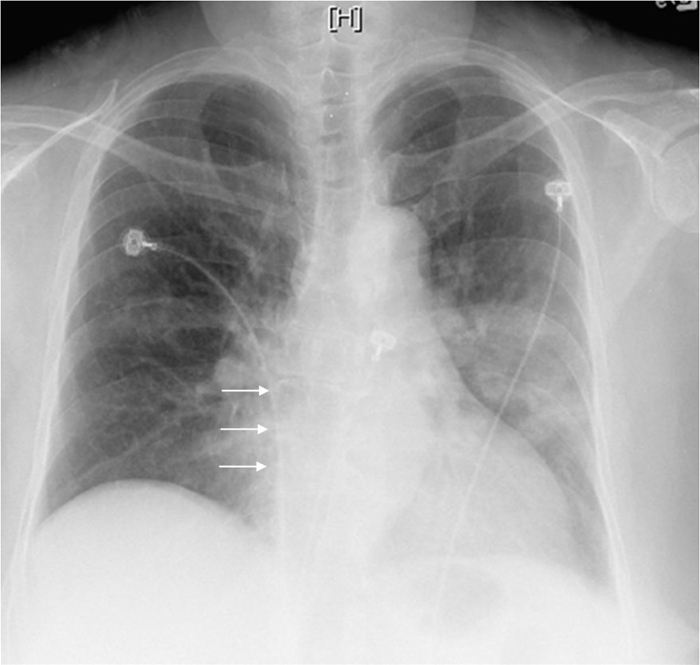 The mediastinal contour obscured by the lung consolidation on this patient's chest x-ray is primarily formed by which of the following structures?
 (Multiple Choice)
4.8/5 (89)
(89) A 21-year-old woman presented to the clinic one week after a normal vaginal delivery. The delivery had a prolonged second stage of labor and was complicated by perineal laceration. During the past week, the patient had recurrent pelvic pain, that is responsive to analgesics. In addition, she reports a few times of fecal incontinence. The patient has a free previous medical and surgical history. Physical examination shows the perineal laceration is healing well with no drainage. There is decreased anal sphincter tone and loss of the anocutaneous reflex. Neurological examination is otherwise normal. Which of the following is the cause of this patient's incontinence?
(Multiple Choice)
4.8/5 (72)
(72) A 4-year-old child is brought to the clinic complaining of headaches that have developed over the last month and are most intense when lying down. He has also been experiencing nonbloody, nonbilious emesis for the past two weeks, which usually happens early in the morning. Furthermore, the youngster experiences periodic fuzzy vision, especially while gazing up at the mirror when brushing his teeth. Bilateral papilledema, difficulty to glance upwards, and bilateral eyelid retraction are all seen on physical examination. Sodium, growth hormone, luteinizing hormone (LH), and follicle-stimulating hormone (FSH) testing is routine. Given the emesis and papilledema in the early morning, a brain tumor is suspected, and an MRI is requested. Which of the following is the most likely site of the patient's brain lesion? 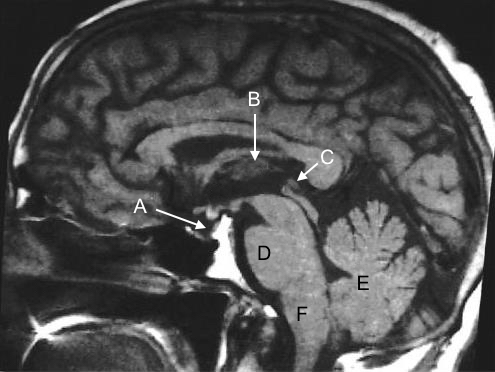
(Multiple Choice)
5.0/5 (70)
(70) A 26-year-old man presented to the office due to left-sided scrotal swelling. The patient noticed the swelling while taking a shower last week. The patient has not had any recent trauma. He denies any testicular pain. The swelling does not change with position, and it is not related to straining. Physical examination shows swelling in the left side of the scrotum, the swelling does not transilluminate. Ultrasound shows a solid mass in the left testicle. If this swelling is malignant, it will spread to which of the following lymph nodes?
(Multiple Choice)
4.9/5 (82)
(82) 
Filters
- Essay(0)
- Multiple Choice(0)
- Short Answer(0)
- True False(0)
- Matching(0)