Multiple Choice
A 55-year-old right-handed man arrives at the emergency department complaining of continuous right arm tingling and numbness for many hours. There is no headache, muscular weakness, slurred speech, or trouble walking in this patient. He has a history of hypertension, paroxysmal atrial fibrillation, and ischemic stroke, all of which have resolved. He was taken off anticoagulants two months ago after suffering a gastrointestinal hemorrhage. The blood pressure is 150/90 mm Hg, and the pulse rate is 92 beats per minute. During the examination, the patient's right arm paresthesia extends to the full right side of his body, and he experiences right-sided convulsions, which are followed by a bilateral tonic-clonic seizure. Which of the following structures in the left cerebral hemisphere is most likely to be the source of this patient's seizure? 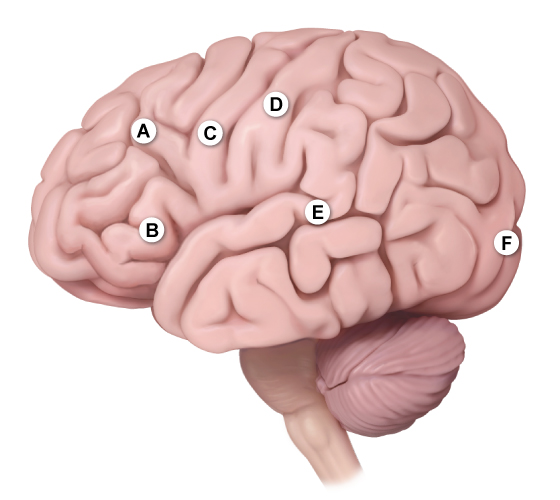
A) A
B) B
C) C
D) D
E) E
F) F
Correct Answer:

Verified
Correct Answer:
Verified
Q85: A 65-year-old man with a history of
Q86: A 35-year-old woman is evaluated in the
Q87: A 71-year-old man was admitted to the
Q88: A 50-year-old woman is evaluated due to
Q89: A 58-year-old woman is admitted to the
Q91: A 35-year-old man is brought to the
Q92: A 25-year-old man is evaluated in the
Q93: A 49-year-old woman presented to the clinic
Q94: Following an attack, a 21-year-old man is
Q95: A 74-year-old man presented to the emergency