



 Chat with AI
Exam 37: Oceania Before 1980

Exam 1: Art in the Stone Age50 Questions
Exam 2: Ancient Mesopotamia and Persia50 Questions
Exam 3: Egypt From Narmer to Cleopatra50 Questions
Exam 4: The Prehistoric Aegean50 Questions
Exam 5: Ancient Greece50 Questions
Exam 6: The Etruscans50 Questions
Exam 7: The Roman Empire50 Questions
Exam 8: Late Antiquity50 Questions
Exam 9: Byzantium50 Questions
Exam 10: The Islamic World50 Questions
Exam 11: Early Medieval Europe50 Questions
Exam 12: Romanesque Europe50 Questions
Exam 13: Gothic Europe North of the Alps50 Questions
Exam 14: Late Medieval Italy50 Questions
Exam 15: South and Southeast Asia Before 120050 Questions
Exam 16: China and Korea to 127950 Questions
Exam 17: Japan Before 133350 Questions
Exam 18: Native American Cultures Before 130049 Questions
Exam 19: Africa Before 180050 Questions
Exam 20: Late Medieval and Early Renaissance Northern Europe50 Questions
Exam 21: The Renaissance in Quattrocento Italy50 Questions
Exam 22: Renaissance and Mannerism in Cinquecento Italy50 Questions
Exam 23: High Renaissance and Mannerism in Northern Europe and Spain50 Questions
Exam 24: The Baroque in Italy and Spain50 Questions
Exam 25: The Baroque in Northern Europe50 Questions
Exam 26: Rococo to Neoclassicism: the 18th Century in Europe and America50 Questions
Exam 27: Romanticism, Realism, Photography: Europe and America, 1800 to 187050 Questions
Exam 28: Impressionism, Post-Impressionism, Symbolism: Europe and America, 1870 to 190050 Questions
Exam 29: Modernism in Europe, 1900 to 194550 Questions
Exam 30: Modernism in the United States and Mexico, 1900 to 194550 Questions
Exam 31: Modernism and Postmodernism in Europe and America, 1945 to 198050 Questions
Exam 32: Contemporary Art Worldwide50 Questions
Exam 33: South and Southeast Asia, 1200 to 198050 Questions
Exam 34: China and Korea, 1279 to 198050 Questions
Exam 35: Japan, 1333 to 198050 Questions
Exam 36: Native American Cultures, 1300 to 198050 Questions
Exam 37: Oceania Before 198050 Questions
Exam 38: Africa, 1800 to 198050 Questions
Select questions type


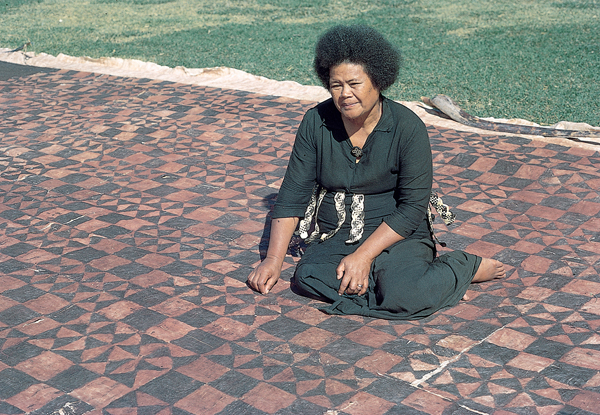 Which of the following is NOT one of the steps in the production of decorated barkcloth (ngatu)?
 (Multiple Choice)
4.8/5  (69)
(69) What was done with the elaborate mangrove wood bisj poles created by the Asmat people before a retaliatory raid against another group?
(Multiple Choice)
4.8/5 (80)
(80) Which of the following is NOT the term for a male community house among the peoples of Melanesia?
(Multiple Choice)
4.7/5 (73)
(73) The men's ceremonial houses of the Belau are different from Melanesian ceremonial houses in being made of what material?
(Multiple Choice)
4.8/5 (74)
(74)
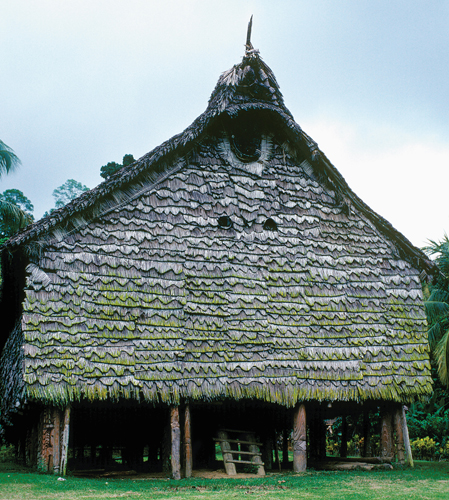 What people created this structure, and where is it located?
 (Multiple Choice)
4.9/5 (67)
(67) Because of the structure of the social hierarchy, which group historically owned art in Polynesia?
(Multiple Choice)
4.8/5 (79)
(79) Women in Oceanic societies took part in creating which of the following art forms?
(Multiple Choice)
4.8/5 (94)
(94) Which date range have researchers assigned to the earliest Australian sites?
(Multiple Choice)
4.9/5 (82)
(82) What was the final phase in the use of the colossal masks made for the Hevehe ceremony?
(Multiple Choice)
5.0/5 (96)
(96) The Hevehe ceremonial cycle of the Elema people lasted for how long?
(Multiple Choice)
4.8/5 (83)
(83) 
Filters
- Essay(0)
- Multiple Choice(0)
- Short Answer(0)
- True False(0)
- Matching(0)