



 Chat with AI
Exam 9: Byzantium

Exam 1: Art in the Stone Age50 Questions
Exam 2: Ancient Mesopotamia and Persia50 Questions
Exam 3: Egypt From Narmer to Cleopatra50 Questions
Exam 4: The Prehistoric Aegean50 Questions
Exam 5: Ancient Greece50 Questions
Exam 6: The Etruscans50 Questions
Exam 7: The Roman Empire50 Questions
Exam 8: Late Antiquity50 Questions
Exam 9: Byzantium50 Questions
Exam 10: The Islamic World50 Questions
Exam 11: Early Medieval Europe50 Questions
Exam 12: Romanesque Europe50 Questions
Exam 13: Gothic Europe North of the Alps50 Questions
Exam 14: Late Medieval Italy50 Questions
Exam 15: South and Southeast Asia Before 120050 Questions
Exam 16: China and Korea to 127950 Questions
Exam 17: Japan Before 133350 Questions
Exam 18: Native American Cultures Before 130049 Questions
Exam 19: Africa Before 180050 Questions
Exam 20: Late Medieval and Early Renaissance Northern Europe50 Questions
Exam 21: The Renaissance in Quattrocento Italy50 Questions
Exam 22: Renaissance and Mannerism in Cinquecento Italy50 Questions
Exam 23: High Renaissance and Mannerism in Northern Europe and Spain50 Questions
Exam 24: The Baroque in Italy and Spain50 Questions
Exam 25: The Baroque in Northern Europe50 Questions
Exam 26: Rococo to Neoclassicism: the 18th Century in Europe and America50 Questions
Exam 27: Romanticism, Realism, Photography: Europe and America, 1800 to 187050 Questions
Exam 28: Impressionism, Post-Impressionism, Symbolism: Europe and America, 1870 to 190050 Questions
Exam 29: Modernism in Europe, 1900 to 194550 Questions
Exam 30: Modernism in the United States and Mexico, 1900 to 194550 Questions
Exam 31: Modernism and Postmodernism in Europe and America, 1945 to 198050 Questions
Exam 32: Contemporary Art Worldwide50 Questions
Exam 33: South and Southeast Asia, 1200 to 198050 Questions
Exam 34: China and Korea, 1279 to 198050 Questions
Exam 35: Japan, 1333 to 198050 Questions
Exam 36: Native American Cultures, 1300 to 198050 Questions
Exam 37: Oceania Before 198050 Questions
Exam 38: Africa, 1800 to 198050 Questions
Select questions type


How did the architects of Hagia Sophia accomplish their fusion of the central-plan form and the basilica?

Free
(Multiple Choice)
4.9/5  (82)
(82) Correct Answer: Verified
D
What is the role of Christ in his image as Pantokrator?
Free
(Multiple Choice)
4.9/5 (76)
(76) Correct Answer:Verified
VerifiedC
Which of the following events did NOT worsen the outlook of Byzantium in the Late Byzantine period?
Free
(Multiple Choice)
4.9/5 (87)
(87) Correct Answer:Verified
VerifiedC
Which city remained the Byzantine foothold in Italy for two centuries?
(Multiple Choice)
4.8/5 (83)
(83) Which 11th-century empress has a mosaic portrait in Hagia Sophia?
(Multiple Choice)
4.9/5 (91)
(91) Which prominent figure in the Ascension scene from the Rabbula Gospels is not mentioned in the biblical text describing the event?
(Multiple Choice)
5.0/5 (77)
(77) Which new Byzantine stylistic feature appeared in the mosaics at San Vitale?
(Multiple Choice)
4.9/5 (77)
(77) What two authors wrote about the wonders of the Hagia Sophia around the time it was built?
(Multiple Choice)
4.9/5 (63)
(63) What comprises the octagon on which the dome of the Katholikon at Hosios Loukas rests?
(Multiple Choice)
4.7/5 (78)
(78) What image, embroidered on Theodora's garment, underscored her elevated rank?
(Multiple Choice)
4.8/5 (83)
(83) In the mosaic program of San Vitale, how is the importance of Bishop Maximianus signaled?
(Multiple Choice)
4.7/5 (80)
(80) 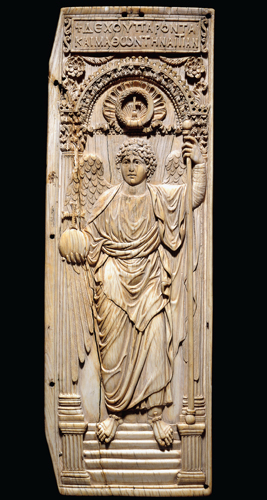 What is the material of this artwork?
What do art historians view as the origin of icon paintings?
(Multiple Choice)
4.9/5 (84)
(84) 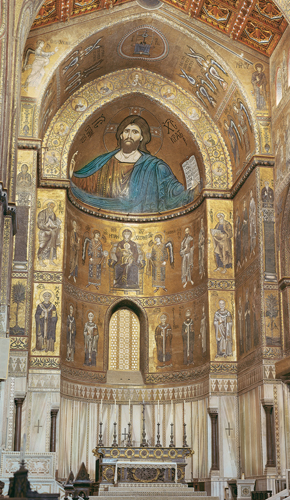 What is the location of this church?
What do art historians think was the model for the image of the Archangel Michael on the Early Byzantine ivory diptych?
(Multiple Choice)
4.7/5 (74)
(74) In which country did the monastic movement begin in the third century?
(Multiple Choice)
5.0/5 (84)
(84) Which of the following was the likely reason Emperor Leo III chose to initiate iconoclasm?
(Multiple Choice)
4.9/5 (71)
(71) 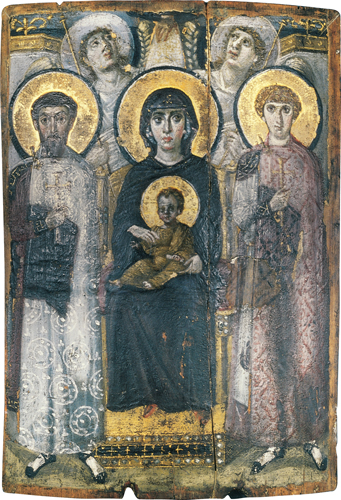 What is the title of this icon?
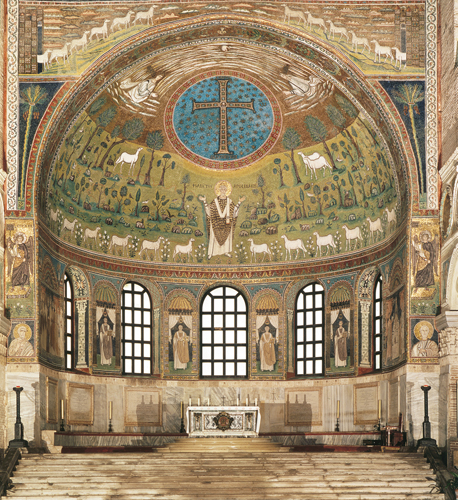 This is the apse of which Byzantine-era church?

Filters
- Essay(0)
- Multiple Choice(0)
- Short Answer(0)
- True False(0)
- Matching(0)